The "Anti-Accounting" Guide: Manage Your Books Without a Degree
You do not need an accounting degree to run a profitable business. You need to track the right numbers and avoid the expensive mistakes.
Why Most Accounting Advice Does not Work for Business Owners
Most accounting advice misses the mark for business owners. It is written by accountants, for accountants.
It assumes you care about accrual versus cash basis. It assumes you want to dive into debits and credits. It assumes you have time for 400-page textbooks on financial reporting.
You do not.
You are running a business. You need to know if payroll is covered next week. You need to know if revenue targets are on track. You need to decide if an overdue invoice is worth chasing.
In the GCC, the gap is wider. Many SMEs operate on cash logic — money in, money out — because that is how business has worked for decades. Formal accounting feels like a foreign language.
That intimidation keeps people stuck. They linger in spreadsheets too long. They miss tax deadlines because they do not know what to track. They hire bookkeepers who produce unreadable reports.
That is expensive.
The good news: you do not need to master accounting. You need to manage three core numbers, follow a 20-minute weekly routine, and know when to bring in help.
The Three Numbers That Actually Matter
Forget the balance sheet. Forget retained earnings. Forget accumulated depreciation.
If you are a small business owner in the GCC, these three numbers reveal more than any 10-page financial report:
1. Money in the Bank (Cash Position)
This is not your profit. This is not your revenue. This is the actual money sitting in your business bank account right now.
Why it matters: you cannot pay suppliers with profit. You pay them with cash.
A business can be profitable on paper and still run out of money. It happens all the time. You land a big contract, invoice the client, and wait 60 days for payment. Meanwhile, you have payroll, rent, and supplier bills due now.
How to track it without software:
- Check your bank balance every Monday morning.
- Compare it to last week: did it go up or down?
- If it went down three weeks in a row, you have a cash problem.
In the GCC, payment terms of 30-60 days are standard. Plan for it. Do not assume an invoice sent is money earned.
2. Money Owed to You (Receivables)
These are the invoices you sent but have not been paid yet.
Why it matters: unpaid invoices are not revenue. They are promises. Some promises break.
What to track:
- Which invoices are overdue by more than 30 days?
- Which clients are repeat late payers?
- How much total money are you waiting on?
In Saudi Arabia and the UAE, chasing payments is part of doing business. If you are not tracking aging invoices, you are leaving money on the table.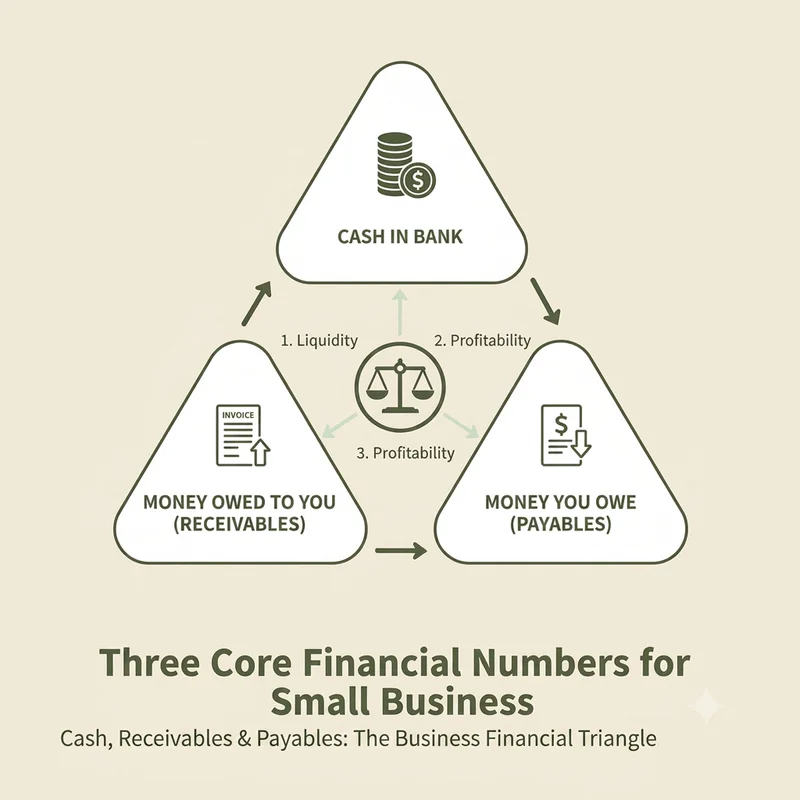
3. Money You Owe (Payables)
These are the bills you need to pay — suppliers, landlords, utilities, VAT.
Why it matters: missing a supplier payment damages your reputation. Missing a VAT deadline costs you fines.
What to track:
- Which bills are due this week?
- How much VAT do you owe this quarter?
- Are you current on all tax obligations?
GCC-specific: In the UAE, VAT is 5%. In Saudi Arabia, it is 15%. If you are not tracking VAT separately from your other expenses, you will miss the filing deadline. The penalty for late VAT filing in Saudi Arabia can reach SAR 50,000 for repeat offenses.
The 20-Minute Weekly Routine
You do not need daily bookkeeping. You need a consistent weekly check.
Every Monday morning, answer these five questions:
The 5-Question Check
1. How much cash do we have right now?
- Open your business bank account. Write down the balance.
- Compare it to last Monday. Up or down?
2. Which invoices are overdue by more than 30 days?
- Pull your unpaid invoice list.
- Send a polite follow-up to any client past 30 days.
3. What bills are due this week?
- Check your calendar or supplier emails.
- Schedule payments so nothing goes overdue.
4. Did we collect more than we spent last week?
- Add up deposits. Add up payments out.
- If you spent more than you collected for three straight weeks, investigate.
5. Are we on track for this month's VAT or tax obligations?
- If you are VAT-registered in the UAE or Saudi Arabia, set aside the VAT amount from every invoice you collect.
- Do not spend it. It is not your money.
That is it. Five questions. 20 minutes.
Most small business failures are not strategy failures. They are cash visibility failures. You ran out of money and did not see it coming.
What to Track (and What to Ignore)
Track this:
- Invoices sent (date, amount, client, due date)
- Payments received (date, amount, invoice reference)
- Bills paid (date, vendor, amount)
- Bank balance at the start and end of each week
Optional (useful but not urgent):
- Expense categories (office supplies, marketing, travel)
- Monthly revenue vs. expenses comparison
Ignore this (for now):
- Depreciation schedules
- Deferred revenue recognition
- Equity and retained earnings calculations
- Multi-currency adjustments (unless you are invoicing in multiple currencies regularly)
GCC-specific tracking:
- ZATCA-compliant invoice fields (Saudi Arabia): invoice number, QR code, VAT number, seller details
- ETA e-invoice and e-receipt requirements (Egypt)
- UAE VAT return filing dates (quarterly for most SMEs)
Mistakes That Cost More Than Hiring an Accountant

Some mistakes are learning opportunities. Others are expensive.
1. Not Tracking VAT Properly
If you are VAT-registered in the UAE or Saudi Arabia, you are collecting tax on behalf of the government. That money is not yours.
Many small businesses treat VAT as extra revenue. They spend it. Then the VAT return is due, and they do not have the cash to pay it.
In Saudi Arabia, the penalty for late VAT filing starts at SAR 5,000 and can reach SAR 50,000 for repeat offenses.
What to do instead:
- Open a separate bank account or set aside VAT in a dedicated spreadsheet column.
- When you collect SAR 1,150 from a client, you collected SAR 1,000 in revenue and SAR 150 in VAT.
- Move that SAR 150 out of your operating cash mentally (or literally).
2. Missing Invoice Fields
Under ZATCA Phase 2 in Saudi Arabia, a missing field on your invoice can trigger a compliance issue. The invoice might get rejected by the buyer's system. You do not get paid until you fix it.
Required fields include:
- Sequential invoice number
- QR code
- Seller VAT number
- Buyer VAT number (for B2B invoices)
- Line-item VAT breakdown
In Egypt, the ETA portal requires structured e-invoices. If your format is wrong, the submission fails.
What to do instead:
- Use invoicing software that generates compliant invoices automatically.
- If you are using Word or Excel templates, double-check the format against official guidelines.
3. No Backup for Tax Deductions
You bought a laptop for the business. You want to deduct it. Where is the receipt?
Without documentation, you cannot claim the deduction. The tax authority will disallow it during an audit.
What to do instead:
- Keep digital copies of all receipts (photo on your phone works).
- Note what each expense was for (laptop for office use, not personal).
4. Mixing Personal and Business Money
This is common in small GCC businesses. You use the business account to pay personal bills. You use your personal card to pay business expenses.
It works until it does not.
When tax season comes, you cannot separate personal from business spending. When you want to sell the business or raise funding, the financials are a mess.
What to do instead:
- Open a business bank account (not a personal account in the business name — an actual business account).
- Pay yourself a salary or regular draw.
- Run all business transactions through the business account.
When to Stop Being "Anti-Accounting"
This guide works when you are small. It stops working when you grow.
Here are the signs it is time to bring in an accountant:
1. You are spending more than 2 hours per week on your books
If bookkeeping is taking up half a day every week, the opportunity cost is too high. Your time is better spent selling, hiring, or building product.
2. You are hiring employees
Payroll is complicated. Withholding taxes, end-of-service benefits, social insurance contributions — these are not DIY-friendly in the GCC.
In the UAE, failing to register employees with the Ministry of Human Resources and Emiratisation (MOHRE) can result in fines. In Saudi Arabia, Gosi (social insurance) contributions are mandatory.
3. Your revenue exceeds SAR 1 million or AED 1 million
At this scale, tax and compliance requirements increase. You might need audited financials. You might be subject to additional reporting obligations.
4. You are raising funding
Investors want GAAP-compliant financial statements. They want to see gross margin, burn rate, and unit economics. They want financials they can compare to industry benchmarks.
You cannot deliver that with a spreadsheet and good intentions.
If any of these apply, it is time to hire. Not because accounting is too hard. Because your time is better spent elsewhere.
For a deeper dive on when and how to hire, see: When to Hire an Accountant for Your Small Business.
See how Bizrah handles the basics automatically — VAT tracking, compliant invoices, and cash visibility in one place. Start your free trial.