Balance Sheet Explained: How to Read What Your Business Owns
Most owners open the income statement first. It answers the question everyone asks at the end of a month: whether the business made money.
Then they close the file.
That is the mistake. The balance sheet explained properly answers a harder question, and it is the question that decides whether a business is still trading next year: not did you make money, but could you survive a quarter where the money stops arriving.
Profit is an opinion about a period. Solvency is a fact about a date.
What the balance sheet answers that the income statement cannot
The income statement covers a stretch of time, from January to December. Revenue came in, costs went out, and something was left over.
The balance sheet does not cover a stretch of time at all. It captures a single moment, usually the last day of the period, and lists everything the business owns and owes at that instant.
That is the whole difference. The income statement is a video. The balance sheet is a photograph.
A company can post a strong year on the income statement and still be one late payment away from missing payroll. The income statement will not show that. The balance sheet will, because it shows what is actually sitting there on the date the photograph was taken.
The balance sheet explained: three blocks, one equation
Everything on the statement falls into three groups, held together by one equation.
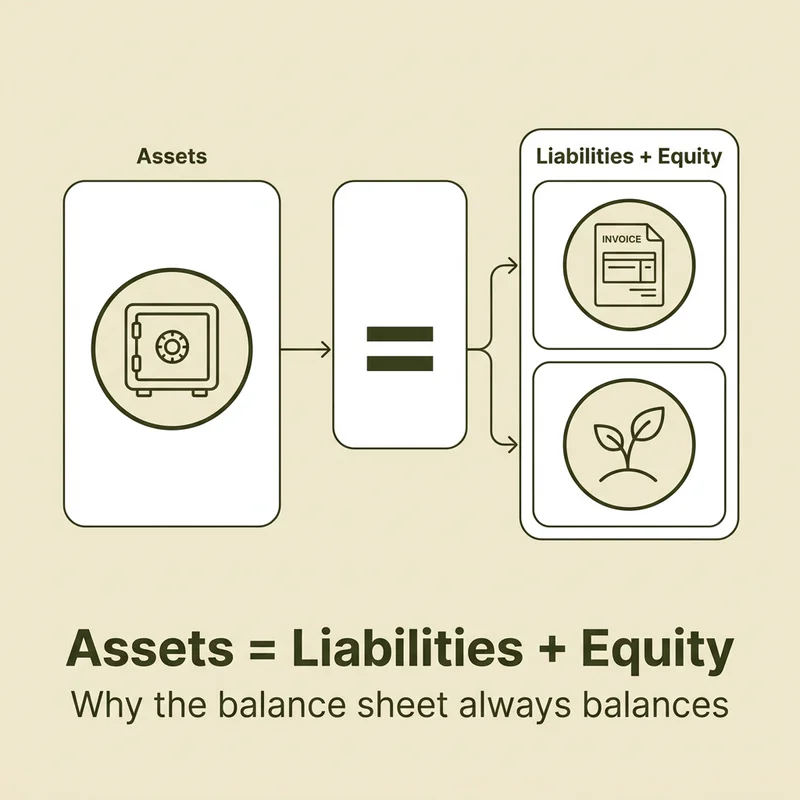
Assets equal liabilities plus equity.
That equation is not a principle to admire. It is an arithmetic check. If the two sides do not match, something has been recorded wrong, and the statement is telling you to go find it in the general ledger, rather than telling you anything about the business.
Assets: what you own, sorted by how fast it becomes cash
Assets are ordered by liquidity, which is a formal way of saying how quickly each one turns into money you can spend.
Current assets convert within twelve months. Cash, obviously. Receivables, meaning invoices you have issued and are waiting to be paid on. Inventory, meaning goods you expect to sell.
Non-current assets sit below that line: equipment, vehicles, fit-out, anything you bought to use rather than to sell. These carry a book value that falls over time through depreciation.
Pay attention to the composition, not just the total. A business holding AED 400,000 in current assets is in a very different position depending on whether that figure is mostly cash or mostly receivables owed by clients on ninety-day terms.
Liquidity on paper is not liquidity in the bank.
Liabilities: what you owe, sorted by when it comes due
The same split applies. Current liabilities are due within twelve months: payables to suppliers, short-term borrowing, and the VAT you have collected but not yet remitted.
That last one catches people. VAT collected from a customer never belonged to the business. It sits on the balance sheet as a liability from the moment it lands in the account, and treating it as spendable cash is one of the fastest ways a compliant business becomes a non-compliant one.
Customer deposits work the same way. Money received before the work is done is a liability, not revenue, until the work is delivered.
Long-term liabilities are everything due beyond twelve months, mostly bank facilities and long-dated loans.
Equity: what is actually yours
Equity is what remains after every claim against the business is settled. It has two main parts.
Paid-in capital is what the owners put in. Retained earnings are the accumulated profits that were never distributed, running from the day the business started.
Retained earnings are the most honest number on the statement. A single strong year looks impressive on the income statement. Retained earnings show whether that year was a pattern or an exception.

A worked example
Take a trading company in Dubai closing its year.
Current assets come to AED 480,000: cash of 120,000, receivables of 260,000, inventory of 100,000. Non-current assets add 220,000. Total assets, AED 700,000.
On the other side, current liabilities are AED 310,000: payables of 190,000, VAT payable of 45,000, and a short-term loan of 75,000. Long-term debt is 150,000. Equity is 240,000. Total, AED 700,000.
The equation holds. Now read it.
Working capital, meaning current assets minus current liabilities, is AED 170,000. The business can cover what is due in the next twelve months. That is the first thing a lender checks.
But look at where the current assets are. Of the 480,000, only 120,000 is cash. More than half is sitting with customers who have not paid. If those receivables slow by thirty days, the comfortable-looking position gets tight fast. That is the working capital problem hiding inside a healthy-looking statement.
The four numbers to read first
Current ratio, current assets divided by current liabilities. In the example above, 1.55. Below 1.0 means the next twelve months are already underfunded. Above 2.0 often means cash is sitting idle.
Working capital in absolute terms. The ratio hides scale. AED 170,000 of headroom means something different on AED 700,000 of assets than on AED 7 million.
Debt to equity, total liabilities divided by equity. In the example, 460,000 over 240,000, or 1.9. Lenders in the Gulf start asking harder questions above 2.0.
Retained earnings, tracked year over year. Flat or falling retained earnings alongside reported profits usually means distributions are outrunning performance. Track it beside your other financial KPIs.
Why UAE corporate tax made this statement non-optional
The balance sheet used to be something owners could safely ignore between bank applications. That changed.
Ministerial Decision No. 114 of 2023 requires taxable income to be determined from financial statements prepared under IFRS, or IFRS for SMEs. Ministerial Decision No. 84 of 2025 goes further: audited financial statements are mandatory for standalone entities with revenue above AED 50 million, and for every Qualifying Free Zone Person regardless of revenue. The Federal Tax Authority publishes the current thresholds.
Records must be kept for seven years. Returns are filed within nine months of the financial year end through EmaraTax.
Understanding corporate tax obligations starts with understanding the statements they are built from.
The balance sheet stopped being a management report. It became a filing input.
---
Try Bizrah free for 14 days — no credit card needed.