Bank Reconciliation Guide: Match Your Books to Your Bank
You open the banking app. The balance looks fine. You move on. That is a glance, not a reconciliation, and the gap between the two is what this bank reconciliation guide is for.
Your bank holds one record of your cash. Your books hold another. They are built by different parties, on different days, from different information, so they will almost never show the same number at the same moment.
Treat the reconciliation as the routine you should have been handed on day one.
What a bank reconciliation actually is
A bank reconciliation is the exercise of proving that two independent records of the same cash agree once you account for everything that sits between them.
Not that they match. That they can be made to match, item by item, with every difference named.
That distinction matters. A balance that happens to look right tells you nothing. A balance you can explain line by line is evidence. Your general ledger is where your side of the story lives, and the bank statement is the outside witness. Reconciliation is the bridge between them, not a second opinion on which one is correct.
In practice, both records are usually right. They are simply right about different moments in time.
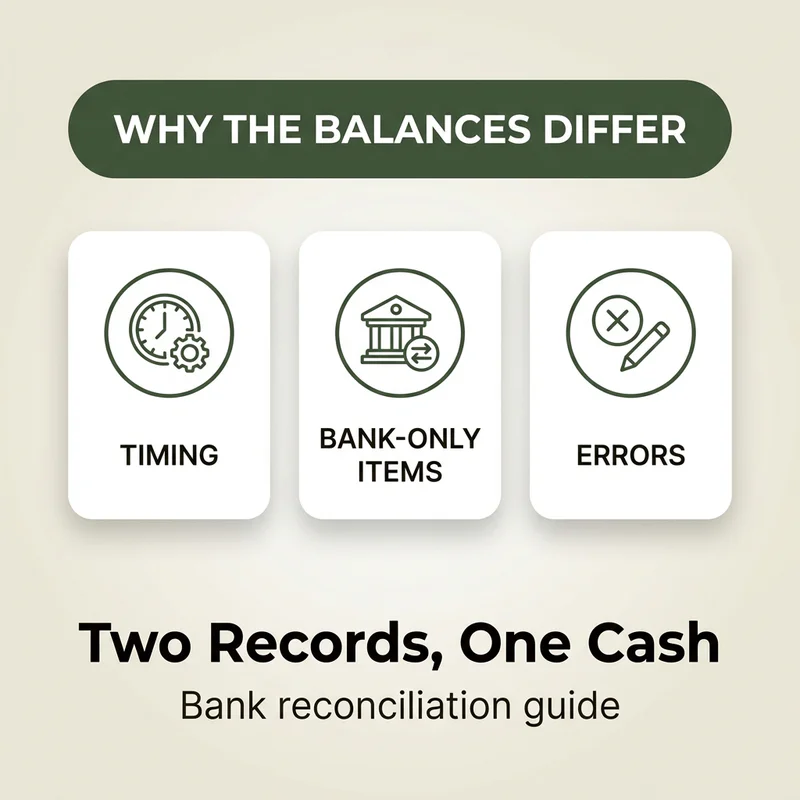
Why your ledger and your bank never agree on the same day
Three forces pull the two numbers apart. Once you can name which one you are looking at, the work becomes mechanical.
Timing differences
You deposited a customer cheque on the 30th. The bank cleared it on the 2nd. Your books recorded it in the old month, and the statement shows it in the new one. That is a deposit in transit.
The same thing happens in reverse. You issued a supplier cheque on the 28th and reduced your cash balance immediately. The supplier has not presented it yet. That is an outstanding cheque, and it is the single most common reason an owner believes there is more money available than there is.
Card settlements behave the same way. The sale happened on Thursday. The money lands on Sunday, net of the processor fee.
Items only the bank knows about
Account fees. Transfer charges. The margin buried in a foreign exchange conversion. Standing orders you set up eighteen months ago. A customer payment that bounced and was quietly reversed. Interest credited on a deposit account.
None of these enter your books until you read the statement. That is why the statement is not a document to file. It is a source document to post from.
Errors, on both sides
Transposed digits. A payment entered twice. An amount posted to the wrong account in your chart of accounts. Banks make mistakes too, less often, but they do.
Timing differences resolve themselves. Errors do not. They compound quietly until someone goes looking.
The bank reconciliation guide in five steps
The process is short. The discipline is doing it on a fixed date, every period, without exception.
One. Fix a cut-off. Pick the last calendar day of the month and hold both records to it.Two. Start from the closing balance on the bank statement. Add deposits recorded in your books that have not yet cleared. Subtract cheques and transfers you have issued that the bank has not yet paid. The result is your adjusted bank balance.
Three. Start from the closing balance in your ledger. Post every bank-only item you found on the statement: fees, charges, reversals, interest. The result is your adjusted book balance.
Four. Compare the two adjusted figures. If they agree, the period is reconciled.
Five. If they do not agree, find the difference before you close. Do not carry it forward as a plug.

A worked example in AED
Your bank statement closes at AED 184,500. Your ledger says AED 180,300. The gap is AED 4,200, and it feels arbitrary until you break it down.
Two customer deposits totalling AED 14,000 went in on the 30th and cleared on the 2nd. Add them: AED 198,500.
Three supplier cheques totalling AED 20,400 are still outstanding. Subtract them: AED 178,100 adjusted bank balance.
Now the other side. The statement shows AED 1,800 in account and transfer fees you had not recorded, and a returned customer cheque of AED 400. Both reduce your ledger: AED 180,300 less AED 2,200 gives AED 178,100 adjusted book balance.
The two agree. The AED 4,200 was never a mystery. It was four named items that nobody had looked at.
What reconciliation catches that nothing else will
A duplicate supplier payment sits in your books as a single expense and in the bank as two debits. Reconciliation is the only routine that surfaces it while the money is still recoverable.
The same is true of the subscription that renewed after the project ended. The same is true of revenue you recorded against an invoice that was never actually paid, which quietly inflates both your profit and your receivables. Your profit figure and your cash position drift apart for exactly these reasons.
Then there is compliance. A VAT return is built on ledger figures. If those figures have not been reconciled to the bank, you are filing numbers you cannot defend. The UAE Federal Tax Authority and ZATCA in Saudi Arabia both expect records that support the return, and both expect them retained for years after filing.
An unreconciled ledger is not a bookkeeping shortcut. It is an audit exposure with a delay on it.
How often, and where it fits into the close
Monthly is the floor. If transaction volume is high or cash is tight, weekly is better, and businesses running thin runway should be looking daily.
Reconciliation belongs at the front of the month-end close, not the end of it. Everything downstream depends on it. Your trial balance is only as trustworthy as the cash line underneath it, and no management report is worth reading if the bank position inside it was never proved.
Most owners treat reconciliation as an accounting chore performed after the decisions are made.
It is the opposite. It is the check that tells you whether the numbers you decided on were real.
---
Try Bizrah free for 14 days — no credit card needed.