Most loan applications do not fail on the pitch.
They fail on the books.
An owner walks in with a real business, real customers, and a credible reason to borrow. Then the relationship manager asks for two years of audited statements and a reconciled aged receivables report, and the conversation quietly ends. Not because the business is weak. Because nobody can produce the evidence that it is strong.
That is what business loan financial requirements actually are. Not paperwork. A credibility test you either pass on paper or lose on paper.
Business loan financial requirements, in plain terms
A lender is answering one question: if this business stops performing, how early will the bank know and how much will it recover?
Everything on the document list exists to answer it. Historic financial statements show the pattern. Current management accounts show the present. Bank statements show whether the statements are true. Tax filings show whether a third party has seen the same numbers. Debt disclosure shows who else has a claim ahead of the bank.
Your job is not to make the numbers look good. Your job is to make them verifiable.
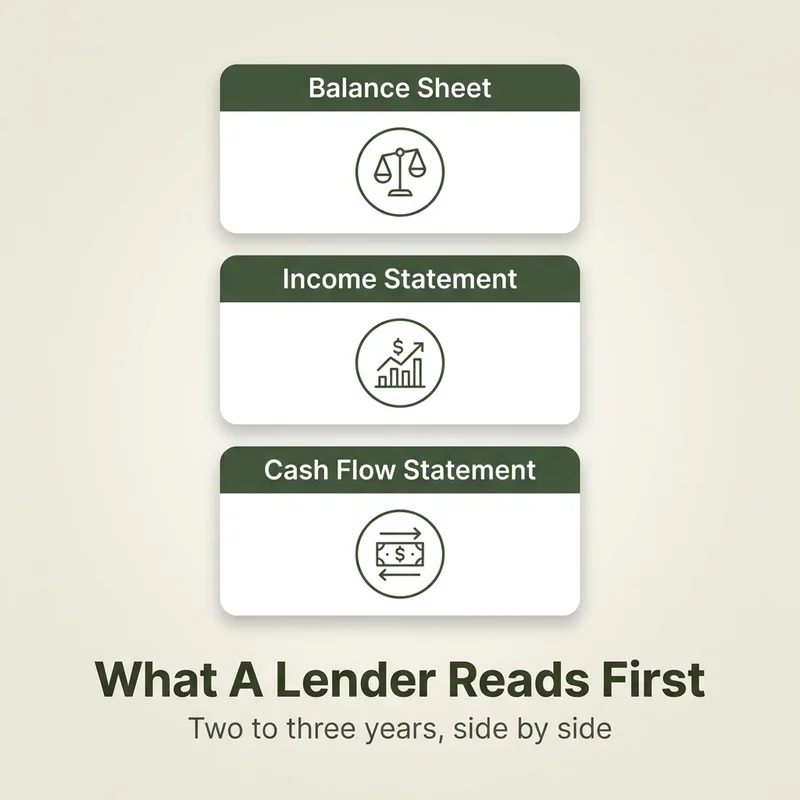
The three statements a lender opens first
Underwriters do not read your business plan first. They read your financial statements side by side, two or three years at a time, looking for a story that holds together.
The balance sheet question: what do you already owe?
Before anything else, the bank is measuring how much of your business is already pledged: existing facilities, supplier credit stretched past its terms, equipment on finance, and the loan you quietly made to yourself last year.
That last one causes more trouble than owners expect. Money moved between the owner and the company, never documented, shows up as a receivable from a related party or as negative equity. A lender reads it as either poor control or hidden debt.
The income statement question: is the margin real?
Revenue growth alone proves very little. The underwriter is looking at gross margin across several periods and asking whether it is stable, and whether it survives without a single large customer or a one-off contract.
A business whose margin swings fifteen points year to year is a business whose pricing is not understood. If the income statement walkthrough is not something you can produce and explain line by line, the loan conversation is premature.
The cash flow question: can you service the instalment?
This is the decisive one. Operating cash flow, not profit, pays the monthly repayment.
A profitable business with ninety-day receivables and thirty-day payables can still miss an instalment. Lenders know this, which is why working capital and a credible cash flow forecast often carry more weight in the file than the profit line does.
Audited, reviewed, management accounts: not the same document
This is the distinction that derails applications, and almost nobody explains it clearly.
Management accounts are what your own system produces. Nobody external has tested them. Reviewed statements carry limited assurance. Audited statements carry an opinion from a licensed auditor who has tested the balances and taken responsibility for the opinion.
Lenders in the region generally want the third kind. In the UAE, banks commonly ask for two to three years of statements audited by a licensed UAE auditor. In Saudi Arabia, applications under the Kafalah finance guarantee programme are typically assessed on three years of audited statements alongside valid GOSI, ZATCA and Saudization certificates.
Here is where owners get it wrong. UAE Ministerial Decision No. 84 of 2025 requires audited financial statements for taxable persons with revenue above AED 50 million, for tax periods starting on or after 1 January 2025. The decision text is published by the Ministry of Finance. Businesses below that threshold read the number and conclude they do not need an audit.
They do not need one for corporate tax. They still need one for the loan.
The tax threshold and the lending threshold are different thresholds set by different parties for different reasons. Treating the lower of the two as permission to skip the audit is how a funding round gets delayed by four months. The same confusion shows up in many of the misconceptions about UAE corporate tax.

What a lender asks for beyond the statements
The statements are the centre of the file. They are not the whole file.
Expect to provide six to twelve months of bank statements covering every business account, not just the main one. Expect filed VAT returns, your corporate tax registration and tax registration number, a valid trade licence, and the shareholder documents.
Then comes the operational evidence: aged receivables and payables, major customer contracts, supplier agreements, existing loan agreements with balances and repayment history, and a credit bureau report. Al Etihad Credit Bureau in the UAE, SIMAH in Saudi Arabia.
Eligibility screens come before any of this. UAE lenders commonly set a floor around AED 1 million in annual turnover and at least one year of trading, with some asking for considerably more. Kafalah sizing runs to SAR 3 million in revenue for a micro enterprise, SAR 3 to 40 million for a small one, and SAR 40 to 200 million for a medium one.
Fail the screen and the quality of your books never gets looked at.
The six months before you apply
An audit does not create good books. It reports on the books you already have. Which means the work happens well before the auditor arrives.
Separate personal and business money completely, and stop invoicing customers from a personal account. Reconcile every bank account monthly, so the statements and the ledger agree without a late reconciliation that an auditor will flag. Document every transaction between the company and its owners. Clean up the chart of accounts so that expenses are not sitting in a general bucket nobody can explain. Chase the aged receivables, because a receivables ledger full of invoices past 120 days tells a lender your collection process does not work.
None of this is sophisticated finance. It is bookkeeping discipline, maintained over months, in a system that produces the same number twice.
That is the part owners underestimate. The bank is not really assessing your financial statements. It is assessing whether you are the kind of operator who knows what is in them.
---
Try Bizrah free for 14 days — no credit card needed.