Break-Even Analysis for GCC Owners: A Worked AED Example
Revenue was up last quarter. The bank balance was not.
That gap is the most common reason a growing business still feels tight. It usually means nobody has run a break-even analysis on the current cost structure. Sales targets get set from ambition, or from last year's number, and almost never from the floor the business actually has to clear.
That floor is knowable. It takes about twenty minutes and two columns of numbers.
What break-even analysis actually tells you
The break-even point is the level of sales where total revenue exactly covers total cost. Profit is zero: not a loss, not a win.
It is not a forecast. A forecast is a guess about what will happen. The break-even point is a fact about your cost structure, true whether or not the month goes well.
That distinction matters because it changes what you do with the number. A forecast gets revised. A floor gets defended.
Most owners can name their monthly revenue. Far fewer can name the revenue below which the month loses money, no matter how busy it felt. Those are different numbers, and only one of them tells you whether the business works.
The two kinds of cost, and the one most owners get wrong
Everything the business spends falls into one of two buckets. Sorting them correctly is most of the work.
Fixed costs stay put
Rent on the office or warehouse. Trade licence renewal. Salaries for anyone not paid per sale. Software subscriptions. Insurance. The accountant's retainer.
These do not care whether you sell one unit or one thousand. They arrive on the first of the month either way.
Variable costs move with every sale
Cost of the goods themselves. Inbound shipping and customs. Last-mile delivery. Payment gateway fees. Sales commission. Packaging.
This is where the sorting often goes wrong. Delivery charges and gateway fees get filed under general overhead because they arrive as one monthly invoice from one supplier. They are not overhead. They scale with volume, one to one, and parking them in the fixed column makes every unit look more profitable than it is.
If a cost would drop to zero in a month with no sales, it is variable. That is the whole test.
Contribution margin: the number in the middle
Subtract the variable cost of one unit from its selling price. What is left is the contribution margin, and the name is literal: it is what each sale contributes toward covering the fixed costs.
Two formulas come out of it.
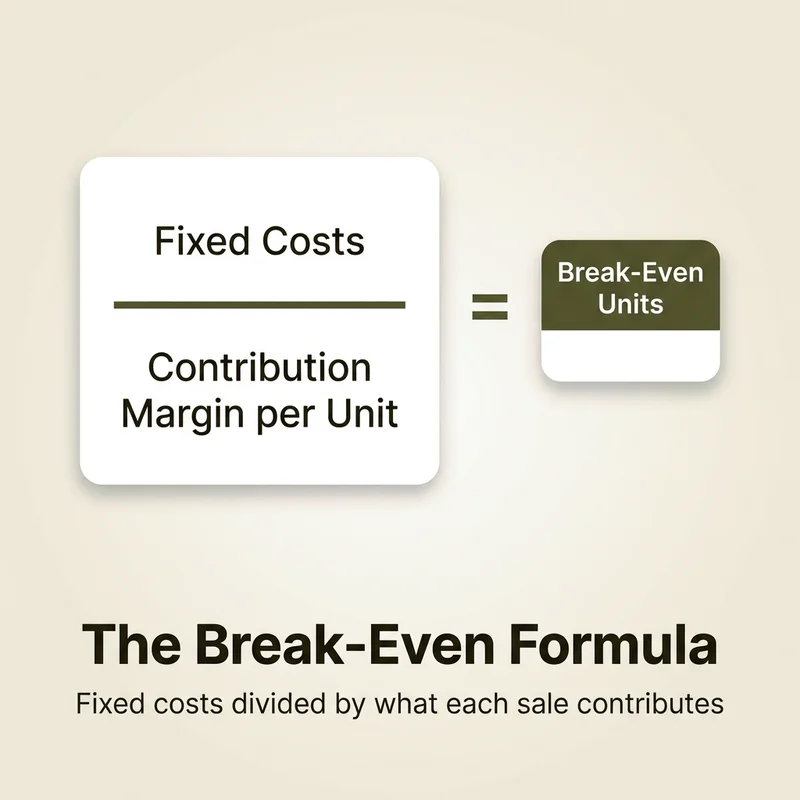
Break-even in units equals fixed costs divided by contribution margin per unit.
Break-even in revenue equals fixed costs divided by the contribution margin ratio, where the ratio is contribution margin as a percentage of price.
Use the unit version if you sell a countable thing. Use the revenue version for services, retainers, or a mixed catalogue where a single unit does not exist. The logic underneath is identical.
A worked example in AED
Take a small trading business in Dubai with one product line.
The product sells for AED 250. The unit costs AED 150 once goods, shipping, and payment fees are counted. The contribution margin is AED 100 per unit, a ratio of 40%.
Fixed costs run AED 60,000 a month: warehouse rent, two salaries, the licence amortised across the year, software, and the owner's own draw.
Divide 60,000 by 100. The break-even point is 600 units a month, or AED 150,000 in revenue.
Below 600 units the business loses money. At 610 it makes AED 1,000. That is the entire picture, and it took two numbers.
What a 10% discount really costs
Now run a promotion. Price drops 10%, to AED 225.
Variable cost has not moved, so contribution margin falls from AED 100 to AED 75. Break-even climbs from 600 units to 800.
A 10% price cut requires a 33% increase in volume just to stand still. Not to grow, but to stand still.
This is the calculation that should run before a discount is approved, and it almost never does. Margin gets discussed as a percentage on a slide. Break-even converts it into a unit count somebody has to actually sell.

Where the break-even point quietly moves
Four things shift the floor, and three of them are easy to miss.
VAT is collected, not earned. The 5% you charge belongs to the tax authority and passes through the business. Model break-even on net-of-VAT prices, or the number comes out flattering. Registration becomes mandatory once taxable supplies pass AED 375,000 in a twelve-month period, and the mechanics of input and output VAT sit outside the profit calculation entirely.
Corporate tax sits above the line. The 9% applies to taxable income over AED 375,000, so it does not change where break-even falls. It does change the target you set beyond it.
The owner's salary is a fixed cost. Leaving it out is the most common way a break-even point comes back reassuring, and wrong. A floor that does not pay the owner is not a floor.
Step changes in fixed costs move it hard. A new hire, a bigger warehouse, a licence upgrade: each one raises the floor the month it lands, and revenue follows later, if it follows at all. Recalculate before signing, not after.
What to do with the number once you have it
Set it as a monthly floor and check the month against it. Not against last year, not against the target, but against the floor.
Read it alongside your working capital and margin KPIs rather than on its own, because break-even tells you nothing about timing. A business can clear its break-even point on paper and still run out of cash while waiting on a 90-day receivable, which is the difference between profit and cash that catches most owners once. Pair it with your runway number for the full picture, and check that your costs are landing in the right places on the income statement before you trust either.
Then recalculate. Every time price changes, every time a supplier raises a rate, every time a fixed cost steps up.
A break-even point calculated once and filed away is decoration. Calculated monthly, it is the fastest read you have on whether the business works.
Try Bizrah free for 14 days — no credit card needed.