Cash Flow Forecasting for Growing Businesses: A Practical Guide
Growth does not kill businesses. Running out of cash while growing does.
You landed the big contract. Revenue is up 40 percent year-over-year. Your P&L looks good.
Then payroll week arrives and you are scrambling to cover it.
That is the paradox of growth. Revenue shows up on paper before cash shows up in the bank. You hire people and buy inventory today to serve customers who will pay you 60 days from now. The gap between what you owe and what you are owed widens the faster you grow.
Cash flow forecasting is how you see that gap before it becomes a crisis.
Why Cash Flow Forecasting Matters More Than You Think
Most small business failures are cash flow failures, not profitability failures.
You can be profitable on paper and still run out of cash if your payment terms are longer than your expense cycles. You can close a deal in January, deliver in February, invoice in March, and get paid in May. Meanwhile, rent is due every month. Salaries do not wait.
Growing businesses amplify this problem. More orders mean more working capital tied up in inventory, more receivables, more hiring ahead of revenue. If you do not forecast the timing, growth suffocates you.
That is why forecasting is not optional once you start scaling. It is the tool that tells you whether your growth is sustainable or running on borrowed time.
The Three Forecast Windows You Need
A cash flow forecast is not one spreadsheet. It is three views of the same reality, each serving a different purpose.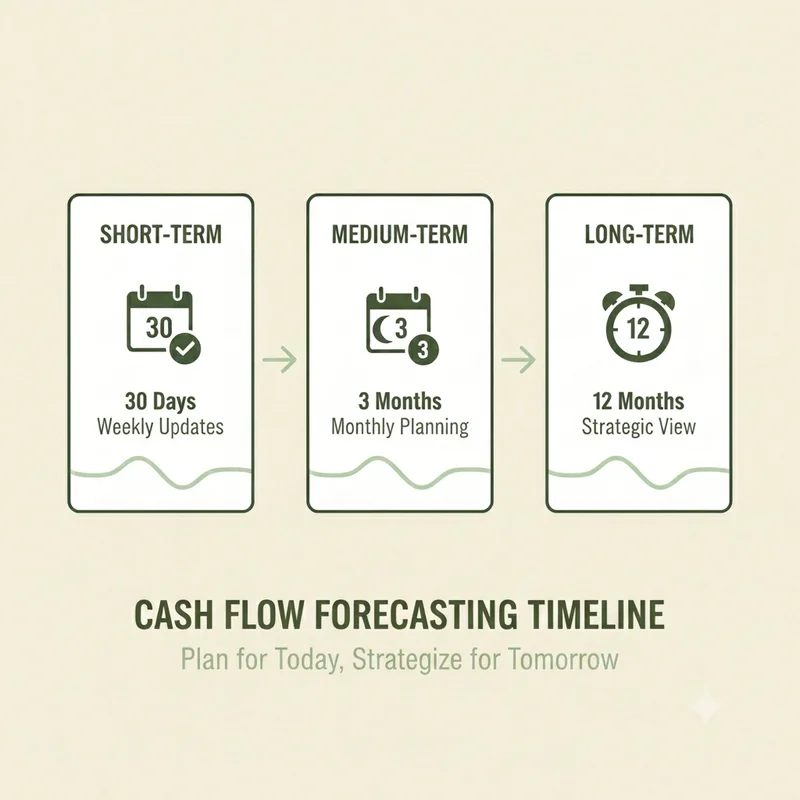
Short-term (next 30 days): This is your operational forecast. Update it weekly or daily. It answers: do I have enough cash to cover next week's payroll, supplier invoices, and VAT payment? This is where you catch problems in time to fix them.
Medium-term (next 3 months): This is your planning forecast. Update it monthly. It tells you whether your pipeline will cover your committed costs. If you see a dip in Q3, you have time to accelerate collections, cut discretionary spending, or arrange short-term financing.
Long-term (next 12 months): This is your strategic forecast. It reveals seasonal patterns, growth capital needs, and whether your business model is sustainable at scale. In GCC markets, this layer helps you plan around Ramadan slowdowns, Eid spending spikes, and quarterly VAT cycles.
Most businesses skip the short-term view because it feels tedious. That is the mistake. The 30-day window is where cash flow crises get prevented, not managed.
What to Track in Your Forecast
A forecast has two sides: what comes in and what goes out. The timing is more important than the amount.
Inflows
Customer payments are your primary inflow. But do not forecast based on invoice date. Forecast based on when you realistically expect payment.
If your payment terms are net 30, assume net 45. If your customers are large enterprises or government entities, assume net 60 to net 90. In GCC markets, payment delays are the norm, not the exception. Your forecast should reflect reality, not contract terms.
Factor in seasonal patterns. Construction businesses see slower payments during summer heat. Retail businesses see stronger cash inflows during Eid and year-end holidays. Ramadan changes payment behavior across sectors.
Outflows
Fixed costs are the easy part: rent, salaries, software subscriptions, insurance. These are predictable and non-negotiable.
Variable costs are trickier. If revenue grows 30 percent, your cost of goods sold and operational expenses will lag slightly behind. Forecast these based on expected sales volume, not historical averages.
Do not forget tax obligations. VAT is due quarterly in most GCC countries. Corporate tax is annual but should be provisioned monthly. Zakat applies to certain business structures in Saudi Arabia. Missing a tax payment because it was not in your forecast is an expensive mistake.
One-time expenses often get overlooked: equipment purchases, office expansions, hiring surges, compliance costs. These are lumpy but predictable if you plan ahead.
The Simple Forecast Formula
The formula is not complicated:
Opening balance + expected inflows - expected outflows = projected balance
If your projected balance goes negative in week 3, you have a problem. The forecast gives you two weeks to fix it.
Here is what a simple 4-week view might look like:
Week 3 shows a cash shortfall. You have two weeks to act: chase receivables harder, delay a supplier payment, or arrange short-term credit.
That is the power of the forecast. It does not prevent the problem, but it gives you time to solve it.
Common Mistakes to Avoid
The most common mistake is being too optimistic about payment timing.
Clients say net 30. You forecast net 30. Then payment arrives at net 60 and your forecast is useless. Always add a buffer. If historical data shows customers pay 15 days late on average, bake that into every forecast line.
The second mistake is treating the forecast as static. A forecast written in January and never updated is worse than no forecast at all. It gives you false confidence. Update your short-term view weekly. Adjust for every late payment, every new expense, every deal that closes or slips.
The third mistake is forgetting that growth costs money before it makes money. Hiring ahead of revenue, stocking inventory for anticipated demand, expanding office space—all of these drain cash today in exchange for future revenue. If you do not forecast the timing gap, growth becomes a cash trap.
What to Do When the Forecast Shows a Gap
A forecast that shows a cash shortfall is not a failure. It is doing its job.
Now you act.
Accelerate receivables: Chase overdue invoices aggressively. Offer early payment discounts (2 percent off for payment within 10 days). Send reminders before invoices are due, not after.
Delay payables where possible: Negotiate extended terms with suppliers. Pay essential vendors first (payroll, rent, critical suppliers). Non-critical expenses can wait.
Cut non-essential spending: Marketing campaigns, office upgrades, travel—anything that does not directly generate revenue or keep operations running can be postponed.
Short-term financing: If the gap is temporary and unavoidable, a line of credit or invoice financing can bridge it. This is the last option, not the first. Borrowing to cover operational shortfalls means your business model has a structural problem.
The forecast tells you which levers to pull and how much time you have to pull them.
Bizrah tracks cash flow in real time so you can see gaps before they become crises. See how it works →