Chart of Accounts Setup: The Foundation Every Business Needs
The structure you choose today determines what questions you can answer tomorrow.
Your Accounting Structure Determines What You Can See
Month-end hits, and you are stuck. "What is our gross margin by product line?" You cannot answer. Your accountant cannot pull it from the system. The data is buried in a single revenue account. You scramble, exporting transactions, manually categorizing sales.
That is the cost of a weak chart of accounts.
Most businesses copy a generic COA template, assuming it will adapt as they grow. They only realize the problem when they cannot generate the reports investors, lenders, or compliance authorities require.
The chart of accounts is not an admin detail. It is the taxonomy of your business finances. Every sale, expense, payment, invoice — all categorized into an account. Those accounts determine what you can report, how fast you can close your books, and whether your financial data supports decisions or creates bottlenecks.
Get it wrong, and you spend month-end fighting your own accounting system.
What a Chart of Accounts Actually Does
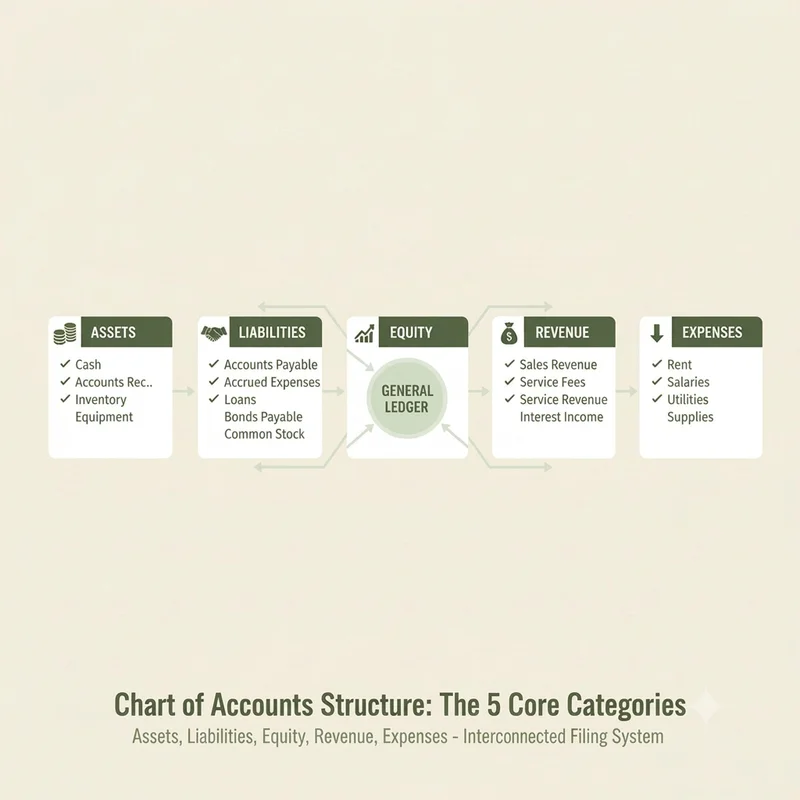
The chart of accounts is the filing system for every transaction your business records.
When you make a sale, it is not just "revenue happened." It assigns that sale to a specific account: product sales, service revenue, or consulting fees. When you pay rent, the expense goes into a rent account, not a generic "business expenses" bucket.
These accounts are not arbitrary labels. They follow a structure that mirrors your financial statements. Your profit and loss statement, balance sheet, and cash flow report are all built from these accounts. If your COA is messy, your financial reports will be messy.
Think of it like this: your general ledger is the record of every transaction. Your chart of accounts is the index that organizes those transactions so you can find what you need when you need it.
A well-structured COA allows you to:
- Generate accurate financial statements in minutes, not hours
- Track performance by product line, service type, or geography
- Meet compliance requirements without manual workarounds
- Scale into new markets or business lines without restructuring
A poorly structured COA forces you to rely on spreadsheets, manual adjustments, and guesswork.
The Five Core Account Categories
Every chart of accounts is built on the same five categories. Understanding these categories is the first step to building a COA that works.
Assets (What You Own)
Assets are resources your business owns that have economic value. This includes:
- Cash and bank accounts — the most liquid assets
- Accounts receivable — money customers owe you
- Inventory — goods you plan to sell
- Prepaid expenses — payments made in advance (rent, insurance)
- Fixed assets — equipment, vehicles, property
In the GCC, you may also need accounts for:
- Retainage receivable — common in construction contracts
- Inventory in free zones — tracked separately for customs purposes
- VAT recoverable — input VAT you can reclaim
Liabilities (What You Owe)
Liabilities are obligations your business has to pay. This includes:
- Accounts payable — money you owe suppliers
- VAT payable — output VAT collected from customers
- Loans and financing — bank loans, equipment financing
- Accrued expenses — costs incurred but not yet paid (salaries, utilities)
- Deferred revenue — payments received for services not yet delivered
For GCC businesses, VAT tracking is critical. You need separate accounts for:
- VAT output (collected from customers)
- VAT input (paid to suppliers)
- VAT liability (net amount owed to tax authorities)
If you are in the UAE or Saudi Arabia, your VAT return pulls directly from these accounts. Mixing them into other liability accounts creates reconciliation nightmares at filing time.
Equity (Owner's Stake)
Equity represents the owner's claim on the business after liabilities are subtracted from assets. This includes:
- Share capital — initial investment by owners
- Retained earnings — cumulative profits kept in the business
- Owner draws — distributions to owners
Equity accounts are less critical for day-to-day operations, but they matter for compliance filings, investor reports, and loan applications.
Revenue (Income)
Revenue accounts track all income your business generates. The key decision here is how much detail you need.
Too broad: a single "Sales" account that lumps everything together. You cannot report revenue by product line, service type, or geography.
Too detailed: 50 revenue accounts that fragment your data and make analysis harder.
The right structure mirrors your business model. If you sell three product lines, create three revenue accounts. If you operate in both the mainland and free zones, separate revenue by jurisdiction for compliance purposes.
For GCC businesses, consider structuring revenue accounts by VAT treatment:
- Standard-rated sales (5% VAT in UAE, 15% in Saudi Arabia)
- Zero-rated sales (exports, international services)
- Exempt sales (certain financial services, residential property)
This structure makes VAT return preparation straightforward. You can pull the numbers directly from your COA without manual categorization.
Expenses (Operating Costs)
Expense accounts track what you spend to run the business. There are two common approaches:
By function: Sales expenses, marketing expenses, operations expenses, administrative expenses.
By nature: Salaries, rent, utilities, software subscriptions, travel, professional fees.
For small businesses, structuring by nature is simpler. For larger businesses with multiple departments, structuring by function provides better insight into where money goes.
Cost of goods sold (COGS) is a special category of expense. It includes direct costs tied to producing or delivering your product or service: materials, direct labor, shipping. COGS appears separately on your income statement to calculate gross margin.
Do not mix COGS with operating expenses. If you do, you lose visibility into your gross margin, which investors and lenders use to assess business health.
How to Structure Your COA for GCC Compliance
Compliance requirements in the GCC add specific needs to your chart of accounts.
ZATCA e-invoicing in Saudi Arabia: Your accounting system must track VAT input and output separately. This means dedicated accounts for VAT collected and VAT paid, with clear reconciliation to your VAT return.
UAE Corporate Tax: Businesses must separate mainland and free zone revenue. If you operate in both jurisdictions, create separate revenue accounts to track this distinction. When UAE CT filing starts, you will need this split readily available.
Retainage accounting: Common in construction and project-based businesses. Create a separate asset account for retainage receivable (money withheld by clients until project completion). This keeps your accounts receivable clean and allows you to forecast cash flow more accurately.
Multi-currency operations: If you invoice or pay in multiple currencies, decide whether to use separate accounts for each currency or rely on sub-accounts. Most accounting systems handle currency at the transaction level, but some businesses prefer dedicated accounts for major currencies (USD, EUR, GBP) to simplify reporting.
Account numbering: Use a consistent numbering scheme. A common structure:
- 1000-1999: Assets
- 2000-2999: Liabilities
- 3000-3999: Equity
- 4000-4999: Revenue
- 5000-5999: Cost of Goods Sold
- 6000-6999: Operating Expenses
This makes it easy to add accounts later without disrupting the structure.
Common COA Mistakes That Break Reporting
Too many accounts: You create 20 revenue accounts for every possible product variation. Your reports become fragmented. You cannot see total sales without summing a dozen lines. Simplify. Use categories and tags for granular analysis, not separate accounts.
Too few accounts: You have one "Expenses" account for everything. At month-end, you cannot answer basic questions: How much did we spend on marketing? What is our payroll burden? You end up manually splitting transactions in spreadsheets. Add accounts for categories you report on regularly.
Mixing account types: You record an expense in cost of goods sold when it should be an operating expense. Your gross margin calculation breaks. Investors see inflated margins. Lenders question your numbers. Understand the difference between COGS and operating expenses before posting transactions.
No sub-accounts for VAT tracking: You record sales without separating VAT. At filing time, you manually calculate VAT from gross amounts. If your pricing includes VAT, you are guessing at the split. This creates reconciliation errors and compliance risk. Use sub-accounts or dedicated accounts to track VAT separately from the start.
Creating accounts on-the-fly: An expense does not fit existing accounts, so you create a new one. Six months later, you have 15 miscellaneous accounts with no clear definition. Your COA becomes a dumping ground. Clean it up quarterly. Merge redundant accounts. Archive accounts you no longer use.
How to Build Your COA (Practical Steps)
Step 1: Start with the standard five categories. Do not reinvent the structure. Assets, liabilities, equity, revenue, expenses. This is the foundation.
Step 2: Add accounts for compliance-critical items first. VAT payable, VAT recoverable, payroll tax, retainage. These accounts prevent compliance headaches later.
Step 3: Mirror your operational structure. If you have three product lines, create three revenue accounts. If you operate in two jurisdictions, separate revenue and expenses by jurisdiction. Your COA should reflect how you run the business, not how accounting textbooks say it should look.
Step 4: Use account codes and naming conventions. Number your accounts (1000-1999 for assets, 2000-2999 for liabilities, etc.). Use clear, descriptive names. "Office Rent" is better than "Rent Expense 1."
Step 5: Test with sample transactions before going live. Record a sale, pay a bill, handle VAT, issue a credit note. Walk through real scenarios. If the transactions do not post to the right accounts, fix the structure before you go live.
Step 6: Review quarterly. Every quarter, review your COA. Are there accounts you never use? Merge or archive them. Are there reports you cannot generate? Add the accounts you need. Do not let your COA drift into chaos.
When to Restructure Your COA
You know it is time to restructure when:
- You cannot answer basic questions: "What is our gross margin by product?" "How much did we spend on marketing last quarter?" If your system cannot generate these reports, your COA is holding you back.
- Month-end close requires manual spreadsheet workarounds. You export transactions, categorize them manually, and rebuild reports outside your accounting system. This is a sign your COA does not match your business.
- Your accountant keeps asking for the same report your system cannot generate. If every board meeting requires custom analysis, your COA is not structured for the reports you need.
- You are growing into new markets. Expanding into free zones, launching new product lines, or operating in multiple currencies? Your COA must support this complexity before it becomes a bottleneck.
- Compliance requirements changed. ZATCA Phase 2, UAE corporate tax, new VAT rules. If your accounting system cannot handle the new requirements without workarounds, restructure now.
Restructuring a COA is not trivial. It affects historical reports, transaction history, and integrations. But the cost of not restructuring is worse: fragmented data, manual reporting, compliance risk, and slow decision-making.
See how Bizrah structures your chart of accounts for GCC compliance out of the box → Try Bizrah free for 14 days