Debits and Credits Explained: The Table You Actually Need
Every accounting tool you have ever opened runs on two words that business owners are routinely told to ignore.
"You do not need to memorize the table."
That is comfortable advice, and it is wrong. Not because you should think like a bookkeeper, but because the table is five lines long and explains why your numbers move the way they do. Here are debits and credits explained without the jargon: the table itself, plus three transactions written out in dirhams.
A previous guide to accounting for non-accountants waved this table away as something the software would handle for you. Software does handle it. The problem is that you still have to check the output, and you cannot check what you cannot read.
Debits and Credits Explained in One Sentence
A debit is the left side of an entry. A credit is the right side.
That is the entire definition.
Debit does not mean money coming in. Credit does not mean money going out. Neither means good or bad. They are directions, and which direction increases an account depends on what kind of account it is.
The second half of the idea is older than any software on the market: every transaction touches at least two accounts, and the total on the left must equal the total on the right. That is double entry bookkeeping. When your trial balance balances, this is the rule being tested.
Debits and credits are sides, and both sides must always match.
The Table You Were Told Not to Memorize
Five account types, one rule each
Everything in your chart of accounts falls into five buckets, and each bucket has one rule.
Assets go up on the debit side: cash, bank balances, receivables, equipment, inventory.
Expenses go up on the debit side too: rent, salaries, subscriptions, fuel.
Liabilities go up on the credit side: payables, loans, VAT you owe.
Equity goes up on the credit side: owner capital, retained earnings.
Revenue goes up on the credit side: sales, service income.
That is the table. Assets and expenses increase with debits. Liabilities, equity, and revenue increase with credits. To decrease any of them, use the opposite side.
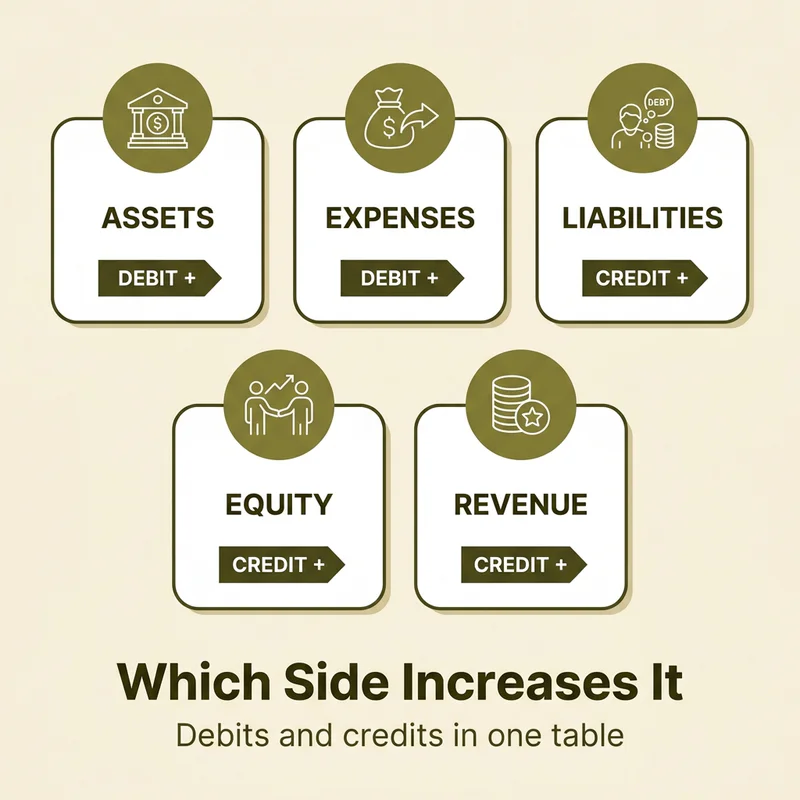
The hook that survives real transactions
Most people remember this as DEA and LER: Debits increase Expenses and Assets, credits increase Liabilities, Equity, and Revenue.
The mnemonic is useful, but the reason is more useful. Assets equal liabilities plus equity. Assets sit on the left of that equation, so the left side of an entry increases them. Liabilities and equity sit on the right, so the right side increases them. Revenue increases equity and expenses reduce it, which is why revenue follows the credit rule and expenses follow the debit rule.
You are not memorizing a convention. You are reading the accounting equation from left to right.
Three Transactions, Written Out in AED
An invoice raised, not yet paid
You invoice a client AED 10,000 plus 5% VAT.
Debit Accounts Receivable AED 10,500. Credit Revenue AED 10,000. Credit Output VAT AED 500.
Notice what did not happen: no cash moved. Revenue was recorded anyway, because the work was done and the obligation exists. The VAT is a liability from the moment the invoice is issued, not from the moment the client pays.
The payment lands three weeks later
The client transfers AED 10,500.
Debit Bank AED 10,500. Credit Accounts Receivable AED 10,500.
Revenue does not appear again. It was recognized when the invoice was raised. This second entry only moves the amount from one asset to another, which is exactly why cash and profit tell you two different stories. The income statement records the first entry, and your bank balance records the second.
A supplier bill and the VAT you reclaim
A supplier invoices you AED 2,100 for services, including AED 100 of VAT.
Debit Expense AED 2,000. Debit Input VAT AED 100. Credit Accounts Payable AED 2,100.
Two debits, one credit, and the sides still match. Input VAT is an asset because the tax authority owes it back to you, which is the whole basis of a VAT return: output VAT collected, minus input VAT paid.

Where Owners Get This Wrong
The most common error is treating the bank statement as the book of record. A bank statement shows cash. It does not show what you are owed, what you owe, or when either was earned.
The second error is recording revenue when the payment arrives after already recording it at the invoice. That double counts the sale and inflates the year.
The third is posting owner drawings as an expense. Money you take out of the business reduces equity. It is not a cost of doing business, and treating it as one understates profit and misstates the tax position.
The fourth is booking a VAT-inclusive amount straight to revenue. An AED 10,500 receipt is not AED 10,500 of income. Five hundred of it belongs to the tax authority and sits on the credit side as a liability until the return is filed. Businesses that skip that split spend the quarter reporting a profit that was never theirs.
The fifth is the quiet one. A general ledger can balance perfectly and still be wrong: both sides equal, both sides in the wrong account. Balanced is not the same as correct.
Why This Matters for Compliance in the GCC
Output VAT and input VAT are ledger accounts, not columns in a spreadsheet. If the entries are not there, the return is a reconstruction, and a reconstruction is what an audit takes apart first.
Corporate tax works the same way. The Federal Tax Authority expects records that support the return, and UAE businesses are required to keep them for seven years. In Saudi Arabia, ZATCA e-invoicing already forces every sale into a structured, timestamped record. Both regimes assume a trail: an entry, a document behind it, and a date.
Software handles the mechanics. It cannot decide that a client deposit is a liability rather than revenue, or that a director loan is not a sale. That judgment stays with you and whoever keeps your books.
That is the real point of the table. Learning which side increases which account takes ten minutes. Reading what your entries say about the business is the part that pays.
Try Bizrah free for 14 days — no credit card needed.