The Essential Guide to Accounting for Startups
The difference between startups that scale and those that stall is often found in the numbers they tracked — or ignored.
Why Accounting Matters from Day One
You launched. You have customers. Revenue is coming in.
The temptation is to treat accounting as something you deal with later — when the business is bigger, when you raise funding, when you hire a CFO.
That is weak thinking.
Accounting is not paperwork. It is visibility. You need to know how much cash you have, how fast you are spending it, and when you will run out. That visibility is the difference between extending runway and discovering too late that you cannot make payroll next month.
In the GCC, the stakes are higher. UAE mandates VAT registration at 375,000 AED. Saudi Arabia enforces ZATCA Phase 2 e-invoicing deadlines. Egypt requires real-time submission to the ETA portal. Free zones have their own compliance requirements. Corporate tax applies to mainland UAE companies at 9 percent from June 2023.
Early accounting setup is not just good practice. It is regulatory survival.
The Core Accounting Setup Every Startup Needs
Chart of Accounts for Early-Stage Companies
Your chart of accounts is the foundation. It is the list of every category where money enters or leaves your business.
For early-stage startups, keep it simple. You need:
Assets: Bank accounts, accounts receivable, prepaid expenses.
Liabilities: Accounts payable, VAT payable, accrued expenses.
Equity: Owner contributions, retained earnings.
Revenue: Product sales, service revenue, subscription revenue.
Expenses: Salaries, office rent, software subscriptions, marketing, professional fees, travel.
For GCC startups, add accounts for VAT receivable and VAT payable. Track withholding tax for cross-border payments.
Accounting Method: Cash vs. Accrual
Cash basis is simpler. You record revenue when paid, expenses when paid. This works for very early-stage businesses with simple transactions.
Accrual basis records revenue when earned and expenses when incurred, regardless of payment timing. This is required once you register for VAT in the GCC. It is also what investors expect when they review your financials.
If you plan to raise funding or expect to hit VAT thresholds within 12 months, start with accrual from day one. Switching methods mid-year creates reconciliation problems.
Tools and Systems
You can start with spreadsheets. Many founders do.
The problem appears later. Spreadsheets break when multiple people need access, you need real-time visibility into cash position, VAT filing requires categorized transactions, or investors ask for monthly financials with 48 hours notice.
Accounting software solves these problems. For GCC startups, look for:
- Arabic language support
- VAT-compliant invoicing
- Multi-currency support
- E-invoicing integration
- Bank feed integration
The right time to upgrade is before you need to. If you are filing VAT returns manually from spreadsheets, you have waited too long.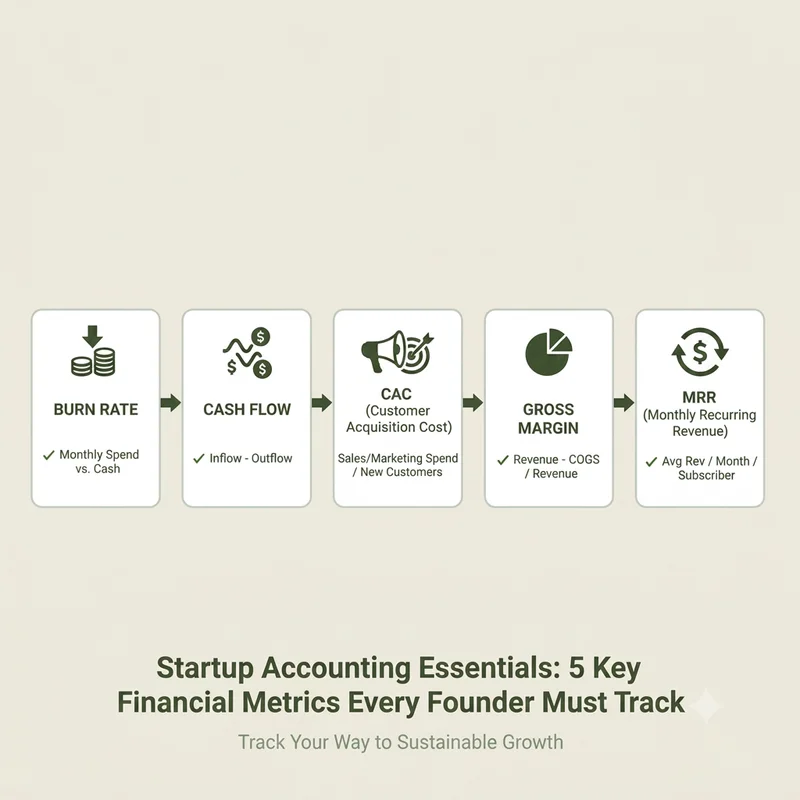
The 5 Financial Metrics Every Founder Must Track
1. Burn Rate and Runway
Burn rate is how much cash you spend per month. Runway is how many months you can operate before running out.
Calculate it monthly. Not quarterly. Not when you feel like it. Monthly.
The formula is simple:
- Burn rate = (Starting cash balance - Ending cash balance) / Number of months
- Runway = Current cash balance / Monthly burn rate
If you have 500,000 AED in the bank and burn 100,000 AED per month, your runway is 5 months.
The mistake founders make is treating burn rate as a static number. It changes as you grow. Hiring accelerates burn. Customer churn extends runway. You cannot manage what you do not measure.
For a deeper look at burn rate management, see Understanding Burn Rate: A Founder's Guide to Extending Runway.
2. Cash Flow (Not Just Profit)
Profit is revenue minus expenses. Cash flow is money in minus money out.
They are not the same.
You can be profitable on paper and still run out of cash. This happens when customers pay 60 days after invoicing but you pay suppliers within 30 days. Revenue exists, but cash does not.
Track operating cash flow separately from financing cash flow. If operating cash flow is negative every month, growth will not fix that. You need structural changes to your payment terms or cost structure.
Read Cash Flow vs. Profit: Why One Matters More for Survival for the full breakdown.
3. Customer Acquisition Cost (CAC)
CAC is how much you spend to acquire one customer.
Calculate it by dividing total sales and marketing spend by the number of new customers in the same period.
If you spent 50,000 AED on marketing last month and acquired 25 customers, your CAC is 2,000 AED per customer.
The critical question is not whether CAC is high or low. It is whether CAC is lower than the lifetime value (LTV) of that customer. If you spend 2,000 AED to acquire a customer who generates 5,000 AED in gross profit over their lifetime, that is sustainable. If they generate 1,500 AED, you are burning cash on every sale.
4. Gross Margin
Gross margin is revenue minus the direct cost of delivering the product or service.
For a software business, gross margin is high (often 70-90 percent) because the cost of serving each additional customer is low.
For an e-commerce business, gross margin is lower (often 30-50 percent) because you pay for inventory, shipping, and fulfillment.
Track gross margin by product or service line. If one product has a 20 percent margin and another has 60 percent, focus growth on the higher-margin product. It sounds obvious, but many startups chase revenue without checking the margin.
5. Monthly Recurring Revenue (MRR) or Revenue Growth
If you have a subscription model, track MRR. This is the predictable monthly revenue from active subscriptions.
MRR helps you forecast. If you have 100 customers paying 500 AED per month, your MRR is 50,000 AED. If you add 20 customers and lose 5, your net new MRR is 7,500 AED.
If you do not have subscriptions, track month-over-month revenue growth. Calculate it as: (This month's revenue - Last month's revenue) / Last month's revenue.
Consistent growth — even small growth — is better than lumpy revenue with big spikes and drops.
Startup Accounting Mistakes (and How to Avoid Them)
Mistake 1: Mixing personal and business finances.
Open a business bank account on day one. Pay yourself a salary. Transfer funds between personal and business accounts with proper documentation. Mixing accounts creates tax headaches and makes investor due diligence painful.
Mistake 2: Ignoring VAT obligations until registration deadline.
In the UAE, once your taxable supplies exceed 375,000 AED in the past 12 months, you have 30 days to register for VAT. Many startups miss the deadline because they did not track cumulative revenue properly. Late registration incurs penalties.
Saudi Arabia has the same threshold (375,000 SAR) with similar penalties. Track your cumulative taxable supplies monthly so you know when registration is approaching.
Mistake 3: Not tracking burn rate monthly.
Burn rate changes as the business scales. Hiring one engineer increases monthly burn. Losing a large customer reduces revenue and shortens runway. If you only calculate burn rate once per quarter, you discover problems too late to fix them.
Mistake 4: Poor receipt and expense management.
Lost receipts mean lost tax deductions. In the GCC, VAT reclaim requires proper tax invoices. If you cannot produce invoices during a tax audit, you lose the deduction.
Use expense management tools. Take photos of receipts. Store them digitally. This is not bureaucracy. It is money left on the table if you do not.
Mistake 5: Waiting too long to hire an accountant.
You cannot do everything yourself. The question is not whether to hire help but when.
For GCC startups, consider hiring an accountant or bookkeeper when:
- You register for VAT (filing requires proper categorization)
- You raise funding (investors expect monthly financials)
- You hit 10+ employees (payroll complexity increases)
- You expand to multiple entities or jurisdictions
For timing guidance, see When to Hire an Accountant for Your Small Business.
GCC-Specific Compliance: What Startups Often Miss
VAT Registration Thresholds
UAE and Saudi Arabia both use a 375,000 threshold (AED in UAE, SAR in Saudi). Oman is 38,500 OMR. Bahrain is 37,500 BHD. Egypt does not have a threshold — VAT applies to all registered businesses.
The mistake is assuming you have time. Once you cross the threshold, registration is mandatory within 30 days. Late registration triggers penalties starting at 10,000 AED in the UAE.
E-Invoicing Requirements
Saudi Arabia enforces ZATCA Phase 2, which requires integration with the ZATCA portal for real-time invoice validation. The rollout is phased by business size, but most startups scaling in Saudi will hit the requirement within 18-24 months.
Egypt requires real-time submission to the ETA portal for all invoices and receipts. The system rejects invoices that do not meet technical specifications.
These are not optional upgrades. They are compliance gates. Missing them blocks your ability to issue valid invoices.
Free Zone Tax Benefits
UAE free zones offer 0 percent corporate tax if you meet qualifying criteria (no mainland business, limited mainland revenue). The accounting requirement is proper transfer pricing documentation if you transact with related mainland entities.
Many startups set up in free zones for tax benefits but fail to document transactions properly. During a tax audit, the burden of proof is on you to show transactions were arm's length. Poor accounting makes that defense impossible.
Withholding Tax on Cross-Border Payments
If you pay non-GCC suppliers for services (software licenses, marketing agencies, consultants), withholding tax may apply. Rates vary by jurisdiction and double tax treaties.
The mistake is paying gross amounts and discovering later that you should have withheld tax. The liability falls on you, not the supplier.
Track cross-border payments separately. Consult a tax advisor before making large payments to foreign entities.
UAE Corporate Tax (9 Percent)
UAE introduced corporate tax at 9 percent for mainland businesses effective June 2023. Free zone entities are exempt if they meet qualifying conditions.
The accounting requirement is proper annual financial statements audited to UAE standards. If you operate informally with poor records, you cannot comply.
When to Upgrade Your Accounting Setup
You will know when spreadsheets stop working. The signs are:
You cannot produce a monthly P&L within 5 days of month-end
VAT filing takes more than 4 hours each quarter
You have no real-time visibility into cash position
Multiple people need access but spreadsheets are on one person's laptop
Investors ask for financials and you need a week to compile them
These are not minor inefficiencies. They are signals that the business has outgrown the tools.
Upgrade when you see the problem forming, not after it causes a crisis.
For more detail on recognizing the tipping point, see 5 Signs Your Business Has Outgrown Your Current Spreadsheet Setup.
Practical Takeaway: Your First 90 Days
Here is the setup checklist for your first quarter:
Week 1-2: Foundation
- Open a business bank account
- Set up a basic chart of accounts
- Choose cash or accrual method (accrual if VAT registration is likely)
Week 3-4: Systems
- Implement accounting software or structured spreadsheet system
- Connect bank feeds for automatic transaction import
- Set up expense tracking (receipt capture app or software integration)
Week 5-6: Process
- Establish monthly close process (reconcile accounts, categorize transactions)
- Create a simple cash flow forecast (next 3-6 months)
- Calculate initial burn rate and runway
Week 7-8: Forecasting
- Build a basic financial model (revenue projections, cost assumptions)
- Identify key metrics to track (MRR, CAC, gross margin)
- Set up monthly reporting template for yourself and any advisors
Week 9-12: Review and Adjust
- Review Q1 results against projections
- Adjust burn rate forecast based on actual spending
- Identify gaps in the accounting setup and fix them before Q2
This is not a one-time project. Accounting is ongoing. The earlier you build good habits, the less painful it is to maintain them as the business scales.
Bizrah handles the GCC compliance complexity — from VAT filing to ZATCA integration — so you can focus on building your startup. See how Bizrah works →