Outsourced Accounting vs In-House: Cost, Control, and Fit
You already know roughly when you need finance help. What you have probably not settled is outsourced accounting vs in-house, and that is the decision that actually costs you.
The invoices pile up. The VAT deadline arrives before the books are ready. Someone asks for a margin number and nobody in the business can produce it without a weekend of work.
Timing is the easy question. The signals that say you need an accountant are well documented, and most owners interpret them correctly.
The model is where it goes wrong.
Outsourced accounting vs in-house often gets treated as a budget line, settled by comparing two monthly numbers. That is the mistake. You are not choosing a price. You are choosing who owns your close, who answers the auditor, and who notices a wrong number before you do.
Outsourced accounting vs in-house is a question about control, not cost
Put the monthly figures side by side and the answer looks obvious: outsourcing costs less. That is true, and it is also beside the point.
An in-house hire buys availability. Someone is in the building, knows which customer always disputes the last invoice, and can answer a question in the afternoon rather than next Tuesday.
An outsourced provider buys a process. The close happens on a schedule whether or not anyone needs to chase it, and the filing gets made because that is what the engagement letter says.
Those are different things, and paying more does not automatically get you both.
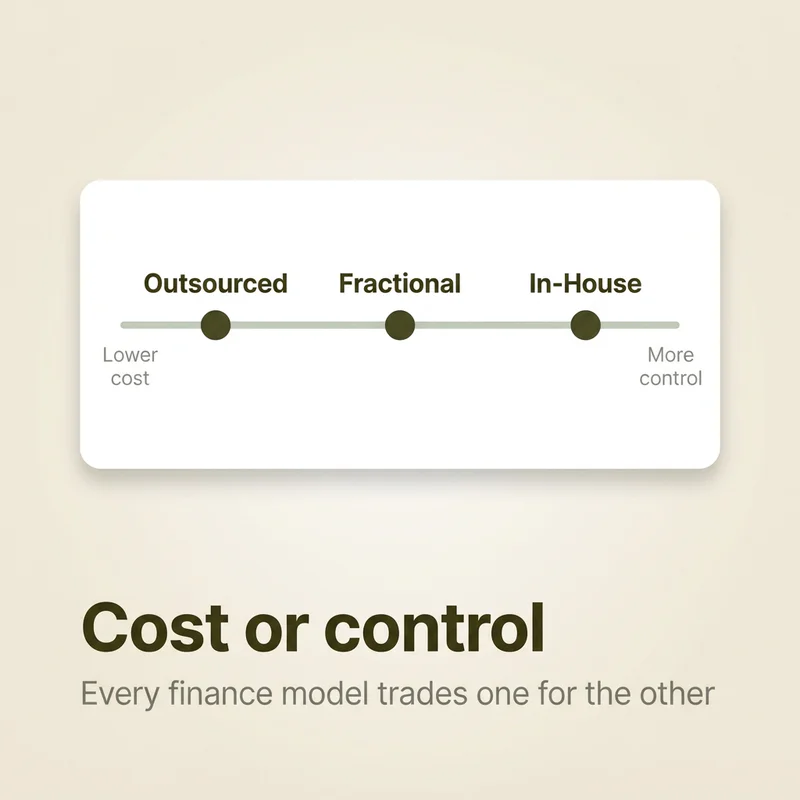
The three models, priced
Three options are actually on the table, not two. Treating it as a binary is how businesses end up paying in-house money for outsourced service.
In-house: you buy availability
Accountant salaries in the UAE run roughly AED 6,000 to AED 40,000 a month depending on seniority and scope. Visa costs, gratuity, insurance and allowances sit on top of that, and they are not small.
The real cost is structural, though, not just financial. One person is one point of failure. When that person takes leave in the week the return is due, the close stops.
In-house makes sense when transaction volume is high enough to fill a week, and when someone senior can actually review the output.
Outsourced: you buy a process
Market pricing in the UAE splits fairly cleanly. Basic bookkeeping sits around AED 1,500 to AED 3,000 a month. Add VAT filing, management reports and compliance support and the band moves to roughly AED 3,500 to AED 6,000. Advisory-level work, including tax planning and audit preparation, reaches AED 7,000 to AED 10,000.
Read the scope before the price. Corporate tax filing is frequently quoted separately at AED 2,000 to AED 5,000 a year, and the annual audit is its own line again.
What outsourcing costs you is context. A provider handling forty clients does not know that your largest customer pays at 90 days and always short-pays the freight line. You either keep that knowledge internally, or nobody has it.
Fractional: you buy judgement, in slices
A fractional finance lead is the model most GCC SMEs skip, and most of them need it. Early-stage retainers run about AED 5,000 to AED 10,000 a month. Growth-stage mandates run AED 15,000 to AED 35,000.
That buys review, forecasting and the conversation with the bank. It does not buy bookkeeping.
That distinction matters, because a fractional hire on top of messy records produces expensive confusion. If the difference between bookkeeping and accounting is still blurred in your business, fix the records first.
What compliance decides for you
Here is where many owners get lazy: they treat the finance model as a preference, something to revisit only when it starts to hurt.
In practice, the regulator has already decided parts of it.
Under UAE corporate tax, the return is due within nine months of the end of the tax period, and records must be kept for seven years. Audited financial statements are mandatory once revenue passes AED 50 million, and for every Qualifying Free Zone Person regardless of size. Cash-basis statements are permitted only below AED 3 million of revenue. The detail sits in the PwC summary of UAE tax administration and in the Ministry of Finance corporate tax pages.

Those thresholds are what force a model change, not the org chart. A business approaching AED 50 million in revenue with one bookkeeper and no reviewer is not understaffed by a little. It is structurally unready for its own audit.
Compliance does not care how you organised your team. It only checks whether the output arrived, and whether it holds up.
How to choose, in four questions
Skip the pros-and-cons list. Four questions settle it.
How many transactions clear each month? Under a few hundred, outsourcing is almost always the right call.
How often do you need an answer the same day? If the answer is weekly, outsourcing alone will frustrate you.
Is a threshold in sight? Crossing AED 50 million, converting to a Qualifying Free Zone Person, or taking on an audit for a lender changes the requirement, not just the workload.
Can anyone in the business review the work? This is the question that actually decides it.
If nobody can review the output, hiring does not solve the problem. It buries it one layer deeper, inside your own payroll, where it is harder to see and more awkward to fix. Outsourcing, by contrast, leaves you with a provider you can question and replace.
The model is not permanent, and treating it as permanent is the real mistake
Most GCC businesses that get this right move through the same sequence rather than picking once.
Outsourced bookkeeping first. Then outsourced bookkeeping with fractional oversight, once decisions start depending on the numbers. Then an in-house hire for day-to-day work with compliance left outside, usually when volume rather than ambition makes the case. Later, the early-stage finance team takes shape around that spine.
Switching is not a failure of planning. Staying in a model you outgrew two years ago is, and the cost of keeping it manual compounds quietly while you decide.
The question was never which model is best.
It is which model you can actually review.
Try Bizrah free for 14 days — no credit card needed.