Your revenue is up. But can you make payroll next month?
Why Most Business Owners Track the Wrong Numbers
Revenue feels like the scoreboard.
It is visible. It is exciting. When it goes up, you feel like you are winning. But revenue is not profit. And profit is not cash. And cash is the only thing that keeps your business operational when the bills come due.
That is the trap.
Many GCC SMEs focus on top-line growth without understanding the margins, the collection cycle, or the liquidity position underneath. They celebrate the big contract wins while their working capital slowly erodes. By the time they realize the cash is gone, it is too late to course-correct.
The businesses that survive are not the ones with the highest revenue. They are the ones tracking the right financial KPIs and acting on what the numbers show.
The Core Financial KPIs That Matter
You do not need 20 metrics on a dashboard. You need 5 that you check weekly and actually understand.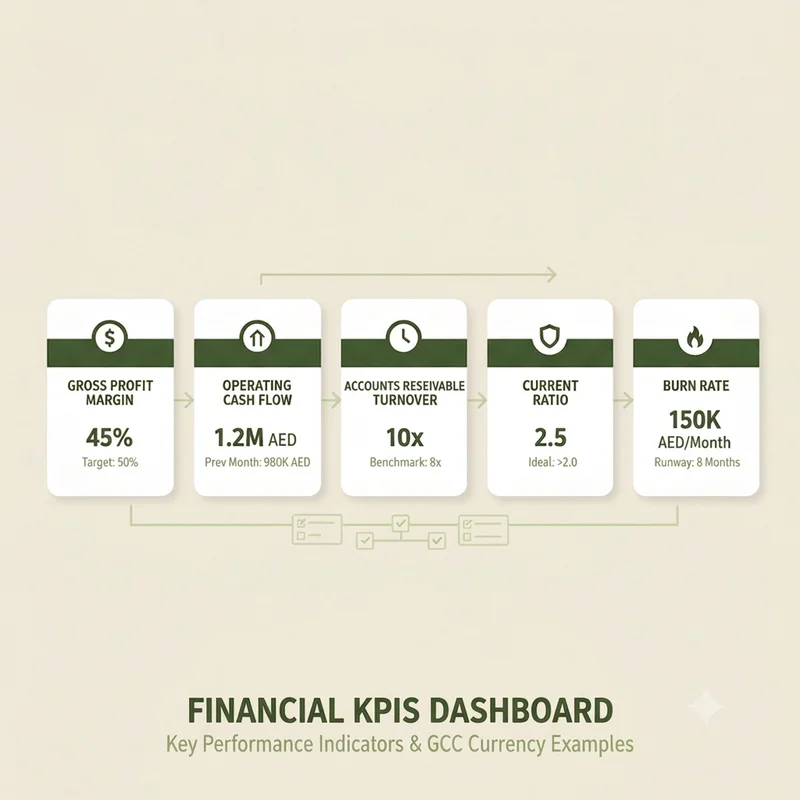
Gross Profit Margin
This tells you whether your business model is fundamentally profitable before overhead.
Formula: (Revenue - Cost of Goods Sold) / Revenue
If you sell a product for AED 100 and it costs you AED 60 to deliver (materials, labor, direct costs), your gross profit margin is 40 percent. That 40 percent has to cover rent, salaries, marketing, software, and still leave profit.
For GCC SMEs, healthy gross margins vary by sector. Product businesses typically need 40 to 60 percent. Service businesses can run higher, 50 to 80 percent, because labor scales differently than physical goods. If your margin is below 30 percent, you have a pricing problem or a cost structure problem.
Do not confuse gross margin with net margin. Gross margin is unit economics. Net margin is what remains after all expenses. You need strong gross margins to have any chance at profitability.
Operating Cash Flow
Profit on your income statement does not pay your suppliers. Cash does.
Operating cash flow measures the actual cash generated from your business operations. It is the difference between cash coming in from customers and cash going out to suppliers, employees, and operating expenses.
You can be profitable and still run out of cash if your customers pay slowly and your suppliers demand payment upfront. This is common in GCC markets where 60 to 90 day payment terms are standard for large buyers and government contracts.
Track your operating cash flow weekly, not monthly. If you wait until the month-end close to realize you are short on cash, you have already missed the warning signs. Businesses that monitor cash flow weekly can act before a shortage becomes a crisis.
For more on why cash flow matters more than profit, see Understanding Working Capital: The Key to Business Survival.
Accounts Receivable Turnover
This measures how fast you collect payment from customers.
Formula: Annual Revenue / Average Accounts Receivable
If your annual revenue is AED 1,200,000 and your average accounts receivable balance is AED 200,000, your turnover is 6. That means you collect your full receivables balance 6 times per year, or roughly every 60 days.
In GCC markets, a healthy collection cycle is 30 to 60 days for most SMEs. If you are taking 90 days or longer, you are financing your customers with your own working capital. That puts pressure on your liquidity and limits your ability to grow.
Watch for increasing Days Sales Outstanding (DSO). If your DSO is creeping up, it means customers are paying slower. That is a leading indicator of cash flow problems.
Current Ratio
This is your liquidity health check.
Formula: Current Assets / Current Liabilities
Current assets include cash, accounts receivable, and inventory. Current liabilities include accounts payable, short-term loans, and upcoming payroll. If your current assets are AED 500,000 and your current liabilities are AED 300,000, your current ratio is 1.67.
A healthy range for most GCC SMEs is 1.2 to 2.0. Below 1.0 means you owe more in the short term than you can access. That is a liquidity crisis. Above 3.0 suggests you are holding too much idle cash that could be reinvested for growth.
This ratio shows whether you have enough buffer to handle delayed payments, unexpected expenses, or seasonal downturns without running out of cash.
Burn Rate (for Growth-Stage Businesses)
If you are in a growth phase and not yet profitable, burn rate is the most critical number you have.
Burn rate is your monthly cash outflow. If you are spending AED 150,000 per month and generating AED 100,000 in revenue, your burn rate is AED 50,000 per month. If you have AED 600,000 in the bank, your runway is 12 months.
Burn rate is not inherently bad. Growth requires investment. But you need to know your runway and have a plan to reach profitability or raise more capital before the cash runs out. Businesses that do not track burn rate either run out of money suddenly or panic-cut expenses too late to save the business.
The Financial KPIs You Can Skip (For Now)
Not every ratio matters at every stage.
EBITDA (Earnings Before Interest, Taxes, Depreciation, and Amortization) is useful for large enterprises and M&A contexts. For an SME trying to stay solvent, it is noise. Focus on operating profit and cash flow instead.
ROI on individual marketing campaigns is tempting to track, but most SMEs do not have the attribution systems to measure it accurately. Track overall revenue growth and customer acquisition cost. That is cleaner and more actionable.
Complex financial ratios that require data you do not have are a distraction. If you are still building your financial reporting muscle, master the 5 core KPIs first. Everything else can wait.
How to Track These KPIs Without a Full Finance Team
You do not need a CFO to track financial KPIs. You need discipline and the right tools.
Set up a weekly financial review routine. Spend 15 minutes every Monday morning reviewing your cash position, accounts receivable aging, and upcoming payables. If you see a trend forming, you have time to act.
Use accounting software dashboards, not spreadsheets. Spreadsheets are manual, error-prone, and always out of date. Accounting software pulls live data from your bank accounts and invoices. You see your KPIs in real time, not two weeks after the month closes.
Set alert thresholds for each KPI. If your current ratio drops below 1.2, you should get a notification. If your DSO crosses 75 days, you should know immediately. Alerts let you act before small problems become big ones.
Schedule a monthly deep dive with your accountant. The weekly reviews catch the operational issues. The monthly deep dive is where you analyze trends, review profit margins, and adjust your financial strategy.
For the foundational knowledge to understand these metrics, see Accounting for Non-Accountants: What Every GCC Business Owner Needs to Know.
What to Do Next
Financial KPIs are not a one-time setup. They are a weekly discipline.
Track the 5 core metrics. Set alert thresholds. Review weekly. Act when the numbers show a problem forming. The businesses that fail are not the ones with bad unit economics. They are the ones that did not see the warning signs because they were not looking at the right numbers.
And if you are still managing this on spreadsheets, you are flying blind.
See how Bizrah tracks financial KPIs, cash flow, and profitability in real-time for GCC businesses. Try Bizrah free for 14 days — no credit card needed.