Financial Warning Signs: The Numbers That Tell You Trouble Is Coming
Nobody runs out of cash on a Tuesday without warning.
The warning was there. It was sitting in the receivables aging report four months earlier, and nobody opened it.
That is the uncomfortable part about financial warning signs. A business in trouble almost always produces the evidence first, in its own ledger, in time to act. What it often lacks is a threshold. Without a number to compare against, a bad month looks exactly like the start of a bad year.
The Warning Never Arrives as a Feeling
Ask an owner when things started going wrong and you get a mood, not a date. Things felt tight. Collections got slow. The bank balance looked thinner than it should.
By the time a business feels tight, the numbers moved two quarters ago.
This is why "things feel tight" is a useless diagnostic. A feeling has no threshold attached, so it cannot tell you whether to renegotiate a supplier term or do nothing at all. A healthy profit and loss statement does not protect you, because profit and cash are different questions. Businesses close while profitable. It happens constantly.
The signals below each come with a number. Watch them monthly, not quarterly.
Five Financial Warning Signs With Numbers Attached
Days Sales Outstanding Drifting Past Your Own Terms
Days sales outstanding, or DSO, measures how long cash takes to arrive after you invoice.
The threshold: DSO running more than 15 days beyond your stated terms, two months in a row. Thirty-day terms collecting in 48 days is not a rough patch. That is your real credit policy, and your customers already know it.
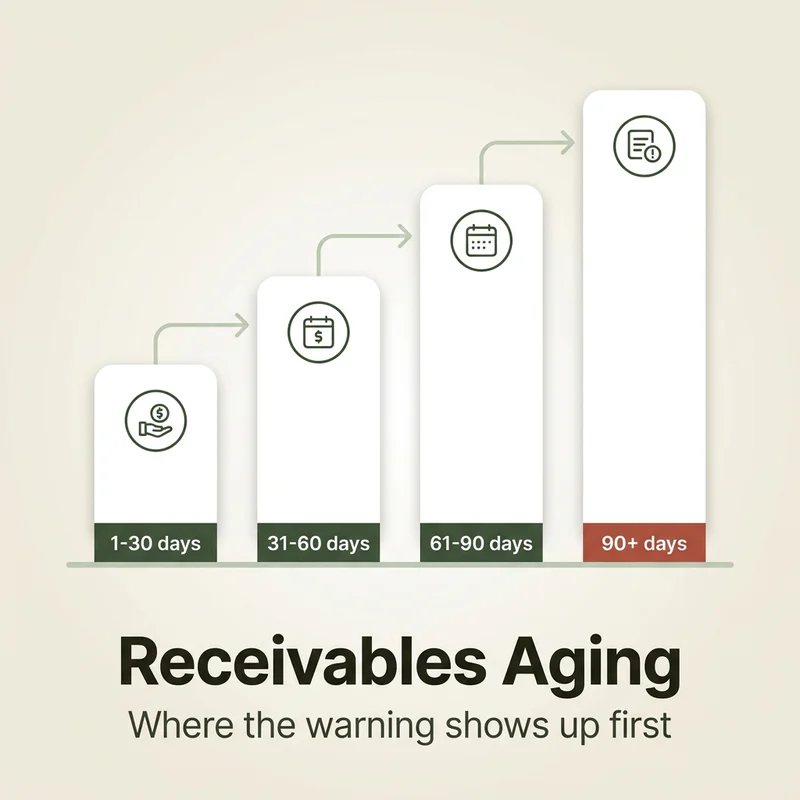
But the aggregate number hides the damage. Age the receivables into buckets instead: 1-30 days, 31-60, 61-90, and 90 plus. The 61-90 bucket is the one to watch. Once it holds more than 15% of total receivables, you are no longer waiting on slow payers. You are carrying accounts that may never pay.
In the GCC, this often gets worse before it gets better. Atradius found that 58% of B2B sales in the UAE are affected by overdue payment, with customers typically taking close to two extra months beyond terms. Sixty and ninety-day terms are normal here. Treating them as immovable is not.
A Current Ratio Sliding Toward 1.0
Divide current assets by current liabilities. That is your current ratio, and it answers one question: can the next twelve months of obligations be covered by the next twelve months of resources.
Below 1.2, start watching weekly. Below 1.0, your short-term liabilities exceed your short-term assets, which means something gets paid late by arithmetic, not by choice.
Pair it with the quick ratio, which strips inventory out. A current ratio of 1.3 propped up by slow-moving stock is a worse position than the number suggests. If the quick ratio sits under 0.8 while the current ratio looks acceptable, your working capital is tied up in things you cannot spend.
Gross Margin Falling While Revenue Rises
This one hides behind good news.
Revenue climbs, the team celebrates, and gross margin quietly gives up two percentage points over the quarter. Growth that costs margin is not growth. It is a discount programme you did not approve.
The threshold: two points of gross margin lost across a quarter with revenue flat or up. Then find the cause, because there are only three. You discounted to win volume. Input costs rose and you absorbed them. Or currency moved against you on imported inputs and nobody re-priced.
Each has a different fix. Averaging them into "costs went up" ensures none of them gets fixed.
Runway Under Six Months
Divide your cash balance by your average monthly net burn. The answer is your runway in months.
Under six months is a planning problem. Under three months is a decision problem, and the decisions available at three months are much worse than the ones available at six. That is the whole argument for tracking it. Burn rate is not a startup metric. Any business with lumpy collections and fixed monthly costs has one.

Payroll Climbing as a Share of Collections
Payroll against invoiced revenue tells you very little. Payroll against cash actually collected tells you whether you can make the transfer.
The threshold: payroll above 40% of cash collected, two months running. The exact percentage varies by sector, so set your own baseline from a good year and watch the drift rather than the absolute level.
The distinction matters more than the number. Invoiced revenue has never once paid a salary.
Thresholds, Not Vibes
| Signal | Threshold | What it means |
| DSO | 15+ days past your terms, 2 months running | Your stated terms are fiction |
| 61-90 day bucket | Over 15% of receivables | Collection risk, not slow payment |
| Current ratio | Below 1.2 watch, below 1.0 act | Obligations outrun resources |
| Quick ratio | Below 0.8 | Working capital trapped in inventory |
| Gross margin | 2 points lost in a quarter, revenue flat or up | Unapproved discounting or unpassed costs |
| Runway | Under 6 months plan, under 3 decide | Options are closing |
| Payroll to collections | Above 40%, 2 months running | Fixed cost outpacing real cash |
Print it. Check it on the same day every month.
The Signals That Are Not in the Ledger
Some warnings never appear as a ratio.
Every VAT return filed as a scramble in the final week. Month-end close slipping past day ten, then day fifteen. The owner funding payroll from personal accounts and calling it a loan nobody documents. A long-standing supplier moving you from credit to prepaid without explaining why.
That last one deserves attention. Your suppliers watch your payment behaviour closely, and they often downgrade you before your own reports catch up.
The First Week After a Number Turns
A threshold breach is not a verdict. It is a prompt, and it has a sequence.
Reconcile the bank first, because none of the ratios mean anything on stale data. Age the receivables. Call the top three overdue accounts yourself rather than sending another automated reminder. Then rebuild a 13-week cash flow forecast from collections you actually expect, not invoices you have issued.
Do that inside a week and most breaches resolve without anything structural changing.
Leave it a quarter and you move from managing the business to managing a shortfall. Leave it longer and the options narrow to formal ones. The UAE handles that through Federal Decree-Law No. 51 of 2023, which exists precisely because distress is survivable when it is addressed early.
The reason to watch the financial warning signs in your business is not pessimism. A warning sign is lead time, and lead time is the only thing that makes any of the remaining options good ones.
---
Try Bizrah free for 14 days — no credit card needed.