VAT Return Filing in the UAE: Every Box, Every Deadline
Day 28 does not move.
VAT return filing in the UAE runs entirely on that one date. It arrives the same number of days after every tax period, it is printed on your registration certificate, and it still catches businesses out four times a year.
That point is worth sitting with. The return itself is not a hard task. It is a transcription exercise: fourteen boxes, most of them arithmetic, and a payment instruction. The work is not the form.
The work is having books clean enough to complete it.
What VAT return filing in the UAE actually asks of you
The return and the payment are both due within 28 days of the end of your tax period, as the Federal Tax Authority sets it out. One deadline, two obligations.
Those two obligations can fail separately, and that matters more than it sounds. Filing on time while paying late triggers one penalty. Missing both triggers two.
Note the word payment, not transfer. The money has to reach the authority by day 28. A transfer instructed on the afternoon of the 28th that settles on the 29th is a late payment, and the bank’s timestamp is not the one that counts.
Monthly or quarterly is not your choice
The authority assigns your tax period at registration. Businesses with annual turnover of AED 150 million or more file monthly. Everyone else files quarterly.
Your period end dates sit on your registration certificate. Do not assume they are calendar quarters, because for plenty of registrants they are not. A business that has quietly been working to 31 March when its period actually closed on 28 February has been late for years without knowing it.
Form VAT 201, box by box
The form has fourteen numbered boxes in two halves. The first half is what you charged. The second half is what you paid. The difference is what you owe.
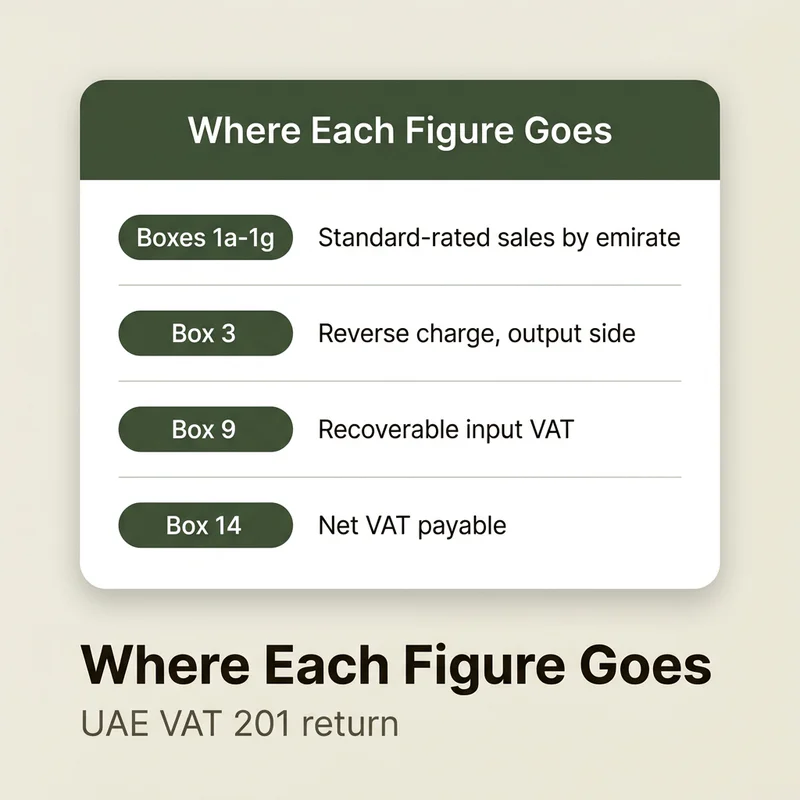
Output VAT: boxes 1 to 8
Boxes 1a to 1g are your standard-rated sales, split by emirate. Not by where your licence sits, and not by where the customer’s office is, but by where the supply was made.
Box 2 is VAT refunded to tourists and arrives pre-filled. Box 3 is the output side of reverse-charge supplies. Box 4 is zero-rated sales and box 5 is exempt sales, and those two are not interchangeable.
Box 6 is imported goods, pulled in automatically from customs records. Box 7 exists only to correct box 6 when the customs figure is wrong. Box 8 totals the lot.
Input VAT: boxes 9 to 11
Box 9 is your standard-rated expenses carrying recoverable VAT. Box 10 is the input side of the same reverse-charge transactions you declared in box 3. Box 11 is the total.
Reverse charge appears twice, deliberately. You declare the tax and you reclaim it in the same return, and when it is fully recoverable the two cancel out.
The net position: boxes 12 to 14
These are calculated, not typed. Box 14 is the net figure, payable or refundable.
If box 14 surprises you, stop. The return is not wrong. The ledger behind it is.
Where returns actually go wrong
Five errors account for most of the corrections, and none of them is exotic.
The five that cost the most
Standard-rated sales reported against the wrong emirate. This is the quiet one, because the total is right and the split is not, and the total is what most owners check.
Reverse charge entered on one side only. Declaring in box 3 and forgetting box 10 means paying tax you were entitled to reclaim.
Exempt income parked in the zero-rated box. The two look similar on a dashboard and behave differently, because zero-rated supplies support input tax recovery and exempt supplies do not. Put exempt income in box 4 and you have overstated what you can claim back.
Input tax claimed without a valid tax invoice showing the supplier’s tax registration number. This is the single most common reason a refund gets reduced. A WhatsApp photo of a till slip is not a tax invoice.
Entries back-dated into a filed period. The period is closed. Reopening it to slot in a late supplier bill quietly breaks the agreement between your general ledger and a return already submitted.
Every one of these is a bookkeeping failure wearing a compliance costume.
Fixing a return you have already filed
Errors happen. The authority distinguishes between small ones and serious ones by their tax effect.
A tax effect of AED 10,000 or less can generally be corrected in your next return. Above that, the route is a voluntary disclosure, normally within 20 business days of spotting the error.
Keep your records for five years from the end of the period they relate to. For real estate, fifteen.
What a late return costs now
This part changed, and a lot of advice still circulating has not caught up.
Cabinet Decision No. 129 of 2025 came into force on 14 April 2026 and replaced the old penalty tables. The structure most people remember, 2% on the due date and 4% every month after, is gone. Late payment now accrues at an annualised 14%, charged monthly on tax still outstanding, as PwC Middle East summarises it.
A late return is AED 1,000, rising to AED 2,000 for a repeat within 24 months. An incorrect return is AED 500 for a first violation and AED 2,000 for a repeated one.
Read those two numbers next to each other. Filing a return you are not completely confident in costs AED 500. Not filing costs AED 1,000, plus interest on money you were going to owe anyway. If the figures are imperfect but the cash is ready, file.
The same logic applies to the broader UAE tax picture, where the gap between what businesses assume and what the law says keeps producing expensive misconceptions.

The deadline is not the test
Businesses treat day 28 as the hard part. It is not. It is a date on a calendar, and it has never once arrived unannounced.
The hard part is the four weeks before it, when invoices need to be raised, supplier bills captured with their registration numbers intact, bank accounts reconciled, and the period locked. A business that does that continuously fills in the VAT 201 in twenty minutes.
A business that does not spends the last three days of the month rebuilding its own quarter from memory.
Day 28 does not test your discipline on day 28. It tests the ninety days you already spent.
---
Try Bizrah free for 14 days — no credit card needed.