Investor Due Diligence Checklist: What You Will Be Asked
The pitch went well. The term sheet is on the table.
Now someone you have never met is going to spend three weeks inside your books, and an investor due diligence checklist is the only warning you get about what they will look for.
Most founders in the Gulf prepare for the pitch and improvise the rest. They rehearse the market slide, polish the growth chart, then hand over a folder of exports that nobody inside the business has reconciled since last quarter.
That is where rounds get repriced.
What an investor due diligence checklist is really testing
Treat the checklist as a document hunt and you will miss the point entirely.
The documents are a proxy. What is actually under examination is whether your numbers hold up when someone who is paid to doubt them starts pulling threads. Does the revenue in the deck match the revenue in the ledger. Does the ledger match the bank. Does the bank match what you told the last investor.
An investor is not looking for perfect books. Early-stage businesses do not have perfect books. They are looking for books that are consistent, and for a founder who knows where the weak spots are before being asked.
That distinction shapes how the next three weeks go. A founder who says "receivables are ugly, here is why, here is the plan" keeps control of the narrative. A founder who is surprised by their own aged receivables report hands that control away.
If the income statement is still something your accountant explains to you rather than something you read yourself, start there. Diligence is a poor time to learn the vocabulary.
The data room, folder by folder
Four folders carry most of the weight.
Financial statements and the trailing twelve months
Monthly profit and loss for at least twenty-four months, balance sheets at each period end, and a cash flow statement that actually ties to the bank. Include the trial balance and the general ledger export, because a serious reviewer will go to the transaction level.
The trailing twelve months matter more than the fiscal year. Investors rebuild that period from scratch, testing revenue against your own stated policy and checking that the opening and closing balance sheets cut the periods correctly.
Revenue, contracts, and how you recognise it
Signed customer contracts, your top customers by revenue, a churn and retention history, and a written statement of when you recognise revenue.
That last one is skipped constantly. If you invoice annually and recognise the full amount on signature, say so, because the adjustment is coming either way. Deferred revenue sitting in the wrong period is the single most common correction in financial due diligence.
Tax and compliance records
VAT returns and the filings behind them, corporate tax registration, trade licence, and any correspondence with a tax authority.
Reviewers sample historical returns and trace them back to supporting records to judge whether the filings are reasonably correct. They check registration status, any open or recent audit, and how much input VAT you have been unable to recover. PwC's guidance on UAE deals treats the control environment itself as a finding: who prepares the return, and what stops an error from reaching the authority.
If corporate tax registration is incomplete, fix it before the data room opens rather than explaining it inside one. The Federal Tax Authority publishes the obligations and the deadlines, and an investor will assume you have read them.
Cap table, debt, and related parties
A current cap table, every loan agreement including the founder loan you made in year one, and a complete list of related-party transactions.
Related parties are tested for one thing: whether the terms are what an unrelated party would have accepted. Rent paid to a company your brother owns is not a problem. Rent at half the market rate, propping up the margin, is.
The questions behind the documents
Every document invites a question. In practice, these two come up in almost every process.
Walk me through the gap between profit and cash
You reported a profitable quarter and your bank balance fell. Both can be true. An investor wants to hear you explain it without reaching for a spreadsheet.
The answer usually lives in working capital. Receivables stretched, inventory built, a supplier paid early. Quality of earnings, the framing most reviewers use, asks whether earnings convert into cash and whether they repeat. Profit that never becomes cash is a number, not a result, which is the argument the cash flow versus profit piece makes at length.
Know your own working capital cycle in days. Being unable to state it is worse than having a bad one.
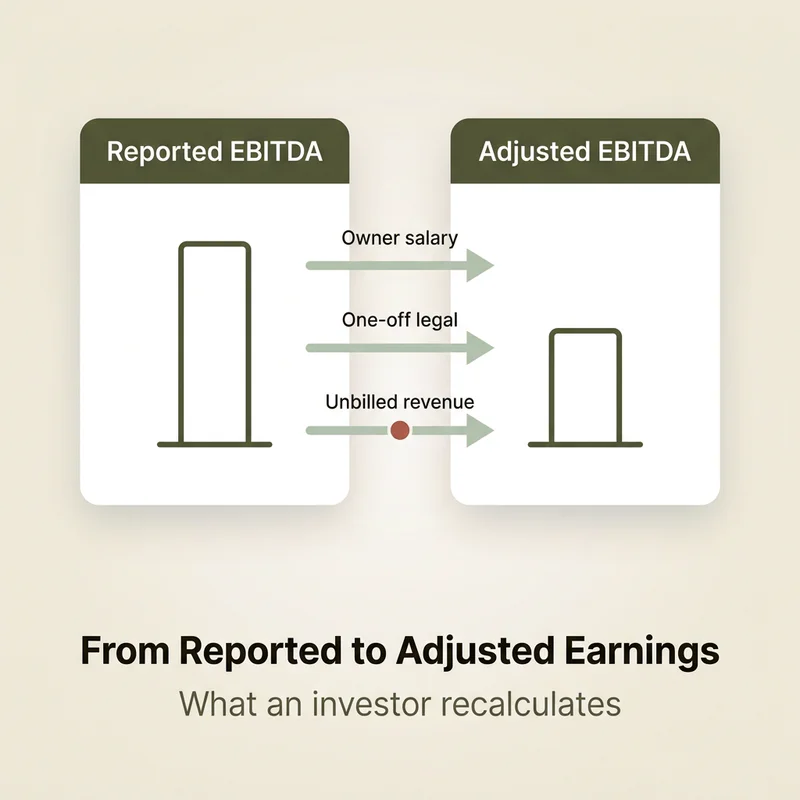
Which of these add-backs survive scrutiny
Founders add back the things they consider unrepresentative. The owner's above-market salary, a one-off legal bill, the office move.
Reviewers validate each one against original documentation, and estimates are refused. An add-back you cannot evidence does not get a discount; it gets removed, and it makes every other number you provided look softer. The volume of corrections a reviewer has to make is itself read as a signal about the strength of your finance function.

What gets a deal repriced
Three findings move valuation rather than merely irritating the reviewer.
Revenue recognised too early, which inflates the growth rate the entire valuation rests on. Related-party transactions on non-market terms, which means the real cost base is higher than reported. Tax filings that do not reconcile to the ledger, which creates an unquantified liability the buyer has to price.
None of those are accounting trivia. Each one changes what the business is worth.
Start the cleanup before you start the raise
The uncomfortable part is that none of this can be assembled during diligence.
A reconciled general ledger, a written revenue policy, VAT returns that trace to source, a related-party list kept current. Each is a habit maintained monthly, and the three weeks of a diligence process are far too short to retrofit any of them.
Founders who raise cleanly tend to be running a monthly close long before an investor asks for anything, often with the kind of lean finance function that takes one person and a disciplined calendar. The metrics they report internally are the same ones they hand over.
Diligence readiness is not a fundraising task. It is bookkeeping, done on time, for long enough that a stranger can follow it.
Try Bizrah free for 14 days — no credit card needed.