The five-day close gets quoted like a law of nature.
Investors ask about it. Advisors hold it up as the mark of a serious finance function. Almost nobody explains how to reach it.
Your close is not slow because your team is slow. It is slow because nobody has written the order down. A month-end close checklist is not a list of tasks. It is a dependency order, and that distinction is the difference between a five-day close and a nineteen-day one.
What a month-end close checklist is actually for
Most closes fail in one of three places, and none of them are effort problems.
The first is waiting. The books sit open because a supplier invoice has not arrived, and everything downstream waits with it. The second is reconciling twice, because someone posted adjustments while the bank reconciliation was still running. The third is reviewing too early, when the numbers are still moving and the review has to be repeated.
A checklist fixes all three by fixing sequence. Inputs stop, then accounts get reconciled, then adjustments get posted, then somebody reviews. Each stage finishes before the next one starts.
That is why a good close is boring. Nothing is being discovered at the end.
If the relationship between the ledger and the trial balance is still fuzzy, start there. The close is the process that turns one into the other on a schedule.
The month-end close checklist, day by day
Five working days, counted from the first business day of the new month.
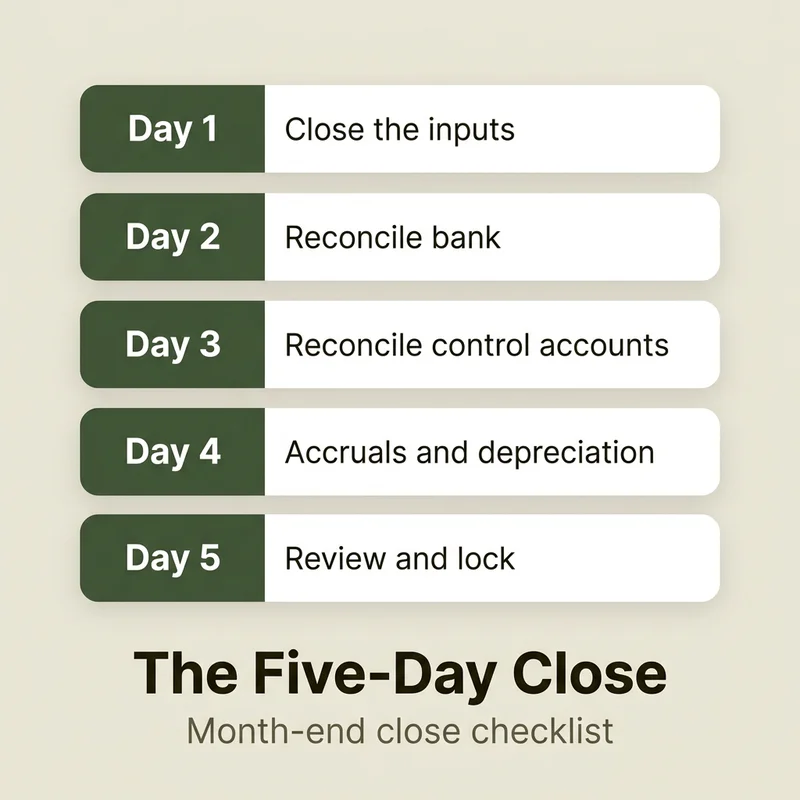
Day 1: close the inputs, not the books
Nothing gets reconciled until the inputs stop arriving.
Set a hard cut-off for customer invoices, supplier bills, expense claims, payroll, and petty cash. Announce it to the team before the month ends, not on the morning you enforce it. Anything that lands after the cut-off belongs to next month, and a business that cannot live with that rule does not have a close, it has a rolling backlog.
Then chase the two or three items that are late every single month. Every business has them: the utility bill, the freight invoice, the one contractor who submits timesheets on their own schedule. Name them in the checklist so day one is a phone call, not an investigation.
A clean chart of accounts makes this day short. A messy one turns it into coding arguments.
Days 2 and 3: reconcile everything that has a statement
If a third party issues a statement, that account gets reconciled. Bank accounts, credit cards, loans, merchant settlement accounts, intercompany balances, and the VAT control account.
The standard is not "the difference is small." The standard is that every reconciling item is explained and dated. An unexplained difference of AED 400 is a problem of the same kind as one of AED 400,000, because you do not yet know which one it is.
Two days sounds generous. It is not, once multi-currency accounts and merchant settlements are involved. Give it the room.
Day 4: accruals, prepayments, depreciation
Now the ledger stops describing what has been paid and starts describing what has been earned.
Post accruals for costs incurred without an invoice. Release the month's share of prepayments. Run depreciation and amortisation. Move anything sitting in suspense into a real account.
Build these as recurring journal templates. Recalculating the same prepayment schedule from scratch every month is how errors enter a close that has otherwise been clean for a year.
Day 5: review, report, lock
Pull the trial balance and read it against the prior month, line by line.
You are looking for movement you cannot explain in one sentence. A cost centre that doubled. Revenue that did not move when volume did. A balance sheet account that has quietly grown for four months. Anything you cannot explain goes back to day four, not into the report.
Then produce the reports and lock the period. Locking matters. A close that can still be edited is not closed, and the first time someone posts a back-dated journal into a signed-off month, every report that referenced it becomes wrong.
Who does what
A checklist with no owner is a wish list.
The bookkeeper owns days one to three: cut-off, coding, and reconciliations. The accountant owns day four: judgement calls, accruals, and anything requiring a policy decision. The owner or finance lead owns day five and signs off.
One name per line. Not a department, not "finance". When two people share a step, it is done twice or not at all, and nobody can say which until the close has already slipped.

If the roles do not exist yet, the sequence still does. A founder running the books alone follows the same order and simply wears all three hats on different days. The question of when to build a finance team is a separate one, and it usually answers itself around the time day five starts eating the weekend.
The GCC layer most checklists ignore
Imported close templates assume a filing calendar that does not apply here.
In the UAE, the VAT return and the payment are both due within 28 days of the end of the tax period, and the Federal Tax Authority assigns whether that period is monthly or quarterly. A close that finishes on day five leaves three usable weeks. A close that finishes on day fifteen does not, and the filing deadline does not move because your reconciliations ran long.
In Saudi Arabia, businesses above the SAR 40 million threshold in annual taxable supplies file monthly, and everyone else files quarterly. ZATCA expects the return to agree with what was actually cleared through e-invoicing.
That last point changes the close more than most teams expect. Under e-invoicing, the invoice register is fixed before your month-end even begins. Your books have to agree with what cleared, not with what you intended to bill. A credit note issued in the wrong period is now a compliance question, not a bookkeeping preference.
Where five-day closes actually break
The dangerous close is not the one that fails in month one. It is the one that works for three months and then slips.
That happens for predictable reasons. A suspense account nobody empties. A reconciliation that gets skipped once, then habitually. One person holding the whole sequence in their head, then taking leave in a month with a public holiday in it.
The fix is unglamorous. Write the checklist down, put a name against every line, record how long each day actually took, and review the outliers. A close that consistently overruns on day two has a reconciliation problem to solve, not a deadline to push.
Five days is not a stretch goal. It is what happens when the order is written down and somebody owns each step. The businesses that manage it are rarely the ones with the largest finance teams. They are the ones that stopped improvising every month, and treating working capital decisions as something you make on current numbers rather than three-week-old ones.
---
Try Bizrah free for 14 days — no credit card needed.