Payment Terms Negotiation: How to Stop Waiting 90 Days
The terms on your invoice were decided by someone. Most of the time, that someone was not you.
Payment terms negotiation sounds like a procurement exercise for large companies with legal departments and leverage. It is not. It is a conversation that happens once, usually before the first delivery, and then governs every riyal and dirham that moves between two businesses for years.
Most smaller businesses in the Gulf skip that conversation entirely. A purchase order arrives with "90 days from invoice date" printed near the bottom, and it goes into the file unchallenged.
That is how a cash flow problem gets built into a contract.
Long payment terms are a decision, not weather
The 60, 90 and 120-day terms that show up across GCC trade are often described as regional custom, as if they are something you plan around the way you plan around summer.
They are nothing of the kind. Every one of those numbers was chosen by a finance team on the other side of the table, because holding cash for an extra month is free working capital for them and an expensive loan for you.
The scale is not small. Atradius found that 58% of B2B sales in the UAE were affected by overdue invoices, with customers in steel and metals typically taking close to two extra months to clear bills that were already due. Terms were around 40 to 50 days from invoicing to begin with.
Read that twice. The agreed terms were 50 days. The actual money arrived at 100.
The first thing to accept, then, is that the number on the purchase order is an opening position, not a regulation.
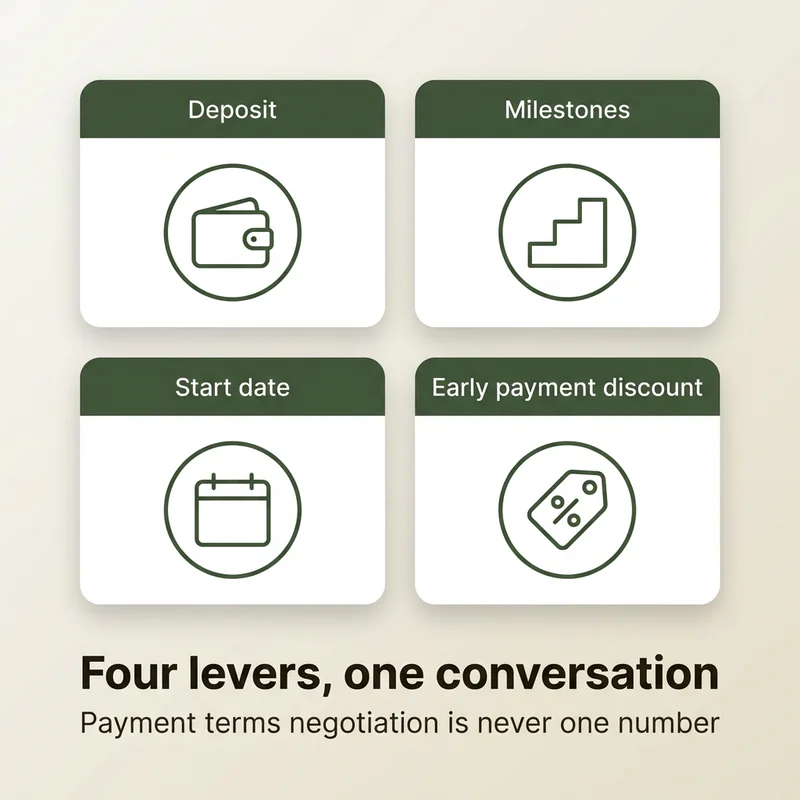
What payment terms negotiation actually moves
The mistake is treating this as a single number that goes up or down. Payment terms negotiation has four levers, and the day count is only one of them.
The clock is a start date, not just a number
"Net 60" means nothing until you define net 60 from what.
From delivery, from invoice date, from invoice approval, or from the end of the month in which the invoice was approved. These four definitions of the same 60-day term can sit 45 days apart in practice, and the last one is common enough in the region that it deserves a specific question rather than an assumption.
A customer who will not move from 60 days will very often move the start date to delivery instead. That costs them almost nothing in policy terms and moves real cash toward you.
Price and terms are one conversation, not two
A business that agrees to a price first and discusses terms afterward has already lost the useful part of the negotiation.
Long terms are a cost. Financing 90 days of a project at any realistic rate is money, and it belongs in the price the same way materials do. Say so plainly: this price assumes payment in 30 days, and here is the price at 90.
That reframing does something a discount request never does. It stops the terms being a favour the customer grants and makes them a line item that both sides are paying for.
Running the negotiation on the receivable side
Before asking anyone for anything, start with what your own numbers say. Days sales outstanding — the average number of days between raising an invoice and being paid — is the figure that turns a complaint into an argument. A business that can say "our terms are 45 days and our days sales outstanding is 81" is negotiating from evidence. Tracking it sits alongside the other financial KPIs every business owner should watch.
Then bring more than one lever to the table.
A deposit is the cleanest of them. Thirty percent before work begins changes the shape of a project entirely, and customers who will argue for an hour about net terms often approve a deposit without comment because it sits in a different mental category.
Milestones do similar work on longer engagements. Three payments across a four-month build is not a discount request; it is a schedule, and schedules are easier to agree than concessions.

The early payment discount is the lever to use most carefully. Two percent for paying in 14 days instead of 60 sounds modest. Annualised across those 46 days, it is a rate well above what any bank in the region would charge you for the same money.
That does not make it wrong. It makes it a price, and prices should be calculated rather than offered reflexively.
The same table, from the payable side
Every argument above is one your suppliers are entitled to make to you.
There is a habit among growing businesses of treating slow payment as a free financing tool. Stretch the supplier, hold the cash, improve the month. It works, briefly.
What it actually buys is worse pricing, last position in the queue when stock is short, and a supplier who quietly prices your unreliability into the next quotation. None of that appears as a line on the income statement, which is exactly why it goes unnoticed for so long.
Paying on agreed terms is not generosity. It is the cheapest supplier discount available, and it is the one most businesses refuse to claim.
When the customer will not move
Some will not. That is a real answer and it deserves a real response rather than silent acceptance.
The law is more helpful here than most owners assume. Under the UAE Commercial Transactions Law, a creditor is entitled to interest on a commercial debt from the date it falls due, with the agreed rate subject to a statutory ceiling of 12% per annum. Writing that entitlement into the contract, in ordinary language, changes the internal conversation on the other side. An invoice that accrues interest stops being the safest one to delay.
Some accounts are simply not worth holding. A customer at 120 days, with a margin thin enough that the financing cost eats it, is a loss wearing the clothes of revenue. Working out which accounts those are is the practical use of a cash flow forecast, and the reason working capital deserves attention long before a shortfall arrives.
Terms are not something that happens to your business. They are something your business agrees to, once, in a conversation most people are too polite to have.
Try Bizrah free for 14 days — no credit card needed.