The Real Cost of Manual Accounting: Time, Errors, and Missed Opportunities
If you are still using spreadsheets and paper receipts to manage your books, you are paying a price that does not show up on any invoice.
Manual accounting seems cheap. No software fees, no tech headaches. But that is a mirage. The hidden costs are bleeding your business dry every day.
These costs hit in three ways: time waste, costly errors, and missed opportunities. Add them up, and manual accounting can cost tens of thousands of dirhams annually, even for small businesses. Here is the real price you are paying.
Time: The Most Expensive Resource You Are Wasting
How Much Time Does Manual Accounting Really Take?
Every hour on manual accounting is an hour not spent growing your business. For a typical SMB in the GCC, manual accounting devours time:
Data entry: 10-15 hours per week entering invoices, receipts, and transactions
Bank reconciliation: 3-5 hours monthly matching transactions to bank statements
Report generation: 4-6 hours monthly compiling financial statements and dashboards
Month-end closing: Additional 6-8 hours per month finalizing books
That is 60-80 hours per month—1.5 to 2 full work weeks lost to bookkeeping. For a finance manager earning AED 15,000 monthly, that is AED 3,750-5,000 in direct labor costs for routine tasks.
The Compound Effect on Your Team
Manual accounting does not just affect one person. It ripples through your organization:
Administrative staff waste 40-50% of their time on repetitive data entry
Finance managers are stuck reconciling transactions instead of analyzing performance
Business owners get dragged into month-end processes, losing strategic focus
Teams waste hours hunting for missing receipts, correcting errors, and chasing documentation
The real cost is not just hours lost, but the opportunities your team misses while trapped in manual processes.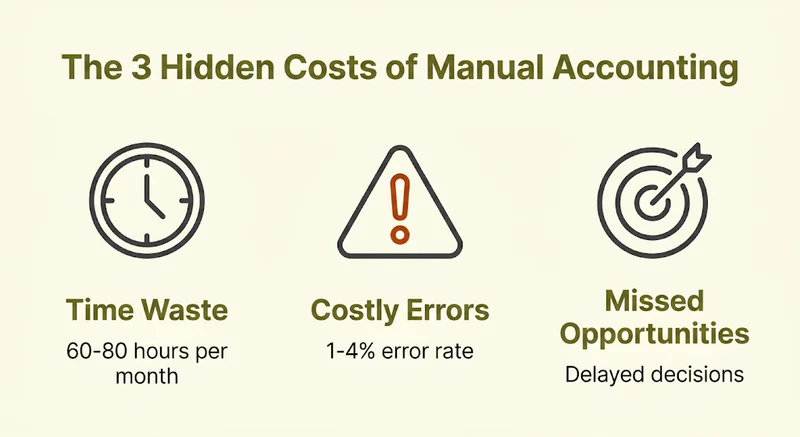
Errors: The Costly Mistakes Manual Processes Create
Common Manual Accounting Errors
Human error is inevitable in manual accounting. Studies show manual data entry has an error rate of 1-4%. In accounting, even small mistakes can be costly.
Common errors include:
Transcription errors: Mistyping amounts, account numbers, or transaction details
Duplicate entries: Recording the same transaction multiple times
Missed transactions: Failing to record invoices, expenses, or payments
Incorrect categorization: Misclassifying transactions, affecting financial reports and tax calculations
Formula mistakes: Spreadsheet errors that cascade through financial statements
The Financial Impact of Accounting Errors
Accounting errors do not just create messy books. They have real financial consequences:
For GCC businesses, stakes are high. Tax authorities like ZATCA in Saudi Arabia and the Federal Tax Authority in the UAE impose strict penalties for errors in VAT returns and e-invoicing. A single mistake in Phase 2 ZATCA compliance can trigger penalties starting at 5% of the transaction value.
Missed Opportunities: What You Cannot See
The most expensive cost of manual accounting is what you do not realize you are losing: strategic opportunities.
Delayed Decision-Making
When your financial data is weeks old, you are making decisions based on outdated information. You cannot spot cash flow problems until it is too late. You cannot identify profitable products or underperforming services in real time. You are driving your business while looking in the rearview mirror.
Lost Early Payment Discounts
Many suppliers offer 2% discounts for payment within 10 days. If manual processes mean you do not see invoices or process payments quickly enough, you are leaving money on the table. For a business with AED 200,000 in monthly vendor expenses, lost early payment discounts cost AED 4,000 per quarter, or AED 16,000 annually.
Inability to Scale
Manual processes do not scale. As your business grows, your accounting workload grows exponentially. Hiring more staff to handle increased transaction volume just multiplies your labor costs without solving the efficiency problem.
No Strategic Financial Planning
When your finance team is buried in data entry and reconciliation, they have no time for the work that drives value: cash flow forecasting, profitability analysis, budget planning, and strategic recommendations. Manual accounting keeps your finance function reactive, not strategic.
Learn how to optimize your working capital to improve financial planning and decision-making.
A Real-World Example: The True Cost for a GCC SMB
Let us put numbers to this for a real business profile:
Company: UAE-based trading company
Annual revenue: AED 5 million
Accounting method: Manual (Excel + paper receipts)
Monthly Hidden Costs:
Annual cost of manual accounting: AED 77,000 (approximately USD 21,000)
This does not include compliance risks, delayed growth opportunities, or the stress of manual processes. For many SMBs, the true cost is even higher.
What Automation Looks Like in Practice
Modern accounting automation eliminates these costs by handling repetitive work humans do not need to do:
Automated data capture: Receipt scanning and bank feeds import transactions automatically
Real-time reconciliation: Transactions match to bank statements instantly, with smart suggestions
Automated invoicing: Generate and send invoices in seconds, with automatic payment tracking
One-click reporting: Financial statements and dashboards update in real time
Tax compliance integration: Direct connection to ZATCA and FTA portals for seamless e-invoicing and VAT filing
The result is not just time savings. It is a fundamental transformation in how your finance function operates.
Setting up the right foundation is crucial. Read our guide on building your chart of accounts for a solid accounting structure.
Making the Switch: Is It Worth It?
The ROI of accounting automation is compelling:
Payback period: 3-6 months for most SMBs
Time savings: 60-70% reduction in manual accounting tasks
Error reduction: 80-90% fewer data entry mistakes
Strategic shift: Finance teams move from data entry to analysis and planning
For the UAE trading company in our example, investing AED 1,500 per month in accounting automation would eliminate AED 6,416 in monthly hidden costs. That is a net monthly savings of AED 4,916, or AED 59,000 annually. The investment pays for itself in under 3 months.
Track the metrics that matter with our guide on critical financial KPIs every business owner must track.
Stop Paying the Hidden Price
Manual accounting is not saving you money. It is costing you thousands in wasted time, expensive errors, and missed opportunities that you cannot see until it is too late.
The businesses thriving in today's competitive GCC market are the ones that have freed their teams from manual processes and empowered them to focus on growth, strategy, and value creation.
Ready to see what automation can save your business? Bizrah is built for GCC businesses like yours, with native support for ZATCA e-invoicing, multi-currency transactions, and Arabic-English bilingual operations. Discover how Bizrah eliminates the hidden costs of manual accounting.