Revenue Recognition Explained: When a Sale Actually Counts
The client transferred AED 60,000 this morning. The money is in the account. The bank app says so.
It is still not revenue.
That gap between money arriving and a sale counting is where revenue recognition lives. It is also one of the few accounting rules that quietly changes what your business looks like on paper. Get the timing wrong and a strong quarter turns into a weak one, or a weak one flatters you into hiring.
Revenue recognition is a timing question, not a cash question
Three different dates often get treated as one: the date cash lands, the date the invoice goes out, and the date the work is actually done.
Only the third one decides when revenue belongs in your books.
An invoice is an administrative event. You control it. You can issue it early to hit a deadline, late because someone was on leave, or as one lump because the client asked for a single document. None of that changes when the business earned the money, and none of it should move the revenue line.
This builds directly on the choice between cash and accrual accounting. Cash-basis books record revenue when the money moves and stop there. Accrual books ask a harder question, and revenue recognition is the answer to it.
The invoice date is a convenience. Delivery is the rule.
The five questions behind every recognized sale
International Financial Reporting Standards set this out in IFRS 15, the standard almost every GCC business either follows or is asked about the moment an auditor, a lender, or a tax authority arrives. Stripped of the language, it is five questions asked in order.
Is there a contract? Not necessarily a signed document, but an arrangement with real commercial substance where both sides know what is owed.
What did you promise? Each distinct thing you agreed to deliver is a separate promise, even when the client sees one project.
What is the total price? Including discounts, rebates, and anything variable such as a performance bonus you may or may not earn.
How does that price split across the promises? A single number on a quote has to be allocated across each distinct deliverable.
Have you delivered? Revenue is recognized as each promise is satisfied, not before.
Where GCC businesses actually go wrong
The failure is almost always at question four.
A design studio quotes AED 90,000 for a brand identity, a website, and twelve months of retainer support. One number, one invoice, one line in the books. The identity ships in week three and the whole 90,000 gets recognized.
That is wrong, and it is wrong in the direction that hurts. Eleven months of obligation are still sitting there unfunded, the revenue that should have covered them has already been reported, and the following year opens with a hole nobody planned for. Splitting the price across the three promises is not paperwork. It is the difference between knowing what the business earned and guessing.
A deposit is not revenue, and VAT does not care
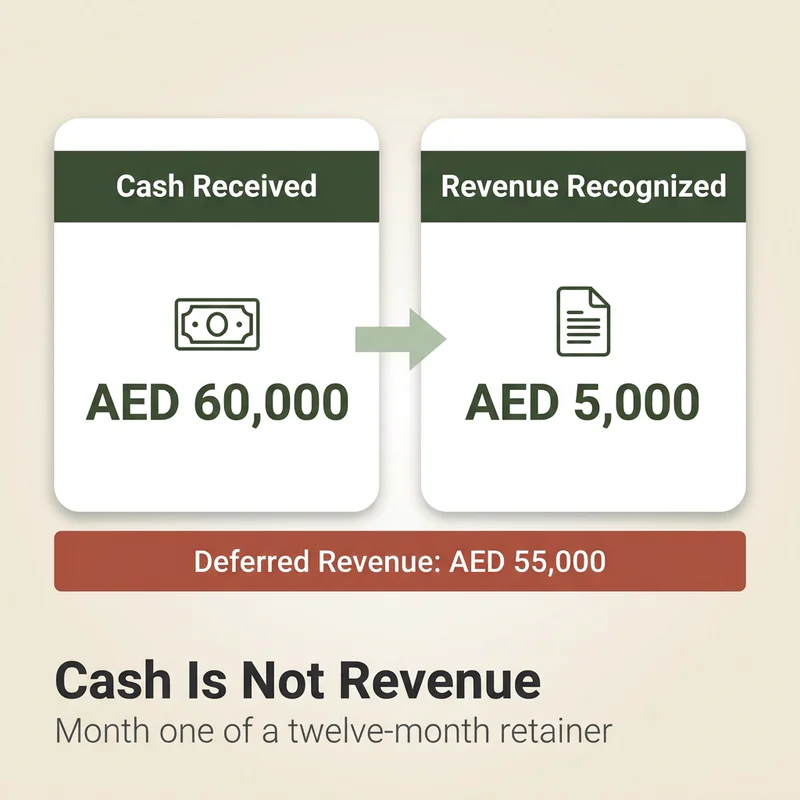
An advance payment is a liability. The client has given you money for work you still owe. Until you deliver, that AED 60,000 sits on the balance sheet as deferred revenue, not on the income statement as a sale.
Here is where GCC businesses get caught. Under the UAE date of supply rules, VAT becomes due on the earliest of several triggers, and receiving payment is one of them. The same applies to issuing a tax invoice. So the moment that deposit lands, VAT is payable on money that accounting rules say you have not yet earned.
Two systems, two clocks, and they do not agree. VAT looks at the payment. Revenue recognition looks at the delivery.
Businesses that treat the deposit as revenue often miss this entirely, because the two mistakes cancel out on the surface and then diverge badly at year end. Take the deposit, book the liability, pay the VAT, and recognize the revenue when the work is done.
Cash in the account is a fact about your bank. It is not a fact about your performance.
Multi-month contracts and deferred revenue
Retainers, annual licences, maintenance agreements, and support contracts all share the same shape: one payment, many months of obligation.
A worked example
A Dubai consultancy signs a twelve-month retainer at AED 60,000, paid in full in January.
January does not produce AED 60,000 of revenue. It produces AED 5,000. The other AED 55,000 sits as deferred revenue, a liability, because eleven months of work remain owed.
Each month, AED 5,000 moves off the balance sheet and onto the income statement. By June the liability is down to AED 30,000. By December it is zero and the full AED 60,000 has been recognized, spread across the twelve months that actually earned it.

Run it the wrong way and January reports a 60,000 month against normal costs, which looks like the best month in company history. February through December then report zero revenue against twelve months of salaries. Nothing about the business changed. Only the income statement told a false story about it.
What this changes about your books
Recognition timing is not just presentation. It moves real money.
UAE corporate tax starts from the accounting net profit in your financial statements and adjusts from there, which means the period in which you recognize revenue is the period in which it becomes taxable income. Pull a year of retainer revenue into a single month and you have pulled next year's tax into this year with it.
It also changes what your numbers are good for. A revenue line built on delivery tells you whether the business works. A revenue line built on deposits tells you when clients happened to pay, which is a different and much less useful thing to know.
Three habits carry most of the weight. Split bundled contracts into their separate promises before the first invoice. Book every advance as a liability on the day it arrives. Release deferred revenue on a schedule that matches delivery, not one that matches your cash needs.
None of this requires an accounting degree. It requires deciding, once, that a sale counts when the work is done, and then keeping the books honest about it.
Revenue recognition is not a reporting formality. It is the point where your accounts either describe the business or flatter it.
---
Try Bizrah free for 14 days — no credit card needed.