Separating Business and Personal Finances: A Practical GCC Guide
You paid for the office coffee machine with your personal card because the company card was in the other jacket. Separating business personal finances felt like a problem for a bigger company.
Six months later, that AED 1,400 is either a deductible business expense or an unsupported entry that your accountant cannot defend. Which one it becomes depends entirely on what you did in the ten minutes after the purchase.
That is the part most owners underestimate. It gets treated as tidiness, a habit you will get around to once the business is bigger. It is not tidiness. It is the difference between a set of numbers you can stand behind and a set of numbers you can only explain.
The money in the business account is not yours yet
Once you register a company, you have created a second person in the eyes of the law and the tax authority.
That second person owns the revenue. It owes the suppliers. It files its own return. You own shares in it, which is different from owning its bank balance.
This sounds like a technicality until the first time it matters. A lender asks for two years of statements and finds school fees in them. A buyer runs diligence and cannot tell which costs the business actually carries. A tax auditor asks why a personal grocery run sits in office supplies.
The business account is not a convenience. It is a boundary, and it only works if you treat it like one.
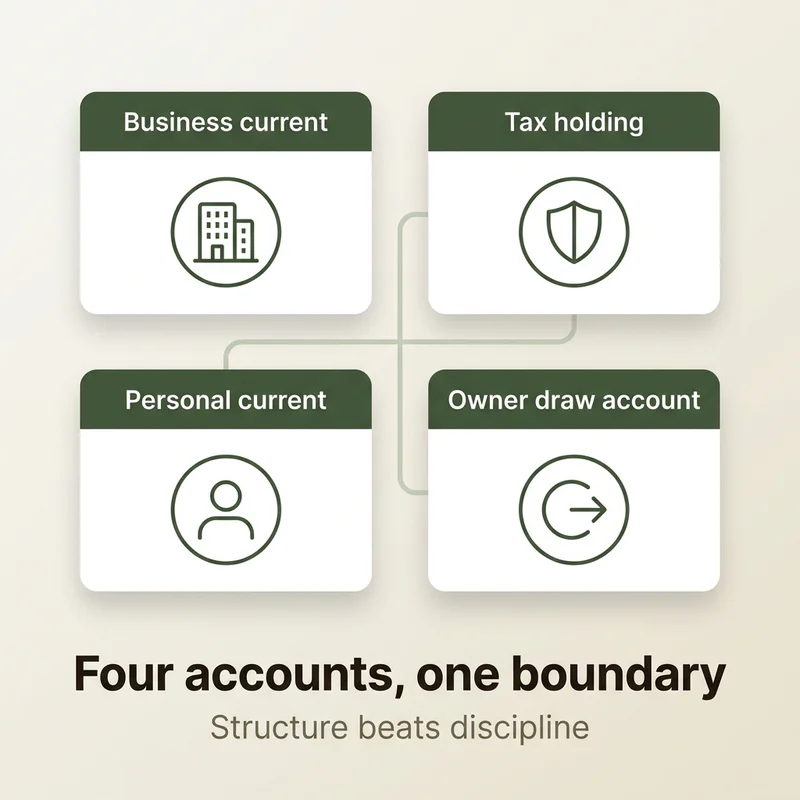
Separating business personal finances starts with the accounts
Owners usually try to solve this with discipline. Discipline fails on a Thursday evening when a supplier needs paying and the business card is declined.
Structure holds where discipline does not. Build the structure first, and the rules mostly enforce themselves.
The four accounts that end the argument
One business current account. Every dirham of revenue lands here. Every supplier payment leaves from here. Nothing personal touches it.One tax holding account. Move the VAT you collect, and a provision for corporate tax, out of the current account the moment it is collected or accrued. Money that is not yours to spend should not sit where you can spend it.
One personal current account. Your salary, your draws, and your own bills. Never a customer receipt, even a small one, even as a favour to a customer who already has your personal details.
One owner draw account in your ledger. This is a bookkeeping account, not a bank account, and it is the one most businesses skip. It is where every transfer from the company to you gets recorded, so both sides of the boundary stay visible.
The first three are a morning at the bank. The fourth is a line in your chart of accounts, and it is what makes the other three meaningful.
Owner draws are not an expense
Here is the error that shows up in more small-business books than almost any other.
You take AED 20,000 out of the company. Your bookkeeper, or the software, or you at midnight, codes it to miscellaneous expense. It looks harmless. It is not.
Coded as an expense, that AED 20,000 reduces reported profit by AED 20,000. Your income statement now shows a business that earned less than it did. Coded correctly as a draw, profit is untouched and the amount reduces your equity instead, because you have taken back part of what you already owned.
Same cash out of the same account. Two completely different sets of financial statements.
The expense version is the more dangerous one, and not only because it understates profit. It buries a personal transaction inside operating costs, which is exactly the pattern an auditor is trained to look for. If you are still building your instinct for which entry goes where, the accounting basics for non-accountants piece covers the ground underneath this.
Salary, draw, or dividend
These three are not interchangeable, and owners use the words as though they are.
A salary is remuneration for work, run through payroll, and deductible to the company. A draw is a withdrawal of capital and changes nothing on the income statement. A dividend is a distribution of profit after tax, and it is explicitly not deductible.
Pick the wrong label and you either overstate your deduction or hand yourself an adjustment later. Under UAE corporate tax, payments to an owner are also connected-person transactions, which means the amount has to be defensible as what an unrelated person would have been paid for the same work.

What mixing does to your deductions
This is where the cost turns into a number.
UAE corporate tax allows a deduction for expenditure incurred wholly and exclusively for the purposes of the business. Where a cost serves both business and personal purposes, only the identifiable business portion is deductible, determined on a fair and reasonable basis (PwC Worldwide Tax Summaries).
Read that phrase again: identifiable. A mixed credit card statement is not identifiable. It is one number covering two purposes, and the burden of splitting it sits with you.
Entertainment tightens this further, with customer and business partner costs capped at 50% of the amount incurred. VAT works on the same logic from a different direction. Input VAT is recoverable when the tax invoice is in the company's name, for a business purpose. An invoice with your personal name on it does not become a company invoice because the company paid for it.
None of this is exotic. It is the ordinary operation of a regime that taxes profit above AED 375,000 at 9% (PwC Worldwide Tax Summaries), and it turns every undocumented mixed expense into a real amount you pay for a second time. Several of the misconceptions that persist about UAE corporate tax start with exactly this habit.
The deduction you cannot evidence is not a deduction. It is an intention.
If your books are already mixed, start from a cut-off date
Most owners reading this are not starting clean, and the instinct is to go back and fix three years. Do not.
Pick a cut-off date, ideally the start of a month or a tax period. Open the accounts you are missing. From that date forward, nothing personal touches business money and nothing business touches personal money.
Then deal with history once, in a single pass. Every historic personal item comes out of expenses and goes to the owner draw or director's current account, so the balance owed in either direction is a stated figure rather than a rumour. Reconcile from the cut-off date forward and leave the older periods alone unless your accountant tells you otherwise.
One pass, one adjustment, one clean starting balance. That is far more defensible than a rolling clean-up that never finishes, and it gives your general ledger a date from which it starts telling the truth.
Separation is not about keeping the bookkeeper happy. It is about owning a set of numbers that survives the first person who asks a hard question about them.
---
Try Bizrah free for 14 days — no credit card needed.