Setting a Small Business Expense Policy Your Team Will Follow
Someone on your team just paid for a client lunch with a personal card. The receipt is in a jacket pocket. It surfaces six weeks later, faded, with no tax registration number printed on it, and by then the VAT on it is gone. A small business expense policy is what stops that from becoming the normal outcome.
Most owners in the Gulf file this under HR: fairness, per diems, a paragraph about reasonableness.
That is a misread. An expense policy is a tax document. Every claim your team submits either survives a review by the Federal Tax Authority or ZATCA, or it does not. The difference is usually settled months earlier by a rule nobody bothered to write down.
What belongs in a small business expense policy
A small business expense policy has to answer four questions, and only four:
Who may spend company money. Up to what amount, without asking first. What evidence has to come back with the claim. And by when.
Everything else is decoration. A team of eight does not need a twelve-page handbook with an appendix of approved hotel chains. It needs one page a new hire can read on a first morning and follow on a first afternoon.
That is the real test. A policy that cannot be followed from memory will not be followed at all.
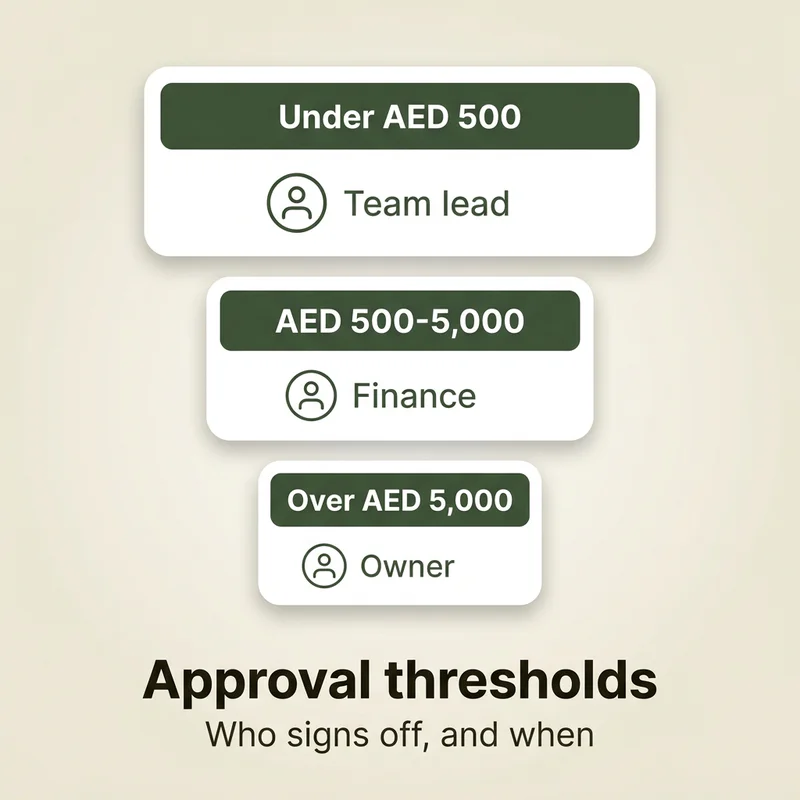
Approval thresholds are the whole policy
The part that tends to fail in practice is approval. Either everything needs the owner's signature, which turns one person into a bottleneck and quietly teaches the team to spend first and explain afterwards, or nothing does, and the first surprise arrives on a bank statement.
Thresholds fix this. They are also the only part of the policy that genuinely has to be numeric.
A three-tier model that survives a growing team
Below a small amount, the team lead approves. Call it AED 500. Taxis, a working lunch, a software seat, a replacement cable. Asking for more than a line manager here costs more in time than the spend is worth.
In the middle band, finance approves before the money moves. AED 500 to AED 5,000 is where a single decision starts to matter, and where unbudgeted subscriptions can quietly accumulate.
Above that, the owner approves. Not because the owner has better judgment about a laptop, but because spending at that level is a commitment, and commitments belong with whoever carries them.
Pick your own numbers. The structure matters more than the amounts, and the amounts should move as revenue does.
One clause worth adding is that standing approvals expire. A recurring vendor approved once two years ago is not approved forever. Re-approve every subscription annually, or the policy has a hole in it that widens every month.
A receipt is a tax document, not a formality
This is where most policies go soft. They ask for "a receipt" and stop there.
A card slip is not a receipt. A bank line item is not a receipt. What the business needs, in order to recover the VAT it already paid, is a valid tax invoice, and the requirements are specific.
What the UAE and Saudi rules actually require
In the UAE, a supplier may issue a simplified tax invoice where the customer is registered and the consideration does not exceed AED 10,000. Above that figure, a full tax invoice is required, carrying your own tax registration number. If someone hands over the company TRN at the till for a AED 14,000 purchase and walks out with a simplified slip, the recovery position is not defensible later.
Recovery is conditioned on holding that invoice, not on having spent the money. Records have to be kept for five years (Federal Tax Authority).
Saudi Arabia works the same way and keeps it longer. Input tax deduction requires a valid tax invoice from the supplier, and the standard retention period under the Implementing Regulations is six years (ZATCA Input Tax Deduction guideline).
So the evidence clause should not say "attach a receipt." It should say: attach a tax invoice showing the supplier's tax registration number, the date of supply, a description of what was bought, and the VAT amount stated separately. Anything thinner gets reimbursed to the employee and absorbed as a cost, which is acceptable, as long as it is a decision rather than a discovery.

The categories that will not survive a tax review
Some spending is real, sensible, and still not recoverable. Name these in the policy so nobody is surprised at the end of a quarter.
In Saudi Arabia, input VAT is blocked on entertainment, sporting and cultural services, on catering in hotels and restaurants, and on restricted motor vehicles where any private use is available. Article 50 of the Implementing Regulations is explicit about all four.
Under UAE corporate tax, entertainment for customers, suppliers and business partners is deductible at fifty percent of the amount incurred. Meals, accommodation, transport and admission fees for a client all sit in that bucket. The general test running underneath it is whether the cost was incurred wholly and exclusively for the business and is not capital in nature, which is one of the misconceptions that persist about UAE corporate tax.
The practical consequence is a coding decision, not a ban. Client entertainment still happens. It just needs its own expense category, so the half that is not deductible is visible before the return is filed rather than discovered during it.
The policy itself, in one page
| Category | Limit without prior approval | Evidence required | Approver |
| Travel and transport | AED 500 | Tax invoice | Team lead |
| Internal meals | AED 200 per head | Tax invoice | Team lead |
| Client entertainment | AED 1,000 | Tax invoice plus attendee names | Finance |
| Software and subscriptions | AED 500 per month | Tax invoice, re-approved annually | Finance |
| Equipment | AED 5,000 | Full tax invoice with company TRN | Owner |
| Anything above AED 5,000 | None | Full tax invoice with company TRN | Owner |
Six rows. Adapt the numbers, keep the shape.
Making the business expense claim process stick
Tie the submission deadline to the tax calendar, not to payroll. Claims are due before the VAT return period closes, because a claim that lands afterwards forces either an amended return or a silent write-off.
Code every claim at the moment it is submitted, not at month end. The person who bought the thing knows what it was for, and that knowledge decays fast. A claim form that asks for the category up front does most of the work, provided the categories match your chart of accounts.
Then keep one channel. Claims arriving by email, by message and on paper are three systems pretending to be one, and reconciling them costs more than most owners ever measure (the real cost of manual accounting).
Employee expense reimbursement is not a favour the business does for the team. It is the business buying something through a person, and the paperwork has to be as good as it would be on any other purchase.
An expense policy does not exist to stop people spending. It exists so that when they do, the money is recoverable, the record is defensible, and nobody has to remember what was agreed.
Try Bizrah free for 14 days — no credit card needed.