Startup Bookkeeping 101: Essential Tips Every Founder Needs
Most startups fail because they run out of cash, not because they run out of ideas. Good bookkeeping tells you which one is happening.
Why Bookkeeping Matters for Startups
Here is the mistake most founders make early on.
They assume bookkeeping is something you worry about later. After product-market fit. After the first customers. After you hire someone to "handle the books."
That is weak thinking.
By the time you realize your books are a mess, you have already missed tax deadlines, triggered compliance penalties, or lost investor confidence. In the GCC, where VAT registration is mandatory for most revenue thresholds and e-invoicing is now the law in Saudi Arabia and Egypt, messy books are not just an inconvenience. They are a liability.
Bookkeeping is not admin work. It is survival infrastructure.
If you do not know how much cash you have, how fast you are burning it, or what you owe in taxes, you are not running a business. You are gambling.
The good news is that startup bookkeeping does not require an accounting degree. It requires discipline and the right habits from day one.
The 7 Essential Bookkeeping Practices Every Startup Needs
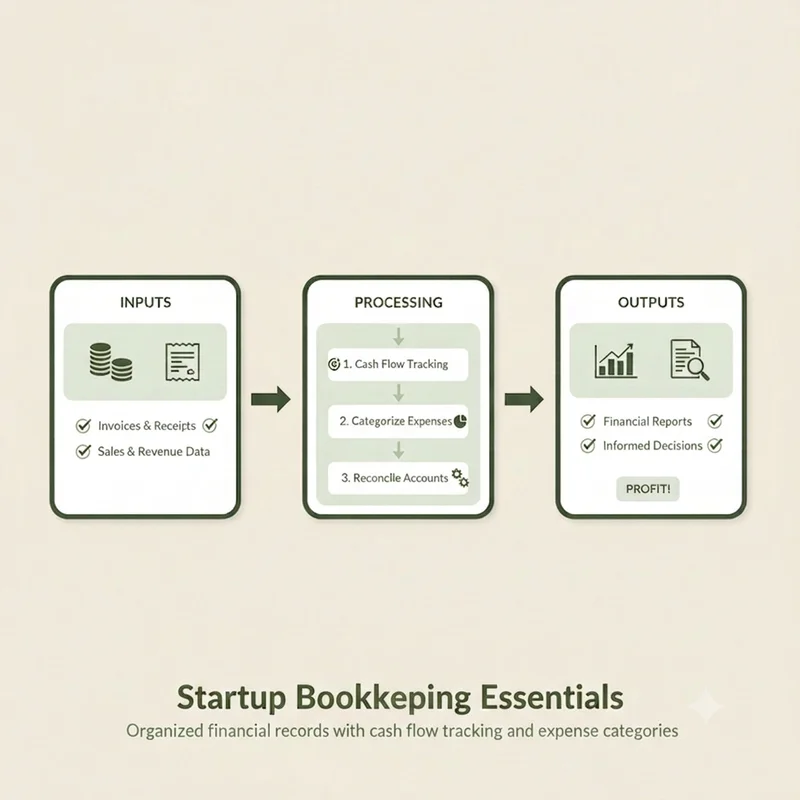
1. Separate Business and Personal Finances Immediately
Founders resist this for two reasons. First, it feels premature when you are bootstrapping. Second, it requires actually opening a business bank account, which sounds like paperwork.
Do it anyway.
Mixing personal and business transactions is the fastest way to destroy financial credibility. Investors will not take you seriously. Tax authorities will question your legitimacy. And you will spend hours trying to untangle which expenses belong to which entity.
In the GCC, separating business and personal finances is not optional if you are VAT-registered. The Federal Tax Authority in the UAE and ZATCA in Saudi Arabia expect clean records. A single bank account with mixed transactions will not pass an audit.
Open a dedicated business account. Use a separate card for business expenses. From day one.
2. Track Every Transaction From Day One
No "I will remember it later." No "I will log it at the end of the month."
Every transaction needs to be recorded when it happens. Date, amount, vendor, category, receipt.
If you are pre-revenue and running on founder savings, you still need to track spending. The expenses you incur before launch are just as real as the ones you incur after. They affect your burn rate. They determine how long your runway lasts. They matter.
At minimum, use a spreadsheet. Better yet, use accounting software that syncs with your bank account and categorizes transactions automatically. The point is not the tool. The point is the habit.
If you wait until tax season to compile your records, you have already failed.
3. Reconcile Your Bank Account Monthly
Reconciliation means comparing your accounting records to your bank statement and making sure they match.
It sounds tedious. It is not.
It takes 15 minutes per month and catches errors before they compound. A missing transaction. A duplicate charge. A refund that never posted. These mistakes pile up fast if you do not reconcile regularly.
In the GCC, where e-invoicing systems like ZATCA Phase 2 and the Egypt ETA portal require real-time invoice reporting, reconciliation is not optional. If your books do not match your invoices, you will trigger compliance flags.
Set a recurring calendar reminder. Last day of every month. Open your bank statement. Compare it to your records. Fix discrepancies immediately.
4. Understand Your Cash Flow, Not Just Your Revenue
Revenue does not equal cash.
You can have a great month in sales and still run out of money if customers pay late, expenses hit early, or inventory costs drain your account.
This is the burn rate mistake that kills startups. Founders celebrate revenue growth while ignoring the fact that cash in the bank is shrinking.
Tracking cash flow is simple. Start with your opening balance. Add all cash inflows (customer payments, investments, loans). Subtract all cash outflows (expenses, salaries, taxes). Your closing balance is what you actually have.
Do this weekly, not monthly. Cash flow changes fast in early-stage startups. If you only check once per month, you will miss warning signs.
For more on why cash flow matters more than profit, read our guide on the difference.
5. Keep Receipts and Documents Organized
In the GCC, keeping receipts is not a best practice. It is a legal requirement.
ZATCA in Saudi Arabia and the FTA in the UAE can audit your records at any time. If you cannot produce receipts for expenses you claimed, you will pay penalties and disallowed deductions.
What you need to keep:
- Sales invoices
- Purchase receipts
- Bank statements
- Supplier contracts
- Employee payroll records
Digital storage works. Cloud-based tools like Google Drive or accounting software with document upload features are fine. Just make sure you have backups.
Physical receipts fade over time. Scan or photograph them immediately after a transaction.
6. Know the Difference Between Revenue and Expenses
This sounds basic, but founders confuse it more than you would expect.
Revenue is money you earn from selling your product or service. Expenses are money you spend to operate the business.
But not all expenses are the same. You have:
- Operating expenses — rent, utilities, software subscriptions, marketing
- Cost of goods sold (COGS) — direct costs tied to producing your product (materials, labor, shipping)
- Capital expenditures — long-term investments like equipment or property that depreciate over time
Mixing these up skews your financial picture. COGS should be tracked separately because it directly impacts your gross margin. Capital expenditures are not immediate expenses; they are spread over the useful life of the asset.
If you are using spreadsheets, create separate columns for each category. If you are using software, tag transactions correctly from the start.
7. Prepare for Tax and Compliance From the Start

You do not wait until you are VAT-registered to start thinking about compliance. You prepare before you hit the threshold.
In the UAE, businesses must register for VAT once annual taxable revenue exceeds AED 375,000. In Saudi Arabia, the threshold is SAR 375,000. In Bahrain, it is BHD 37,500.
What happens when you cross that threshold without clean records? You scramble to retroactively classify transactions, dig up missing receipts, and file returns based on incomplete data. That is when mistakes happen. That is when penalties hit.
Even if you are pre-revenue, you should:
- Track expenses by category (to claim deductions later)
- Keep all receipts (for audit-readiness)
- Understand e-invoicing requirements (ZATCA Phase 2 in Saudi Arabia, ETA portal in Egypt)
Compliance is not something you add later. You build it into your bookkeeping system from day one.
Common Bookkeeping Mistakes Startups Make
Waiting too long to start. Founders justify this by saying "we do not have revenue yet." That does not matter. You have expenses. You are burning cash. That means you need bookkeeping.
Mixing personal and business finances. This destroys credibility with investors and complicates tax filing. It also makes it impossible to track business performance accurately.
Not reconciling regularly. Skipping monthly reconciliation means errors pile up. By the time you notice, you have months of cleanup work ahead of you.
Ignoring compliance deadlines. GCC authorities do not send reminders. If you miss a VAT filing deadline, you pay penalties. If you fail to register for e-invoicing when required, you face fines. Do not wait.
Not tracking cash flow separately. Revenue looks good on paper, but cash in the bank is what keeps you alive. If you only track revenue, you will miss the fact that you are running out of runway.
When to Upgrade From DIY to Professional Help
At some point, spreadsheets stop working.
You know it is time to upgrade when:
- You have multiple revenue streams (product sales, subscriptions, consulting)
- You are handling cross-border transactions or multi-currency payments
- You hit VAT registration thresholds and need to file quarterly returns
- You are preparing for fundraising or an audit and need investor-grade financials
For early-stage startups, bookkeeping software is the next step. Look for tools that sync with your bank account, automate transaction categorization, and handle VAT calculations.
If your business grows beyond that, hire a professional bookkeeper or accountant. The goal is not to do bookkeeping yourself forever. The goal is to have clean records that someone else can take over when the time comes.
For more on recognizing when you have outgrown your current setup, read our guide on the signs to watch for.
What to Do Next
If you are starting from scratch, here is where to begin.
Step 1: Open a dedicated business bank account. No more mixing personal and business transactions.
Step 2: Set up a tracking system. Spreadsheet or software, pick one and start logging every transaction immediately.
Step 3: Schedule monthly reconciliation on your calendar. Last day of every month. Non-negotiable.
Step 4: Review cash flow weekly, not monthly. Track opening balance, inflows, outflows, closing balance. Know your burn rate.
Bookkeeping is not glamorous. It does not close deals or build product features. But it keeps you alive long enough to figure out the rest.
That is what matters.
See how Bizrah handles startup bookkeeping with AI-powered automation and GCC-compliant workflows → Try Bizrah free