UAE e-invoicing is no longer a vague policy idea. It is moving toward implementation, and businesses that wait for the final deadline will put themselves in a weak position.
If you run a VAT-registered business in the UAE, this is not something to deal with at the last minute. Once enforcement starts, invoicing stops being just an internal finance process. It becomes part of your compliance infrastructure.
That changes the game.
This guide explains what UAE e-invoicing actually is, what is already known, what is still unclear, and what businesses should be doing now to prepare.
What e-invoicing in the UAE actually means
Let’s clear up the first misunderstanding.
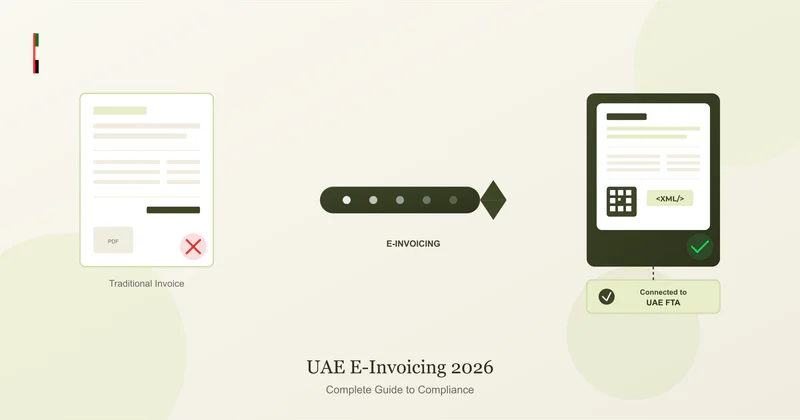
E-invoicing is not emailing a PDF invoice. It is not scanning a stamped invoice. And it is not just generating a digital file from your accounting system.
Real e-invoicing means issuing invoices in a structured digital format that systems can read automatically, validate, transmit, and audit. That usually means formats like XML or JSON, not static PDFs made for human reading. It also means stronger controls, less room for manual editing, and much tighter links between your invoicing process and the tax authority framework.
In other words, this is not a cosmetic change to invoicing. It is a process change.
What is already clear, and what is not
The UAE Ministry of Finance has confirmed that mandatory e-invoicing is coming, with rollout beginning from mid-2026. The current expectation is that the first phase will affect businesses invoicing government entities, with broader business-to-business requirements expected after that.
But here is where many businesses get lazy: they hear that some technical details are still pending and treat that as permission to wait.
That is weak thinking.
You do not need the final schema to know whether your current setup is fragile. You do not need the final API documentation to know whether your team still depends on spreadsheets, PDFs, fragmented approval flows, or incomplete customer tax data. And you do not need the final deadline to know that rushed compliance projects usually cost more and work worse.
So yes, some details are still developing. But the direction is clear enough to act now.
Why the UAE is implementing e-invoicing
This is not happening in isolation.
First, the UAE is aligning with a broader regional shift. Saudi Arabia has already moved ahead with ZATCA e-invoicing, and other GCC markets are moving in similar directions. The UAE is not likely to stay as the weak link in regional tax digitization.
Second, real-time or near-real-time invoice visibility gives tax authorities stronger control over VAT reporting, audit efficiency, and revenue leakage.
Third, this fits the UAE’s wider digital transformation agenda. E-invoicing is not just a tax control measure. It is part of a larger move toward more standardized, traceable, and paper-light business processes.
So businesses should stop reading this as a temporary compliance nuisance. It is part of a structural shift.
What your system will likely need
Even though final technical specifications are still pending, the broad shape is predictable.
Most businesses should expect requirements around:
Structured invoice data
Tax identifiers for seller and buyer
Unique invoice numbering
VAT treatment at line-item level
Digital signatures or equivalent integrity controls
QR-code style validation elements
Direct integration with government systems, likely through APIs
Either real-time clearance or near-real-time reporting workflows
This matters because many businesses are not actually system-ready, even if they think they are.
If your invoicing process still depends on manual edits, disconnected approvals, poor master data, or software that barely handles VAT correctly today, you do not have an e-invoicing problem later. You already have a systems problem now.
What businesses should do now
The right approach is not to panic. It is to prepare in order.
1. Audit your invoicing workflow
Map how invoices are created, reviewed, sent, corrected, and stored today. Most teams think they know their process until they try to document it. Then they discover exceptions, workarounds, and manual patches everywhere.
2. Pressure-test your software vendor
Do not ask vague questions like “Will you support e-invoicing?” Ask directly:
Will your product support UAE FTA e-invoicing when mandated, and what is your expected timeline?
If the answer is fuzzy, that is a signal.
3. Clean your data
E-invoicing makes weak data visible fast. Incorrect TRNs, missing legal names, inconsistent addresses, and poor VAT treatment logic will not stay hidden when invoices are validated systematically.
4. Review your entity structure
If you operate across multiple entities, branches, or GCC jurisdictions, complexity rises quickly. Cross-border businesses should prepare for overlapping compliance demands, not isolated ones.
5. Train the finance team early
This is not just a system rollout. It changes how errors are handled, how invoices move, and how exceptions get resolved. If finance teams only learn the new process at go-live, expect friction.
6. Use sandbox environments as soon as they are available
Teams that test early usually fix problems early. Teams that wait tend to discover them in production, with payment delays attached.
Which businesses are most exposed
Not all businesses face the same level of risk.
Freelancers and sole traders may not be first in line, depending on VAT status and rollout scope. But if they are VAT-registered, they should still move away from informal invoicing habits early.
SMBs are likely to feel the biggest shock. Many still rely on Excel, PDFs, or lightweight systems with limited compliance depth. These businesses are often too complex for manual workarounds, but not mature enough to absorb rushed change easily.
Multi-entity businesses and companies operating across GCC markets are even more exposed. They may have to manage more than one e-invoicing framework at once, which means local compliance choices start affecting regional operating efficiency.
The cost of waiting
This is where businesses fool themselves.
Waiting can feel rational when the final technical details are not published. But in practice, waiting often means:
Rushed vendor decisions
Poor integration work
Bad data surfacing too late
Higher implementation costs
Rejected invoices
Delayed payments
Compliance exposure
Possible penalties and audit risk
Preparing early is not about being overly cautious. It is about keeping options open while you still have room to choose properly.
Once the deadline is close, you are no longer making good decisions. You are making fast ones.
Final takeaway
UAE e-invoicing is coming. The final technical details will matter, but they are not the reason to delay.
The real work starts before that:
understanding your current process, cleaning your data, testing your systems, and choosing tools that can adapt to the compliance environment that is clearly forming.
If you wait for perfect certainty, you will prepare too late.
If you prepare now, you do not just reduce compliance risk. You give your business a cleaner, more resilient finance operation.
Try Bizrah for free and get ready for UAE e-invoicing with cleaner workflows, better data, and less manual work.