Your business is profitable on paper. But your bank account tells a different story.
What Working Capital Actually Means for Your Business
Working capital is not an accounting abstraction.
It is the cash and near-cash resources you have available to run your business day to day. It is what pays your team, your suppliers, and your rent while you wait for customers to pay you. If you run out of working capital, it does not matter if your income statement shows a profit. You cannot operate.
That is the part many business owners miss until it is too late.
When accountants talk about working capital, they mean the difference between your current assets and your current liabilities. But what matters for you is simpler: do you have enough liquid resources to cover your short-term obligations?
If the answer is no, you have a working capital problem. If the answer is yes, but barely, you have a working capital risk.
The Working Capital Formula (and What It Tells You)
The formula itself is straightforward:
Working Capital = Current Assets - Current Liabilities
But the components are where things get real.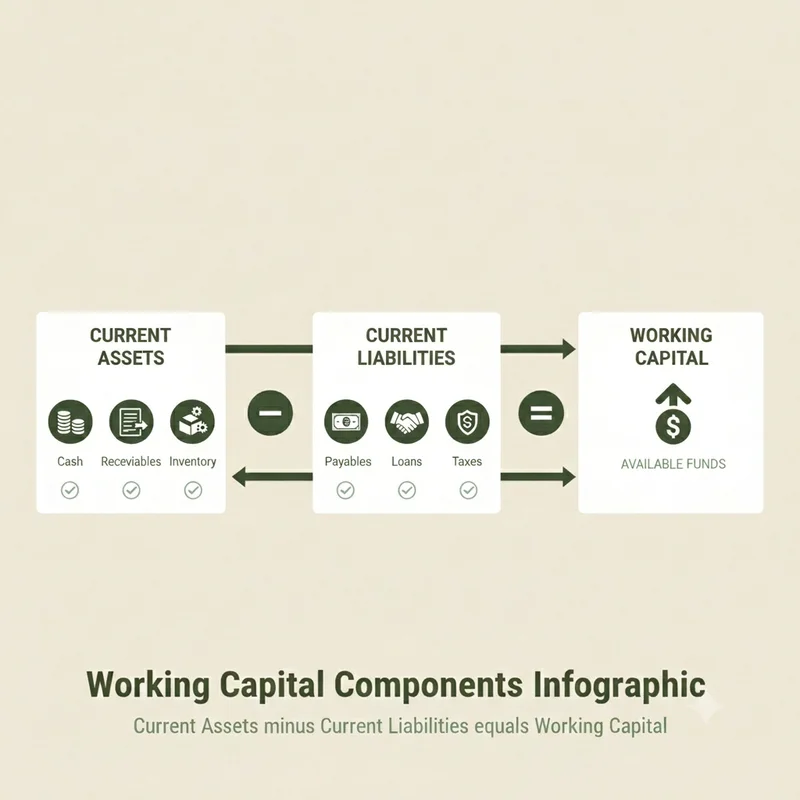
Current Assets: What You Can Convert to Cash Quickly
Your current assets are resources you can turn into cash within 12 months. For most GCC SMEs, this includes:
Cash and bank balances — the most liquid asset you have
Accounts receivable — invoices you have sent but not yet collected
Inventory — products you plan to sell (if you run a product business)
The problem is that not all current assets are equally liquid. Cash is immediate. Accounts receivable might take 60 to 90 days to collect in the GCC market. Inventory could sit for months if demand slows.
Current Liabilities: What You Owe in the Short Term
Your current liabilities are obligations due within 12 months:
Accounts payable — supplier invoices you need to pay
Short-term loans — any financing due within the year
Payroll and taxes — salaries, VAT, and other statutory payments
In the UAE and Saudi Arabia, VAT creates a specific working capital pressure. You pay VAT to suppliers immediately, but you collect VAT from customers on extended payment terms. That gap is a cash drain.
The Formula Explained
If your current assets are AED 500,000 and your current liabilities are AED 300,000, your working capital is AED 200,000. That is positive working capital. You have a cushion.
If your current assets are AED 300,000 and your current liabilities are AED 400,000, your working capital is negative AED 100,000. You owe more in the short term than you can access. That is a crisis.
A healthy working capital ratio for most GCC SMEs is between 1.2 and 2.0. That means your current assets should be 20 to 100 percent higher than your current liabilities. Below 1.0, you are in trouble. Above 3.0, you might be holding too much idle cash that could be reinvested.
Why GCC Businesses Struggle with Working Capital
The working capital challenges in the Gulf are structural, not just operational.
Extended payment terms are the norm. In many GCC markets, 60 to 90 day payment terms are standard, especially for government contracts or large corporate buyers. You deliver the work, send the invoice, and wait. Meanwhile, your own suppliers expect payment in 30 days or less.
Inventory ties up cash. If you run a retail or distribution business, inventory is capital sitting on a shelf. The longer it sits, the less liquidity you have. Seasonal businesses face even worse swings.
VAT creates a cash flow lag. In the UAE, you charge 5 percent VAT to customers and pay 5 percent VAT to suppliers. But if customers pay late, you still owe the VAT to the Federal Tax Authority on time. That creates a temporary cash shortfall every quarter.
Growth makes it worse. When you grow, you need to buy more inventory, hire more people, and extend more credit to customers. All of that consumes working capital before the revenue arrives. Many businesses fail not because they were unprofitable, but because they could not fund their own growth.
That is the paradox: success can kill you if your working capital does not keep up.
How to Improve Your Working Capital Position
Improving working capital is not about raising more money. It is about managing the cycle better.
Accelerate receivables. The faster you collect from customers, the better your working capital position. Send invoices the same day you deliver. Set up automated payment reminders. Offer a small discount for early payment if it speeds up collection by 30 days. In the GCC, businesses that use e-invoicing systems often see faster payment cycles because the process is cleaner and more traceable.
Negotiate better payment terms with suppliers. If you are paying suppliers in 30 days but waiting 90 days to get paid, you are financing your customers with your own cash. Push for 45 or 60 day terms with suppliers. If you have a strong payment history, most will accommodate.
Optimize inventory levels. Holding too much inventory locks up capital. Holding too little risks stockouts and lost sales. Track your inventory turnover ratio and aim to turn inventory at least 4 to 6 times per year for most product businesses. Slow-moving stock is dead capital.
Use accounting automation to reduce delays. Manual invoicing and reconciliation create delays. Every day of delay is a day you are not collecting. Businesses that automate invoicing and reconciliation often cut their accounts receivable cycle by 10 to 15 days, which directly improves working capital.
Monitor your working capital cycle weekly, not monthly. Do not wait for the month-end close to realize you have a cash problem. Track receivables, payables, and cash balances every week. If you see a trend forming, you have time to act.
For more on the basics of tracking these metrics, see Accounting for Non-Accountants: What Every GCC Business Owner Needs to Know.
What Happens When Working Capital Runs Out
When working capital dries up, the consequences are immediate and severe.
Missed payroll. Your team expects to be paid on time. If you cannot make payroll, trust collapses. Good employees leave. The ones who stay lose confidence.
Supplier defaults. If you cannot pay suppliers, they cut you off. No credit. No inventory. No way to fulfill customer orders. Your business grinds to a halt.
Lost customer trust. If you cannot deliver on time because suppliers cut you off, customers stop trusting you. Contracts get canceled. Future sales disappear.
Business closure. Even if your income statement shows profit, you can run out of cash and close. This happens more often than people think. A business can be profitable and insolvent at the same time if working capital collapses.
Consider a real scenario: a Saudi distribution company won a large government contract. Revenue surged. Profit margins looked strong. But the contract required 90 day payment terms. Meanwhile, the company had to pay suppliers upfront to fulfill the order. Working capital evaporated within 60 days. The business could not bridge the gap and shut down before the first payment arrived.
That is not a failure of business model. That is a failure of working capital management.
What to Do Next
Working capital is not a one-time fix. It is an ongoing discipline.
Track your working capital ratio monthly. Monitor your accounts receivable aging weekly. Know your cash runway at all times. If you see your working capital tightening, act before the problem becomes a crisis.
And if you are still managing this on spreadsheets, you are already behind.
See how Bizrah helps GCC businesses track working capital, cash flow, and receivables in real-time. Try Bizrah free for 14 days — no credit card needed.