If your business in Saudi Arabia is approaching ZATCA Phase 2, this is not something to treat like a last-minute compliance task.
That is the mistake many SMEs make.
They wait for the deadline, assume their current invoicing setup will somehow adapt, and only realize the real problem once invoices start failing, software gaps appear, or internal processes break under pressure.
ZATCA Phase 2 is not just another regulatory box to tick. It is a systems deadline. And businesses that still rely on manual work, weak processes, or software that is only “partly ready” are the ones most likely to feel the pain.
This guide explains what Phase 2 actually changes, who is affected, where SMEs usually struggle, and what to do before the deadline turns into operational chaos.
What ZATCA Phase 2 actually means
A lot of businesses still misunderstand this.
Phase 1 was mostly about generating compliant invoices.
Phase 2 is different.
Now the requirement is integration.
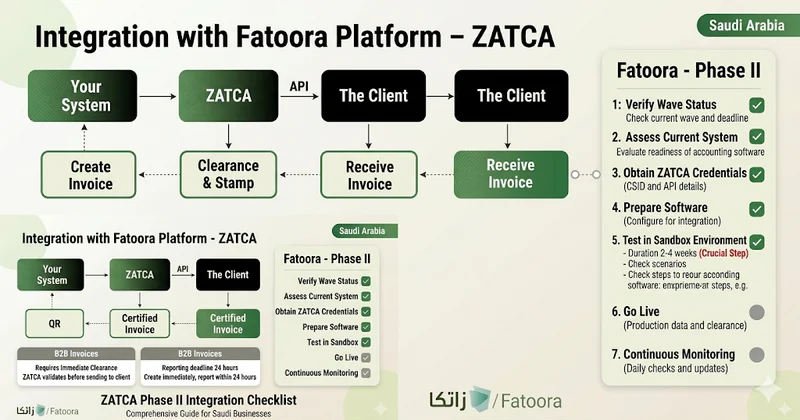
That means your invoicing system must connect directly to ZATCA’s Fatoora platform. For many invoices, especially B2B invoices, the system is no longer just generating the invoice locally. It must send invoice data to ZATCA, receive validation or clearance, and only then allow the invoice to move forward properly.So this is not a cosmetic change to invoice format. It is a change to workflow, software, controls, and timing.
That matters because many SMEs think they are close to ready when they are not. They may already generate invoices digitally, maybe even with QR codes, but that does not mean they are ready for live integration, real-time clearance logic, credential handling, error management, and production monitoring.
Why SMEs struggle with Phase 2
The problem is usually not the regulation itself.
The problem is everything the regulation exposes.
Phase 2 quickly reveals whether a business has:
Software that is actually compliant, not just marketed that way
Structured invoice data
Correct VAT setup
Clean customer records
Clear invoice numbering
Someone responsible for handling failed submissions
Enough process discipline to work with real-time validation
This is why SMEs often feel more pain than larger companies. Big companies have complexity, yes. But many SMEs have fragility. They run on workarounds, partial automation, vendor assumptions, and finance teams carrying too much of the process manually.
That works until integration becomes mandatory.
Then the hidden mess becomes visible.
Who needs to comply and when
ZATCA is rolling out Phase 2 in waves based on annual taxable revenue. Businesses receive notifications and deadlines tied to their revenue bracket. As of March 2026, businesses above 3 million SAR have already been included, with smaller businesses expected in future waves.
But many smaller businesses make a bad assumption here:
“If we have not been notified yet, we still have time.”
Maybe. But that is not the right conclusion.
The better conclusion is:
“If we have not been notified yet, this is our chance to prepare before the deadline creates pressure.”
That is a very different mindset.
The part many businesses underestimate
The hardest part of Phase 2 is usually not getting the rule.
It is getting the operation right.
On paper, the steps look manageable:
check your wave, confirm your software, get credentials, configure the system, test in sandbox, go live.
In reality, SMEs usually get stuck in one of four places:
1. Software readiness is overstated
A vendor says they “support ZATCA,” but that can mean many things. It may mean Phase 1 only. It may mean partial support. It may mean support exists, but needs extra modules, extra setup, or external help.
2. Data quality is weaker than expected
VAT numbers, Arabic names, addresses, invoice sequences, exemption logic, and line-item treatment all become more important when invoices are validated systematically. Weak data stops being a quiet issue and becomes a visible one.
3. Teams do not know how to handle failures
What happens when clearance fails? What happens when authentication breaks, the certificate expires, or the API times out? Many SMEs do not have a real answer until it happens.
4. Testing starts too late
Businesses often test only when the deadline is close. That is when every issue becomes urgent, expensive, and stressful.
What SMEs should do now
The right response is not panic. It is order.
1. Verify your actual obligation
Log into the Fatoora portal, check your notification status, and confirm your deadline and invoice types. Do not rely on assumptions or secondhand advice.
2. Pressure-test your vendor
Ask direct questions:
Are you certified for Phase 2?
Do you support both clearance and reporting flows?
What is included, and what requires extra setup?
How do you handle failures and retries?
What happens if ZATCA is unavailable?
If the answer is vague, that is already an answer.
3. Fix your master data
This is unglamorous, but critical. Correct VAT numbers. Clean customer records. Review Arabic fields. Remove gaps in invoice numbering. Fix exemption and VAT category logic.
4. Get credentials early
Do not leave CSID setup, certificate handling, and onboarding to the last moment. Credentials are not a detail. They are part of the rollout path.
5. Test in sandbox properly
Not once. Properly. Test standard invoices, simplified invoices, credit notes, edge cases, API failures, and real business scenarios. The businesses that test only the happy path are usually the ones that fail in production.
6. Plan post-go-live monitoring
Going live is not the end. Someone needs to watch what happens after go-live: failed clearance, rejected payloads, expired certificates, reconciliation gaps, and operational exceptions.
The real cost of waiting

This is where many SMEs fool themselves.
They think delaying preparation saves effort.
Usually it just delays the effort until it becomes more expensive.
Waiting often leads to:
Rushed software decisions
Weak implementation support
Poor testing
Rejected invoices
Delayed billing or collections
Internal firefighting
Higher compliance risk
Avoidable penalties
That is the pattern.
Not because businesses are careless, but because once the deadline is close, they stop making good decisions. They start making fast decisions.
And fast decisions in compliance infrastructure are rarely the cheapest ones.
What this really is
ZATCA Phase 2 is often framed as an invoicing mandate.
That is true, but incomplete.
For SMEs, it is really a maturity test.
It tests whether your finance operation can run on structured systems instead of patchwork workarounds. It tests whether your invoicing process is designed, or just tolerated. It tests whether your software stack is ready for compliance under real conditions, not just in sales demos.
That is why some businesses adapt smoothly and others struggle badly.
It is not only about size. It is about operational discipline.
Final takeaway
ZATCA Phase 2 is not something SMEs should prepare for at the edge of the deadline.
By then, the risk is no longer theoretical. It is operational.
The businesses that will handle this well are the ones that move early, test properly, clean their data, challenge their vendors, and treat integration as a real systems project.
The businesses that wait will likely say the same thing many companies say before a preventable mess:
“We thought we still had more time.”
Try Bizrah for free .