Cash Flow vs. Profit: Why One Matters More for Your Business Survival
You can show a profit every month and still not be able to pay your staff on Friday.
The Business That Was Profitable and Still Shut Down
Imagine a small trading company in Riyadh. Deals are closing, revenue is climbing, and the books show a profit. Everything seems fine.
Then Thursday arrives. Payroll is due. Rent is due. A supplier invoice is overdue. The bank account holds SAR 4,000. The business owes SAR 60,000 in the next 72 hours.
That business is not struggling. That business is finished.
This scenario is not hypothetical. It is the most common way small businesses in the GCC fail. Not due to a lack of sales or customers, but because the money is not there when it is needed.
The root problem? Confusing profit with cash flow.
What Profit Actually Tells You (And What It Hides)
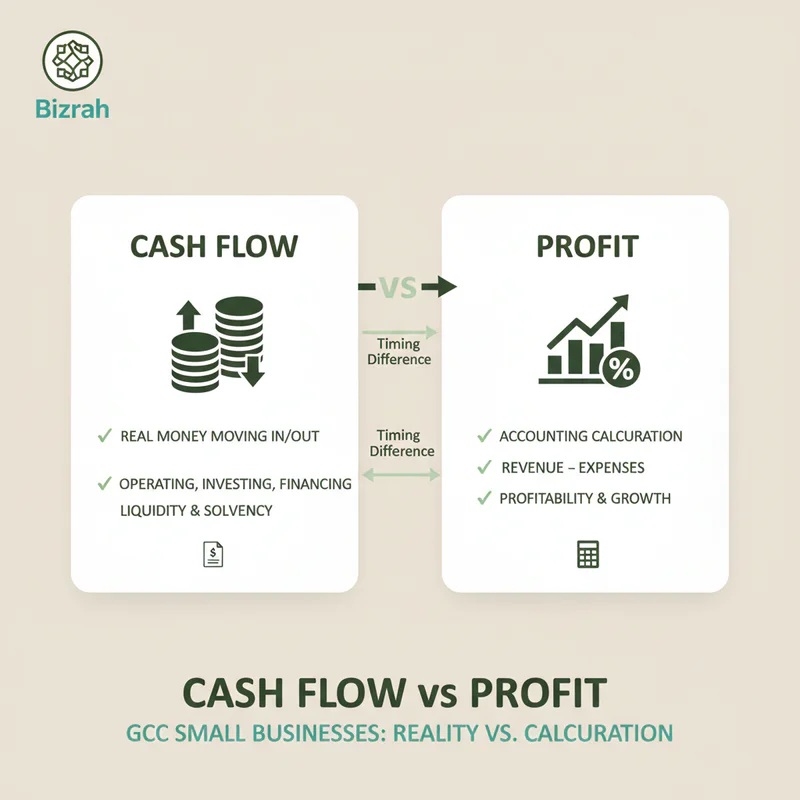
Profit is a calculation: revenue minus costs over a period. It indicates whether your business model works in theory.
That last word matters: theory.
Profit is a Backward-Looking Number
When your accountant says "you made a profit of SAR 30,000 this month," they are telling you what happened. They are not telling you what is in your account. They are not telling you whether you can pay your bills tomorrow.
Profit is recorded when a sale is made, not when cash arrives. Invoice a client for SAR 50,000 on the 28th, and that SAR 50,000 appears as revenue, regardless of whether the client pays in 7 days or 90 days.
Your books look good. Your bank account does not match.
The Accrual Accounting Trap
Most accounting systems, including the ones your accountant uses, run on accrual accounting: income is recognized when earned, expenses are recognized when incurred, not when money actually changes hands.
This method provides a real picture of the business over time. But it also creates a gap.
A profitable P&L can coexist with an empty bank account. The better your business grows, the more common this gap becomes. More sales mean more outstanding invoices. More outstanding invoices mean more profit on paper and less cash in hand.
This is not unique to GCC businesses. But the region's dynamics make it worse. Payment terms in construction, retail, and government contracting in Saudi Arabia and the UAE often stretch to 60, 90, or even 120 days. You complete the work. You wait.
What Cash Flow Actually Tells You
Cash flow is not a calculation. It is a reality check.
Cash flow measures money actually moving in and out of your business. Not invoices issued. Not expenses accrued. Actual money. Cash received from customers. Cash paid to suppliers. Cash transferred to cover payroll. Cash sitting in the account at the end of the week.
The only question cash flow answers is this: can you pay your obligations when they come due?
That question is what keeps your business alive or kills it.
The Timing Problem That Kills Businesses
The gap between when you earn money and when you receive it is called a cash flow gap. Every business has one. The question is whether you can survive it.
Here is how it looks in practice. You purchase SAR 40,000 worth of inventory from a supplier, payable in 30 days. You sell that inventory to three customers, invoicing SAR 60,000 in total, with 60-day payment terms. On paper, you made SAR 20,000 in profit. In practice, you need SAR 40,000 in 30 days and will not receive SAR 60,000 for another 60.
That is a 30-day window where you owe more than you have coming in. If you do not have reserves to cover it, you have a crisis.
VAT timing adds another layer of pressure. In Saudi Arabia and the UAE, businesses collect VAT on behalf of the tax authority, hold it for weeks or months, and then remit it in one lump sum at the end of the quarter. During a growth phase, when you are collecting VAT on rising sales, a significant amount of cash sitting in your account is not yours. When remittance day comes, businesses that did not track this carefully discover they have spent money that was never theirs to spend.

Profit vs. Cash Flow: What Each Metric Actually Does
Profit is the long-term health check. Cash flow is the daily pulse.
A person can be healthy on a blood test and still collapse from dehydration. Your business can show a strong P&L and still not survive Thursday.
Three Cash Flow Mistakes GCC SMEs Make Every Quarter
Most cash flow problems do not come from bad luck. They come from predictable mistakes that repeat every quarter.
Mistake 1: Celebrating a profitable month while ignoring receivables.
You close a big month. The profit number looks strong. You feel good. But 70% of that month's revenue sits in outstanding invoices with 60-day terms. The celebration is premature. The cash has not arrived.
Mistake 2: Using cash flow to fund growth without modeling future commitments.
A business receives a large payment and takes it as a signal to expand: hire more staff, open a new location, buy equipment. They do not model what cash obligations are coming in the next 90 days. Three months later, they are scrambling.
Mistake 3: Not tracking both numbers separately.
Many small business owners in the GCC look at their bank balance and assume it reflects their profitability. It does not. A strong bank balance today can be the result of an advance payment that will need to be refunded. A low bank balance today can sit alongside a very profitable quarter. These are different numbers. Treat them as such.
What to Track and When
You do not need a complex system. You need consistency.
Every week:
- Bank balance
- Receivables due within 30 days (what clients owe you)
- Payables due within 30 days (what you owe suppliers, landlord, staff)
- Net position: will you have more coming in than going out?
Every month:
- Operating cash flow statement: what did actual cash movements look like?
- Days Sales Outstanding (DSO): how many days on average does it take customers to pay?
- If your DSO is longer than your payment terms, you have a growing problem.
Simple rule: if your DSO exceeds your stated payment terms by more than 15 days, your cash flow gap is widening. Act before it becomes a crisis.
The businesses that survive in the GCC are not always the most profitable. They are the ones that never run out of cash. Understanding the difference between these two numbers, and tracking both, is the first step toward building a business that can actually last.
For more on how GCC accounting software can help you track both metrics in real time, see why a native Arabic UX matters for MENA businesses.
See how Bizrah shows you both your cash position and your P&L in one place, so you always know where you really stand. Try Bizrah free for 14 days — no credit card needed.