Your accountant should not have to mentally translate the software before they can do their job.
When Your Software Does Not Speak Your Language
Most accounting platforms in the GCC are built for Western markets.
Designed in English. Left-to-right logic. Gregorian calendar defaults. Invoice templates made for the US or Europe, awkwardly adapted for Arabic-speaking markets.
The result? Quiet friction. Your accountant works in Arabic. Your customers expect Arabic invoices. Your VAT filings require Arabic fields. Yet, your software operates in English. Every day, your finance team translates the interface in their heads before they can work.
That is not a minor inconvenience. It is a productivity leak and a compliance risk that most businesses do not measure until something breaks.
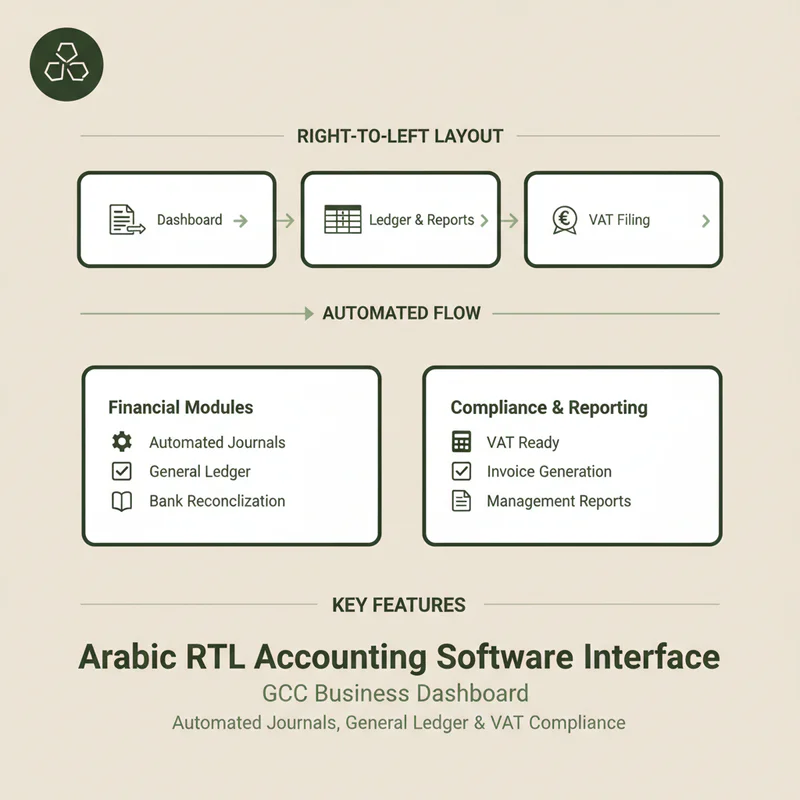
What Native Arabic UX Actually Means in Accounting Software
"Arabic support" is a phrase many software vendors throw around. It rarely means what you need.
More Than a Translation
A translated interface is the minimum — and often not enough.
Real Arabic accounting software means the entire application is designed around how Arabic speakers work:
- Right-to-left layout throughout. Tables, menus, dashboards, forms — everything flows in the correct direction.
- Arabic numerals and formatting conventions where appropriate, not Western numbers with Arabic labels.
- Hijri calendar support for businesses tracking dates in both systems.
- Invoice templates that carry your Arabic business name, addresses, and item descriptions — all formatted correctly for customer-facing documents.
- Compliance field labels in Arabic, because when your accountant fills a ZATCA or ETA form, the field name should match the official Arabic documentation.
This is the difference between software that was translated and software built for Arabic speakers from the start.
The Compliance Risk of Poorly Localized Software
Interface confusion is not just a workflow problem. In the GCC, it is a compliance risk.
Saudi Arabia's ZATCA requires specific Arabic content in e-invoices — buyer and seller names, item descriptions, and VAT summaries must meet format requirements. Egypt's ETA portal enforces similar standards. Navigating an English interface to fill Arabic-language compliance fields increases the chance of error.
A wrong field. A misread label. A data entry mistake submitted to ZATCA before anyone catches it.
These errors are not always visible immediately. They surface later — as rejected invoices, compliance notices, or penalties that trace back to a system your team never fully understood.
You can read more about ZATCA's current requirements in our breakdown of ZATCA Phase 2 and what the Fatoora checklist requires for every compliant invoice in Saudi Arabia.
The MENA Market Demands Local Fit
The GCC is not a secondary market for global software companies. It is one of the fastest-digitizing business regions in the world.
Saudi Vision 2030 and the UAE Digital Economy Strategy are not just government slogans. They are reshaping business operations — more digital infrastructure, more mandatory compliance systems, more expectation that your software keeps up.
And businesses in this environment are Arabic-speaking by default. Over 420 million Arabic speakers live across MENA. In the GCC specifically, daily business operations — internal memos, supplier conversations, customer invoices, government filings — happen in Arabic.
A software platform that treats Arabic as an afterthought asks businesses to adapt to the tool. That trade-off was acceptable when there were no local alternatives. It is not acceptable now.
The market is shifting toward platforms that start with local fit. Language is not a feature. It is the foundation.
What a Native Arabic UX Looks Like in Practice
If you have only used English-first accounting platforms, it is worth being specific about what good actually looks like.
A natively Arabic accounting platform gives your team Arabic invoicing by default — created, sent, and archived in Arabic, formatted correctly for RTL reading, with your Arabic business name and tax number in the right position. It produces Arabic VAT reports formatted for ZATCA and ETA submission, so the output matches what the authority expects to receive.
The dashboard defaults to Arabic. Error messages are in Arabic. Help content is in Arabic. When something goes wrong, your accountant reads the problem in their language — not in a language they have to parse first.
And because GCC business happens on WhatsApp, invoices go out in Arabic over WhatsApp — matching the language of the conversation.
Egypt has a specific localization layer too. The ETA portal, e-receipt requirements, and Arabic invoice standards for Egyptian businesses have their own rules — which we cover in detail in our Egypt ETA portal guide.
What to Check in Your Current Accounting Tool
If you are not sure whether your current software meets the bar, ask these questions.

Does the interface flip completely to RTL — or just the text? Can you create a fully Arabic customer invoice with correct formatting? Are ZATCA and ETA field names shown in Arabic? When something goes wrong, are the error messages in Arabic? Can your team record dates in the Hijri calendar? When you contact support, do they respond in Arabic?
If you answered no to more than two of those, your team is absorbing friction that should not exist.
The right tool does not require your accountant to be bilingual with their software. It works the way they work.
See how Bizrah handles Arabic-first accounting for GCC businesses — try it free for 14 days.