Do Small Businesses Need Accounting? The Honest Answer
The real question is not whether you need it. The question is when.
The Question Every Founder Asks
You started a business. You have a bank account, some invoices, maybe a few expenses.
Do you really need accounting?
The instinct is to say no. You are small. You are scrappy. You will figure it out later when you are bigger.
That is how most small business owners think.
And for a while, it works. A spreadsheet tracks income and expenses. Tax season arrives, you gather receipts, hand everything to an accountant, and hope for the best.
Then something changes.
You cross a revenue threshold. You hire your first employee. You apply for a loan.
Suddenly, the accountant is not just filing your taxes. They are rebuilding your entire financial history from a mess of bank statements and half-remembered transactions.
That rebuild costs more than doing it right from the start. Often, much more.
What Small Business Accounting Actually Means
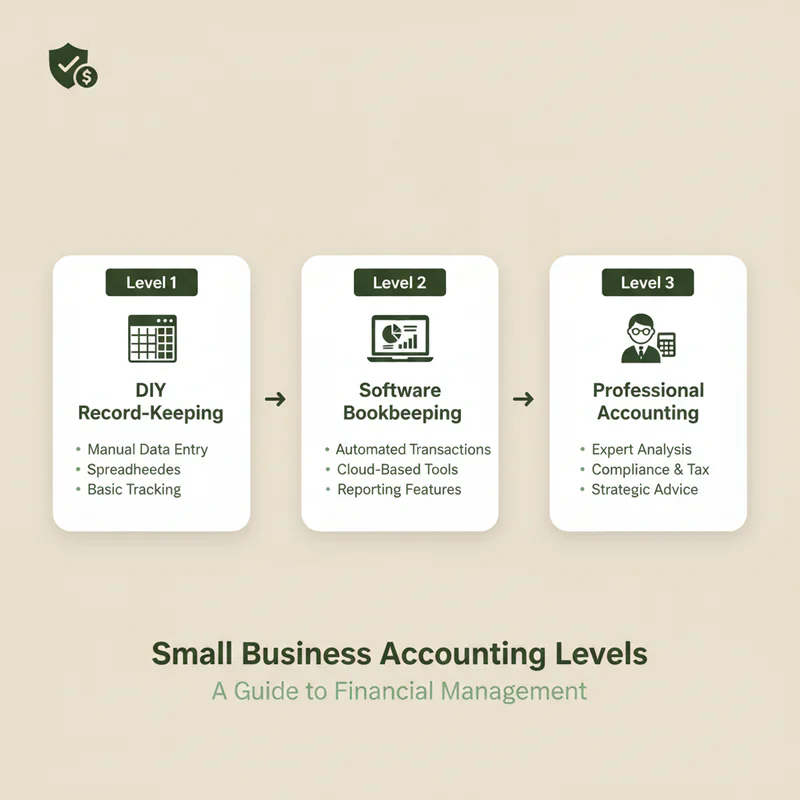
Accounting is not one thing.
It exists on a spectrum, and where you sit on that spectrum determines what you actually need.
Level 1: Basic Record-Keeping
This is tracking what comes in and what goes out.
If you are a freelancer with ten clients and twenty expenses per month, you can handle this yourself. A spreadsheet works. A simple app works. The goal is just to know where your money went.
At this level, you do not need an accountant. You need discipline.
Level 2: Bookkeeping With Compliance
Once your business has regular transactions, inventory, or employees, you need more than a list.
You need categories. You need your income and expenses organized in a way that produces accurate VAT returns, tracks receivables, and gives you a real picture of profitability.
This is where accounting software earns its value.
Accounting software organizes your transactions into a proper chart of accounts. Your general ledger becomes the foundation of every report you produce.
You might still do this yourself. But the system matters.
Level 3: Full Accounting and Tax Strategy
This is where you need a professional.
Complex revenue recognition, multi-entity structures, tax optimization, audit preparation.
If your business has reached this stage, you are not reading articles titled "Do I need accounting?" You already know.
When You Do Not Need Formal Accounting
Here is the honest part.
There is a phase where you genuinely do not need it.
If you are pre-revenue, testing an idea, and have no obligations to anyone, a spreadsheet is fine. If you are a solo freelancer with a handful of clients and no employees, basic record-keeping is enough.
The mistake is staying in this phase too long.
The moment your business has real traction, the rules change.
When You Absolutely Need It

VAT Registration Thresholds
In the UAE, VAT registration is mandatory once your taxable supplies exceed AED 375,000 over twelve months. In Saudi Arabia, the threshold is SAR 375,000.
Below that, you can register voluntarily. But once you cross the line, you must register.
And once you register, you must file. Quarterly. Accurately. With supporting documentation.
You cannot file a VAT return from memory.
You need records. You need a system that tracks input VAT on purchases and output VAT on sales. You need to know, at any moment, what you owe and what you can claim back.
This is not optional. This is the law.
Corporate Tax Is Now Real
The UAE introduced corporate tax in June 2023. Saudi Arabia has had Zakat and income tax requirements for years.
If your business earns above the thresholds, you will file a corporate tax return.
A corporate tax return requires financial statements. Financial statements require a general ledger. A general ledger requires organized, accurate records throughout the year.
You cannot produce these retroactively.
Or rather, you can, but it will cost you. Accountants charge premium rates to reconstruct books from chaos.
Investor and Loan Readiness
Banks want audited financials before approving business loans. Investors want clean books before writing checks.
Neither will accept "I have been tracking things in my head."
If you plan to raise capital or borrow money, your accounting needs to be in order before you start the conversation.
Not during. Before.
The Real Cost of Skipping It
The cost of not having proper accounting is not zero.
It shows up in unexpected ways.
Rebuild fees: Accountants charge more to fix messy books than to maintain clean ones. One business owner on a UAE small business forum described paying AED 1,500 per month for ongoing bookkeeping, while others paying per-filing ended up spending more annually because their accountants had to "rebuild everything from spreadsheets" before each VAT return.
Late filing penalties: Miss a VAT deadline in the UAE and you face a AED 1,000 penalty for the first offense. Repeated late filings escalate. In Saudi Arabia, ZATCA penalties can reach 25% of the unpaid tax.
Missed input VAT claims: If you are not tracking purchases properly, you are not claiming the VAT you paid. That is money you are entitled to recover, left on the table because your records do not support the claim.
Audit nightmares: When the tax authority asks for documentation, you need to produce it. If your records are incomplete or inconsistent, a routine audit becomes a serious problem.
What Actually Works for GCC Small Businesses
The answer is not "hire an expensive accountant" or "do everything yourself."
The answer is usually somewhere in between.
Software Plus Occasional Professional Help
Use accounting software to handle daily transactions, invoicing, and expense tracking. Let the software generate your VAT reports and maintain your general ledger.
Then bring in an accountant for quarterly reviews, annual filings, or specific questions.
This is the hybrid model that works for most small businesses in the region. The software handles volume. The accountant handles complexity.
Monthly Retainer Over Per-Filing
If you do work with an accountant, a monthly retainer is usually better than paying per-filing.
Retainers range from AED 500 to AED 1,500 per month for small businesses, depending on transaction volume and what is included.
The advantage is continuity. Your accountant knows your business because they are in your books every month. When filing deadlines arrive, there is no scramble. The numbers are already organized.
The Key Insight
The best setup is one where your accountant works inside your accounting software, not receiving exports from you.
They log in, see your live data, and catch issues before they become problems.
This eliminates the "rush to the accountant when VAT is due" pattern that creates errors and stress.
The Bottom Line
Do small businesses need accounting?
Eventually, yes. But the form it takes depends on where you are.
If you are just starting, discipline and a spreadsheet might be enough. If you are growing, software becomes essential. If you are crossing VAT thresholds, hiring employees, or planning to raise capital, professional help is not optional.
The real question is not whether to invest in accounting.
The question is whether to invest now, when it is cheap and simple, or later, when it is expensive and painful.
Most businesses choose later. The smart ones choose now.
Bizrah handles your bookkeeping, VAT tracking, and financial reports automatically, so you focus on your business. Try Bizrah free for 14 days