What is a General Ledger? A Plain-Language Guide With Examples
Every financial report your business produces — profit and loss, balance sheet, VAT return — traces back to one document.
The Foundation of Every Financial Record
You have heard the term. But can you explain what it actually does?
The general ledger is not just a report. It is not a quarterly spreadsheet. It is the master record of every financial transaction your business has ever made. It is organized so that any question about your finances can be answered by looking in one place.
When your accountant prepares your tax filing, they pull from the general ledger. When the tax authorities ask to verify your sales tax returns, the audit trail starts with the general ledger. When your bank requests financial statements before approving a loan, those statements are built from the general ledger.
Understanding what it is, how it works, and why it matters is not optional for a serious business owner. It is the difference between running your finances and being run by them.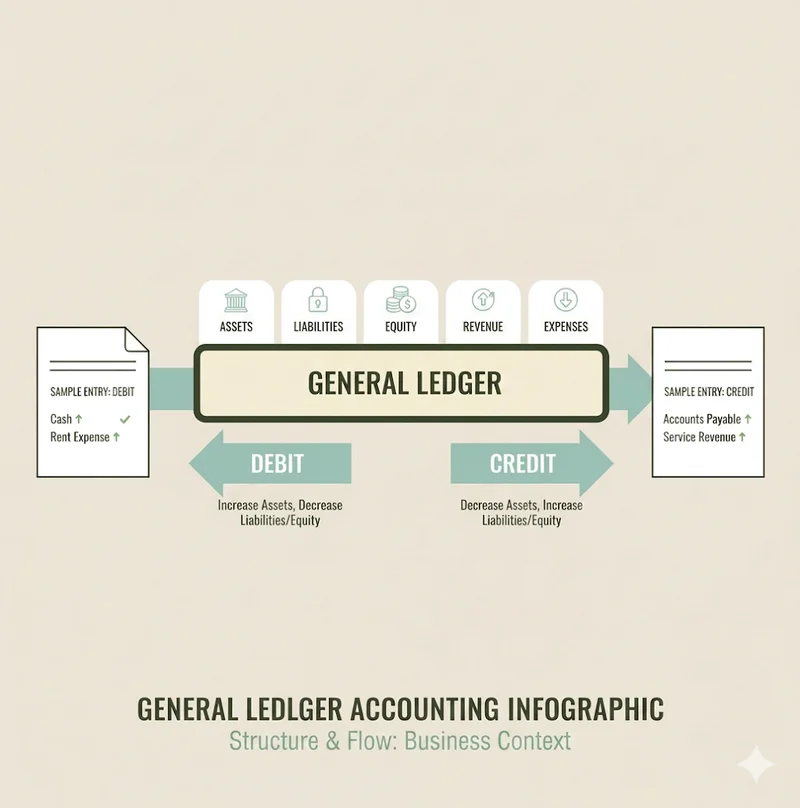
What a General Ledger Actually Is
A general ledger is a complete, organized record of every financial transaction a business has made, grouped by account type.
The key word is organized. A bank statement records transactions chronologically in one account. The general ledger records every transaction across every account — cash, receivables, inventory, liabilities, VAT, salaries, rent — in a structured system that keeps everything connected and balanced.
Think of it this way: your bank statement is one chapter. The general ledger is the entire book.
The Structure of a General Ledger
Every general ledger is built from accounts. Each account tracks a specific category of financial activity. Together, all the accounts form your chart of accounts.
A single ledger entry looks like this:
Each row records what happened, when, how much moved, and which direction. The running balance tells you where you stand at any moment.
Debits, Credits, and the Double-Entry System
This is the part that confuses most people. It does not need to.
Every transaction in a general ledger follows the double-entry rule: every entry affects two accounts simultaneously. One account gets a debit. One account gets a credit. The total always balances.
Here is a real example. You pay SAR 5,000 in rent:
Debit Rent Expense account — SAR 5,000 (the expense goes up)
Credit Cash account — SAR 5,000 (your cash goes down)
The business has spent money on rent. One account records the cost, one records the reduction in cash. Both are true. Both are recorded.
This is not accounting jargon. It is a logic system that makes errors visible. If the totals do not match, something is missing. That is the point.
The Five Account Types in a General Ledger
Every account in your general ledger belongs to one of five categories:
Every transaction you record will touch at least two of these categories. A sale creates revenue and increases your cash or receivables. A loan creates cash (asset) and a liability. Understanding which category each account belongs to is how you read a general ledger without an accounting degree.
A Real General Ledger Example (KSA Context)
Consider a consulting firm based in Riyadh in April. Three transactions this month:
Transaction 1 — Client payment received: SAR 23,000 (including 15% VAT)
Debit Cash account: SAR 23,000
Credit Revenue account: SAR 20,000
Credit VAT Payable account: SAR 3,000
The revenue is recognized. The VAT belongs to ZATCA, not to the business, so it goes into a liability account immediately.
Transaction 2 — Office rent paid: SAR 8,000
Debit Rent Expense account: SAR 8,000
Credit Cash account: SAR 8,000
Transaction 3 — VAT remittance to ZATCA: SAR 3,000
Debit VAT Payable account: SAR 3,000
Credit Cash account: SAR 3,000
At month end, the ledger is balanced. Revenue is SAR 20,000. Expenses are SAR 8,000. Profit is SAR 12,000. Cash reduced by SAR 11,000 (received SAR 23,000, paid SAR 8,000 rent and SAR 3,000 VAT). Every number traces back to a specific entry. Nothing is missing.
General Ledger vs. Other Financial Records
Business owners often confuse these terms. Here is the difference:
General ledger vs. journal: A journal is where transactions are first recorded, in chronological order. The general ledger is where those entries are posted and organized by account. The journal is the draft; the ledger is the final filing system.
General ledger vs. trial balance: A trial balance is extracted from the general ledger. It lists all accounts with their ending balances to confirm that total debits equal total credits. It is a summary check, not a record.
General ledger vs. bank statement: Your bank statement shows one account — your cash. The general ledger shows every account. A SAR 10,000 deposit appears once in your bank statement. In the general ledger, it appears in Cash (debit) and Revenue or Receivables (credit).
Why Your General Ledger Matters for KSA Compliance
In Saudi Arabia, ZATCA requires businesses to maintain complete accounting records for a minimum of ten years.
Your VAT return is built from your general ledger. The input VAT you claim on purchases and the output VAT you collected on sales both live in your ledger accounts. If those numbers are inconsistent, inaccurate, or missing, a tax audit becomes a serious problem rather than a routine check.
A clean, current general ledger does three things for a KSA business:
First, it makes every VAT filing accurate and fast. The numbers are already organized.
Second, it makes audits non-events. When ZATCA asks for records, you produce them immediately.
Third, it gives you real financial visibility. Your cash position, your outstanding receivables, your liabilities — all of it is current and correct, because the ledger is the source.
Understanding how cash flow relates to your accounting records becomes much clearer once you can read a general ledger. The two concepts are connected at every entry.
Bizrah maintains your general ledger automatically as you invoice customers and record expenses — no manual entries, no end-of-month scramble. Try Bizrah free for 14 days — no credit card needed.