You closed the deal. Good.
Now do not let the invoice create the problem.
If you run a business in Saudi Arabia, invoicing is no longer just an admin step at the end of a sale. Under ZATCA’s e-invoicing rules, a missing field is not a small formatting mistake. It can turn into a compliance issue, a rejected invoice, or a fine you did not plan for.
That is the part many smaller businesses still underestimate.
They focus on the sale, the payment, and the customer relationship, but treat the invoice like a simple receipt. That mindset is outdated now. In Saudi Arabia, the invoice itself is part of the compliance system.
So here is the practical checklist: the five things your invoice must include if you want to stay on the right side of ZATCA.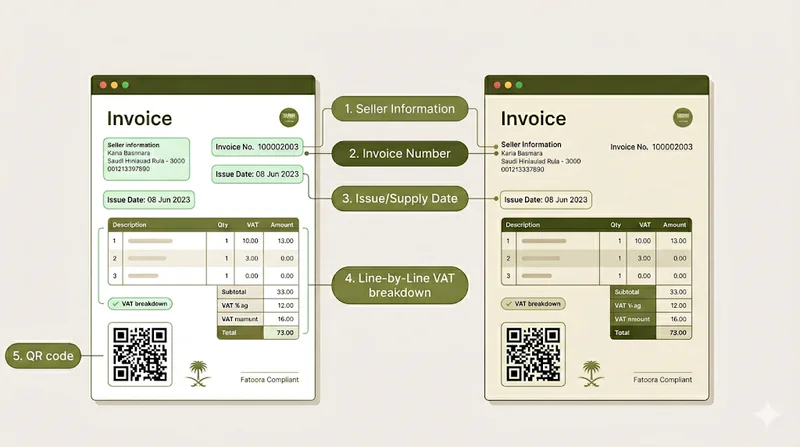
1. Full seller information, including your VAT number
Every invoice must clearly show who issued it.
That means your registered business name, address, and VAT registration number must be present on the invoice. This sounds basic, but many small businesses still issue informal invoices with only a trade name, a phone number, or bank details. That is not enough.
Why this matters is simple: ZATCA uses your VAT number to connect the invoice to your tax records. If that link is missing or wrong, the invoice stops being reliable from a compliance point of view.
This is one of those issues that feels minor until it is not.
2. A unique invoice number with no gaps
Your invoice number is not just there to help you stay organized.
It is part of the audit trail.
Each invoice needs a unique, sequential number. You cannot duplicate numbers, restart them casually, or leave unexplained gaps in the sequence. Businesses that still create invoices manually in Word or Excel often get caught here because numbering becomes inconsistent across branches, staff, or templates.
That may seem harmless internally. It does not look harmless from a compliance perspective.
If your numbering is inconsistent, it raises the obvious question: are all invoices actually being reported?
3. The issue date, and the supply date if it is different
Dates matter more than many businesses think.
Your invoice should include the issue date, and if the actual date of supply is different, that should appear too. This matters because VAT is tied to the date of supply, not just the day the invoice was created. Get that wrong, and you risk putting tax into the wrong period.
That is not just a paperwork issue. It creates a mismatch ZATCA can notice.
A lot of compliance problems are not dramatic. They are just small inconsistencies that add up into something visible.
4. A line-by-line VAT breakdown
This is where lazy invoicing usually gets exposed.
Each item or service on the invoice needs enough detail to stand on its own. That includes the description, quantity, unit price excluding VAT, VAT rate, VAT amount per line, and total including VAT. A lump sum plus one VAT total at the bottom is not the same thing.
And this is where many service businesses cut corners.
They write one broad line like “Consulting services” and add a total. That may feel efficient, but if different items have different tax treatment, or if the invoice lacks proper breakdown, it is not good enough.
The more your invoice hides detail, the weaker it becomes.
5. A QR code for simplified invoices, and increasingly for readiness overall
If you issue simplified tax invoices for B2C transactions, the QR code is mandatory. It must encode specific invoice data, including seller name, VAT number, invoice date and time, invoice total, and VAT amount. ZATCA inspectors can use that code to verify the invoice directly.
That means the QR code is not decorative. It is functional.
And even where businesses are still thinking in terms of “later phases,” that is weak planning. The businesses that add structure only when forced usually end up rushing. The smarter move is to build invoice readiness before the pressure hits.

What happens if you get it wrong?
This is where many businesses wake up too late.
According to the draft, ZATCA penalties for e-invoicing violations can start at SAR 5,000 per non-compliant invoice and escalate for repeated issues. There is a second problem too: non-compliant invoices may not support input VAT deduction claims, which means customers have a reason to reject them.
So the real cost is not just the fine.
It is the combination of:
compliance exposure
invoice rejection
payment friction
damaged trust with customers
avoidable operational mess
That stack adds up faster than most SMEs expect.
The quick checklist before you send any invoice
Before an invoice goes out, confirm that:
Seller name, address, and VAT number are included
The invoice number is unique and sequential
Issue date is present, and supply date appears if different
Each line item includes description, quantity, unit price, VAT rate, VAT amount, and total
The QR code is included where required
That is the minimum.
If your team is still checking these manually every single time, then the problem is no longer just compliance. It is process design.
Final takeaway
Saudi invoicing is no longer something businesses can improvise.
A compliant invoice now needs the right structure, the right sequence, the right tax detail, and the right validation elements. Miss one of them, and the invoice stops being just a document. It becomes a risk.
The businesses that handle this well are not the ones that memorize rules better. They are the ones that stop relying on manual checking and start building compliance into the workflow itself.
Try Bizrah free and make every invoice start with the right structure, so compliance is built in before the invoice is sent.