5 Signs Your Business Has Outgrown Your Current Spreadsheet Setup
The spreadsheet worked until it did not. Here is how to know when to move on.
The Spreadsheet Phase
Every business starts here.
You track income in one tab, expenses in another, maybe a third for invoices. It works. It feels manageable. You tell yourself you will upgrade "when things get bigger."
But bigger is not the threshold. Complexity is.
The moment your business crosses from simple tracking into actual financial management, the spreadsheet stops being a tool and becomes a bottleneck.
Most businesses realize this six months too late.
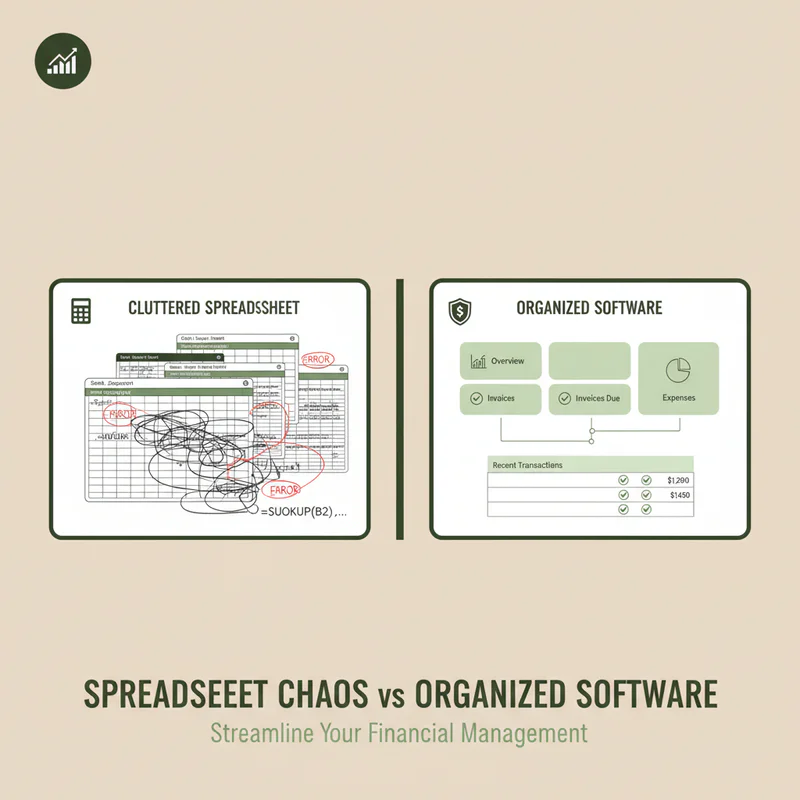
Sign 1: You Are Spending Hours Manually Entering the Same Data Multiple Times
You create an invoice in one spreadsheet. Then you copy the amount to your income tracker. Then you update your VAT calculations. Then you add it to your cash flow projection. Then you reconcile it against your bank statement.
The same transaction, entered five times.
And each entry is a chance for error. A typo in one place does not just break that report. It cascades. Your VAT return is off. Your profit calculation is wrong. Your cash flow forecast misleads you.
This is not a minor inconvenience. This is hours of your week spent on data entry that modern accounting software does automatically.
If you are re-entering the same information across multiple files, you are past the threshold.
Sign 2: You Cannot Answer "What Do I Owe?" or "What Am I Owed?" Without 30 Minutes of Digging
Someone asks how much cash is coming in next month. You cannot answer.
Not because the information does not exist. Because it is scattered. Receivables are in one file. Payables are in another. You have to open three spreadsheets, cross-reference dates, and hope you did not miss anything.
This is where cash flow visibility dies.
And in the GCC, this is not just inefficient. It is risky. VAT deadlines do not wait for you to hunt through files. Corporate tax filings require accurate numbers, not guesses supported by "I think I accounted for everything."
If you cannot produce a receivables aging report in under two minutes, your system is failing you.
Sign 3: VAT Filing Feels Like Reconstructing Ancient History
Every quarter, the same panic.
You open your bank statement. You scroll through hundreds of transactions. You try to remember which expenses had VAT, which did not, which supplier gave you a tax invoice, which forgot.
Then you manually calculate input VAT. Then output VAT. Then you cross-reference against your sales tracker. Then you hope your formula did not break somewhere along the way.
In the UAE, missing a VAT deadline means a AED 1,000 penalty on the first offense. In Saudi Arabia, ZATCA penalties can reach 25% of unpaid tax. And if your records are incomplete during an audit, the fines escalate.
You cannot afford to treat VAT compliance as a quarterly scramble. You need a system that tracks it automatically, transaction by transaction, so filing becomes a review, not a reconstruction.
If VAT season fills you with dread, you are overdue for software.
Sign 4: Multiple People Need Access, But You Are Emailing Spreadsheets Back and Forth
Your accountant asks for the latest file. You email it. They update something. They email it back. Meanwhile, you made other changes in your local copy.
Now there are two versions. Both labeled "Final." Neither is actually final.
This is not how financial records work.
You need version control. You need an audit trail. You need to know who changed what and when. Spreadsheets offer none of this.
And in the GCC compliance environment, this is not just messy. It is exposure. Tax authorities want clean, traceable records. "I think this is the right version" is not a defensible position during an audit.
If your file management strategy involves the word "Final" more than once, your system is broken.
Sign 5: You Realized Your "Financial Reports" Are Just Guesses Supported by Formulas You Hope Are Correct
You pull up your profit and loss spreadsheet. The numbers look reasonable. But are they right?
You scroll to the formula bar. A nested IF statement references cells in three other sheets. You do not remember writing it. You are afraid to touch it because it might break something else.
This is where confidence dies.
You cannot make decisions when you do not trust your data. You cannot pitch investors when your financials are "probably accurate." You cannot apply for a loan when your numbers come with an asterisk.
Banks want audited statements. Investors want clean books. Neither accepts "my spreadsheet says so."
If you cannot explain how your numbers were calculated without opening the file and tracing formulas, you do not have a financial system. You have a black box.

What Happens If You Ignore These Signs
Staying on spreadsheets past their useful life is not free. The cost shows up in ways you do not expect.
Missed VAT claims: If you are not tracking input VAT properly, you are leaving money on the table. Money you already paid, money you are entitled to recover, gone because your records do not support the claim.
Late filing penalties: AED 1,000 in the UAE for the first late VAT return. Penalties escalate with repeat offenses. In Saudi Arabia, ZATCA can penalize up to 25% of the unpaid tax.
Lost opportunities: That loan application rejected because your financials "need work." That investor who passed because they could not verify your numbers. That supplier who would not extend terms because your books looked unreliable.
Accountant rebuild fees: If you do eventually hire help, they will charge premium rates to clean up spreadsheet chaos. One UAE business owner described paying double for an accountant to "rebuild everything from scratch" versus maintaining clean books from the start.
The longer you wait, the more expensive the fix becomes.
When to Make the Switch
This is not about revenue.
You do not need to hit AED 1 million or SAR 500,000 before you deserve real accounting software. You need it the moment the spreadsheet becomes more work than the business it is supposed to track.
If two or more of these signs apply, you are past due.
The switch is not as disruptive as you think. Modern accounting platforms are built for SMEs, not enterprises. Setup takes hours, not weeks. And the time you save in the first month pays for the software.
What to Look For in Accounting Software
Essential Features for GCC Businesses
Not all accounting tools are built for GCC businesses. Look for:
- Arabic interface — not just translated labels, actual Arabic-first design
- Built-in VAT compliance — automatic tracking, not manual calculations
- E-invoicing integration — ZATCA for Saudi, ETA for Egypt, FTA-ready for UAE
- Multi-currency support — if you deal with cross-border clients
- Bank feeds — automatic transaction import, not CSV uploads
- Real-time reporting — see your numbers now, not after month-end close
- Accountant collaboration — they work inside the system, not receiving file exports
The best tool is one that fits your region. Not one designed for the US and adapted for the GCC.
The Bottom Line
Spreadsheets are tools. They are good at certain jobs. Tracking a few transactions per month is one of those jobs. Managing a growing business with VAT obligations, multiple clients, and real financial complexity is not.
If you are still on spreadsheets because "they are free," remember: your time is not free. Your compliance risk is not free. Your missed opportunities are not free.
The real cost of staying on spreadsheets is not the AED 200 per month you save on software. It is the AED 10,000 you pay your accountant to fix the mess later. It is the AED 1,000 penalty for a late VAT filing. It is the investor who passed because your numbers did not inspire confidence.
The smart move is not to wait until the pain becomes unbearable. The smart move is to switch before you need to.
Bizrah gives you real-time financials, automatic VAT tracking, and Arabic-first design built for GCC businesses. Try Bizrah free for 14 days