Understanding Burn Rate: A Founder's Guide to Extending Runway
You raised funding. You hired. You shipped product. Then you check your bank account and realize you have four months left.
That is the moment most founders wake up to burn rate.
By then, you are in survival mode. You are cutting costs, chasing revenue, and scrambling to raise another round before the runway ends. The stress is constant. The options are limited.
The mistake was not tracking burn rate from day one.
Burn rate is not just a metric for fundraising decks. It is the number that tells you whether your business will survive long enough to become profitable. If you do not know your burn rate, you do not know how long you have. And if you do not know how long you have, you cannot make rational decisions about hiring, product, or growth.
This article explains what burn rate is, how to calculate it, and most importantly, how to extend your runway when cash is tight.
What Is Burn Rate?
Burn rate is the rate at which your company spends cash before reaching profitability. It tells you how fast you are consuming your cash reserves.
If you have 500,000 dirhams in the bank and you spend 100,000 per month, your burn rate is 100,000 per month. At that rate, you have five months of runway before you run out of money.
That is the core idea. Burn rate measures cash outflow. Runway measures how long you can survive at your current burn rate.
There are two types of burn rate:
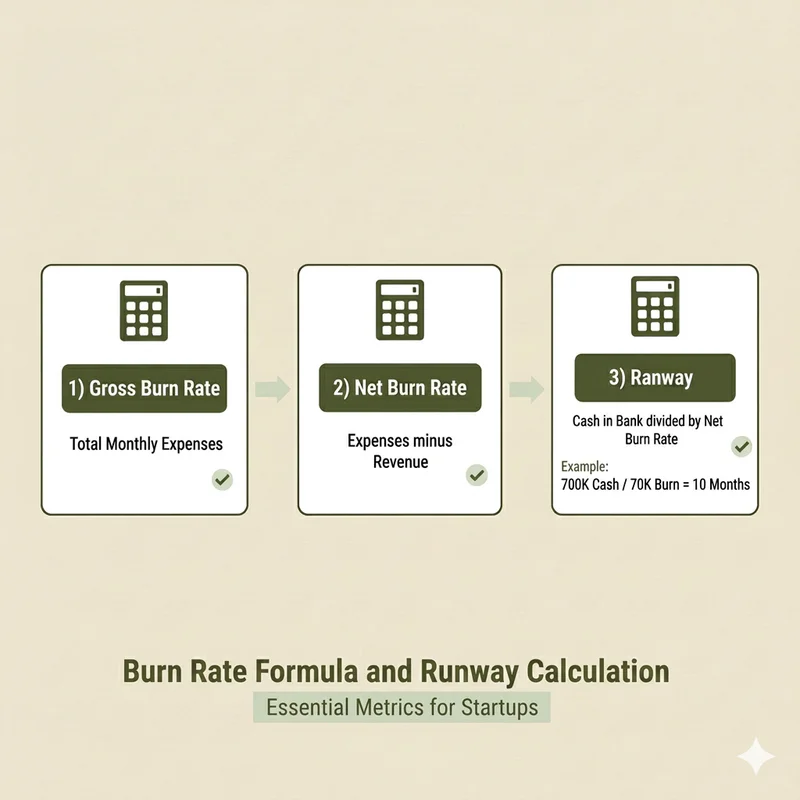
Gross burn rate: Total monthly operating expenses (how much you spend)
Net burn rate: Total expenses minus total revenue (how much cash you actually consume)
Net burn rate is more useful because it accounts for the revenue you are earning. If you spend 100,000 per month but earn 30,000, your net burn rate is 70,000. That is the real number that determines your runway.
Example: A SaaS startup in Dubai spends 120,000 dirhams per month on salaries, office rent, cloud hosting, and marketing. It earns 40,000 dirhams per month from subscriptions. The gross burn rate is 120,000. The net burn rate is 80,000. With 800,000 in the bank, the startup has 10 months of runway.
Why does this matter? Because if you do not track burn rate, you will not see the cliff until you are already falling.
How to Calculate Burn Rate
Gross Burn Rate
Gross burn rate is simple: add up all your monthly operating expenses.
Formula: Total monthly operating expenses
Includes:
- Salaries and payroll taxes
- Office rent and utilities
- Software subscriptions (hosting, tools, SaaS products)
- Marketing spend (ads, campaigns, agencies)
- Travel and meals
- Professional services (legal, accounting)
Does NOT include:
- One-time capital expenses (buying equipment, furniture)
- Loan repayments (these are not operating expenses)
- Founder equity (if you are not paying yourself, it does not count as burn)
Example: A startup spends:
- 60,000 on salaries
- 10,000 on rent
- 5,000 on software
- 15,000 on marketing
- 5,000 on miscellaneous
Gross burn rate = 95,000 per month
Net Burn Rate
Net burn rate is more useful because it accounts for revenue.
Formula: Total monthly expenses - Total monthly revenue
If you are earning revenue, your net burn rate will be lower than your gross burn rate. If you are pre-revenue, your net burn rate equals your gross burn rate.
Example: Same startup as above, but now earning 25,000 per month from customers.
- Gross burn rate: 95,000
- Revenue: 25,000
- Net burn rate: 70,000 per month
This is the number that matters. This is how much cash you are actually consuming every month.
Runway Calculation
Runway is how many months you can survive at your current burn rate.
Formula: Cash in bank ÷ Net burn rate = Months of runway
Example: You have 700,000 dirhams in the bank. Your net burn rate is 70,000 per month.
- Runway = 700,000 ÷ 70,000 = 10 months
Ten months means you have ten months to either:
1. Become profitable (reduce net burn to zero)
2. Raise more funding
3. Shut down
If you have less than six months of runway, you are in the danger zone. Raising funding takes three to six months minimum. If you wait until you have four months left, it is already too late.
Why Founders Get Burn Rate Wrong
Mistake 1: Not Tracking Burn Rate Monthly
Most founders only check their burn rate when they are worried about cash. By then, it is too late to make strategic changes.
You should know your exact burn rate every month. If it is trending up, you need to know why. If it is higher than you projected, you need to adjust.
Mistake 2: Ignoring One-Time Expenses
You hire a lawyer for 20,000 to draft contracts. That spikes your burn rate for one month. But it is not recurring.
Do not let one-time expenses distort your view of sustainable burn rate. Track them separately. Your runway calculation should be based on recurring monthly burn, not one-time spikes.
Mistake 3: Assuming Revenue Growth Will Reduce Burn
Many founders think: "Once we hit 50K in monthly revenue, our burn will drop."
Not usually. In the early stages, revenue growth often increases burn. You hire salespeople. You spend on marketing. You invest in customer success. Revenue goes up, but so does burn.
Burn only decreases when you hit economies of scale or when you deliberately cut costs. Revenue alone does not fix burn rate.
Mistake 4: Confusing Profitability with Cash Flow
Profitability means revenue exceeds expenses on your income statement. Positive cash flow means cash coming in exceeds cash going out.
They are not the same. You can be profitable on paper but still burn cash if customers pay you 60 days late or if you need to buy inventory upfront.
Burn rate is about cash, not profit. Track cash. Not accounting profit.
Mistake 5: Not Forecasting Burn Rate Changes
Your burn rate today is not your burn rate in three months.
If you plan to hire three people next quarter, your burn will jump. If you are launching a marketing campaign, burn will spike. If a big customer churns, revenue drops and net burn increases.
Forecast your burn rate for the next 6-12 months. Do not just look at today's number.
What Is a "Good" Burn Rate?
There is no universal number. Burn rate depends on your stage, business model, and market.
Benchmarks by Stage
Pre-revenue (bootstrapped): Keep burn under 50,000 per month if possible. The lower, the better. You want maximum runway to find product-market fit.
Early revenue (0-50K MRR): Aim to reach profitability within 12 months from your current runway. If you have 12 months of cash left, you should be break-even by month 12 or earlier.
Growth stage (funded): Burn is acceptable as long as you have a clear path to profitability and 18+ months of runway. Investors will tolerate burn if you are hitting growth milestones.
Red Flags
Burn rate increasing faster than revenue: This means unit economics are getting worse, not better.
Less than 6 months runway with no funding lined up: You are in danger. Cut costs immediately or accelerate fundraising.
High burn with no clear milestones: If you cannot explain what the burn is achieving (users, revenue, product milestones), it is waste.
How to Extend Runway (Practical Tactics)

When runway is short, you have two levers: reduce burn or increase revenue. Revenue takes time. Burn reduction is immediate.
1. Cut Non-Essential Spend Immediately
Go through every line item in your expenses. Ask: "If we cut this today, would the business stop working?"
If the answer is no, cut it.
Examples:
- Cancel unused software subscriptions
- Move to a smaller office or go fully remote
- Pause paid marketing campaigns that are not generating immediate ROI
- Defer hiring plans
This is not about long-term optimization. This is about survival. You can always turn things back on later.
2. Shift Fixed Costs to Variable Costs
Fixed costs burn cash every month whether you use them or not. Variable costs scale with usage.
Examples:
- Replace full-time hires with freelancers or part-time contractors
- Switch from annual software contracts to monthly plans (yes, it costs more per month, but you can cancel anytime)
- Use pay-as-you-go infrastructure instead of reserved capacity
Variable costs give you flexibility. Fixed costs lock you in.
3. Increase Prices
If you have revenue, raising prices is the fastest way to reduce net burn.
A 20 percent price increase on existing customers can add tens of thousands in monthly revenue with zero additional cost. That drops your net burn immediately.
Most founders under-price in the early days. If you are burning cash, test higher pricing. You might lose a few customers, but the ones who stay will pay more.
4. Focus on High-Conversion Channels
Cut all marketing experiments. Stop testing new channels. Stop running brand campaigns.
Focus 100 percent of your marketing budget on the one or two channels that actually convert customers. If paid search works, do only paid search. If outbound works, do only outbound.
Experimentation is expensive. Survival mode means doubling down on what works.
5. Negotiate Payment Terms
Extend how long you have to pay vendors. Collect from customers faster.
Ask vendors for 60-day or 90-day payment terms instead of 30 days. That keeps cash in your account longer.
Invoice customers immediately. Follow up on overdue invoices. Offer discounts for upfront annual payments.
Every week you keep cash in your account adds to your runway.
6. Defer Founder Salaries
If you have less than nine months of runway, founders should consider cutting or deferring their salaries.
This is painful. But it buys time. If deferring 30,000 per month in founder salaries adds three months of runway, that might be the difference between survival and shutdown.
You can always pay yourself back later when cash flow improves.
When High Burn Rate Is Acceptable
Burn rate is not always bad. In some cases, high burn is the right strategy.
When You Have Secured Funding and Long Runway
If you just raised a Series A and have 24 months of runway, burning 200,000 per month might be fine. You are investing in growth. You have time.
When Burn Is Tied to Specific Milestones
If you are spending to hit clear targets (10,000 users, 100,000 in MRR, launch in three new markets), and those targets unlock the next funding round, high burn can be justified.
But only if the milestones are realistic and the timeline is clear.
When You Are in a Land Grab Market
In some markets, speed wins. If competitors are raising capital and moving fast, under-investing means losing market share permanently.
In those cases, high burn to capture the market early can be the right move. But you need investors who explicitly approve this strategy.
When Investors Approve the Burn Rate
If your board and investors have reviewed your burn rate, understand the plan, and approved the spending, you are fine.
The problem is when founders burn without alignment. If investors think you should be at 80K/month and you are at 150K, you have a problem.
Always align on burn rate with your investors. Surprises kill trust.
The Bottom Line
Burn rate is not a vanity metric. It is survival data.
If you do not know your burn rate, calculate it today. If you do not know your runway, calculate it today. If you have less than six months, take action today.
Founders who survive are not the ones with the best product or the most funding. They are the ones who know their numbers and make decisions before the runway ends.
For more on cash flow management, see Cash Flow vs. Profit. New to accounting? Start with Do Small Businesses Need Accounting?
Track your burn rate and cash runway in real-time with Bizrah → Start free trial