The Future of Accounting Is Human-AI Collaboration, Not Replacement
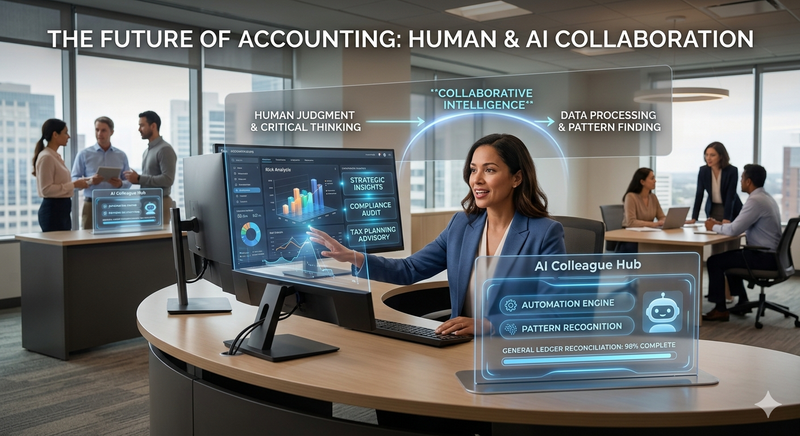
The future of accounting is human-AI collaboration, not replacement
“Will AI replace accountants?”
It is the question everyone keeps asking. And it is the wrong one.
AI is not replacing accountants as a profession. It is replacing parts of accounting work. Mostly the repetitive, structured, high-volume tasks that already should have been automated years ago.
That shift is real. But it does not mean accountants become irrelevant. It means the job changes.
And honestly, that is overdue.
The firms and professionals who understand this early will get stronger. The ones who keep treating AI like either a threat or a gimmick will get squeezed from both sides.
Where AI is already better than humans
AI is strong when the task is repetitive, rules-based, and pattern-heavy. In accounting, that includes:
Data extraction and entry
Invoices, receipts, bank statements, and expense records can now be read, structured, and pushed into workflows in a fraction of the time manual processing takes.
Transaction categorization
AI can learn from historical bookkeeping patterns and apply coding logic with speed and consistency.
Reconciliation
Matching payments, detecting missing items, and flagging mismatches is exactly the kind of work machines handle well.
Error and anomaly detection
AI is useful at spotting duplicates, inconsistencies, suspicious transactions, and entries that deserve review.
Routine reporting
Basic reports, summaries, and standard financial outputs can be generated with much less effort than before.
This is not theoretical. It is already happening.
And it should be happening.
Too many people still defend manual work as if effort alone creates value. It does not. If software can do a task faster, cheaper, and more consistently, your competitive advantage cannot be “I still do this by hand.”
That is not craftsmanship. That is lag.
A practical example is Bizrah’s AI assistant, which can turn WhatsApp voice notes into structured journal entries. That is a strong use case because it puts AI where it belongs: reducing friction in messy operational inputs so humans can focus on review, exceptions, and decisions.
Where humans still win
This is where the conversation usually gets sloppy. People say “humans bring empathy” and leave it there. That is too weak.
The real human advantage in accounting is not some soft cliché. It is judgment under context.
Professional judgment
Not every accounting decision is mechanical. Questions around capitalization, tax treatment, business purpose, or interpretation of edge cases depend on context. AI can support that work. It cannot own it.
Strategic advice
A business owner does not just need clean books. They need help making decisions. Can they hire? Expand? Restructure? Raise prices? Improve margins? That requires financial understanding tied to business reality.
Client trust
Clients do not stay because you sent a report on time. They stay because they trust your thinking. They trust your judgment when things are unclear. They trust how you communicate risk and trade-offs.
Ambiguity
New regulations, unusual transactions, multi-country complexity, grey areas in classification. This is where the real work starts. Not where it ends.
Accountability
AI does not carry professional liability. Humans do. That alone tells you replacement has limits.
So no, human value is not disappearing. But it is moving upward.
The problem is that some professionals still want to be paid for work that is moving downward.
The profession is not disappearing. It is splitting.
This is the part many people do not want to say clearly.
Accounting work is separating into four buckets:
Some work is declining fast because it is easy to automate.
Some work stays protected because it is specialized and complex.
Some work is emerging around AI oversight and workflow management.
And some work is growing because it is closer to strategy, advice, and decision support.
That makes the middle dangerous.
If your role is mostly routine compliance and processing, you are exposed.
If your role combines technical knowledge, good judgment, business understanding, and strong communication, your value likely increases.
That is the actual shift.
Not “AI will take all jobs.”
Not “AI changes nothing.”
But a much less comfortable truth: weak-value work gets punished first.
There is also a talent problem
AI is not the only force reshaping accounting. The profession also has a pipeline issue.
A lot of experienced accountants are nearing retirement. At the same time, younger talent is harder to attract and often more willing to leave. Many ambitious early-career professionals look at accounting and see repetitive work, long hours, and slower upside than tech.
That is a problem.
But AI could help fix part of it.
If the profession uses AI to remove low-value admin work, accounting becomes more attractive. It becomes more analytical, more advisory, and more connected to real decisions. That is a much better value proposition for younger talent.
Still, many firms are getting this wrong.
They talk about innovation, but juniors still spend huge parts of their time doing work that should already be automated. That is not transformation. That is old packaging on old habits.
And younger talent can see through it.
What business owners should take from this
Business owners should stop asking, “Will AI replace my accountant?”
Ask this instead:
What should my accountant be doing now that software can handle more of the routine work?
That question is much more useful.
A few consequences follow from it.
You should expect more efficiency in bookkeeping and compliance work.
You should expect faster turnaround.
And you should expect more strategic support, not just cleaner reports.
If your finance partner is still mostly delivering backward-looking PDFs with little insight, then you are not getting the real benefit of the shift.
You should also ask direct questions about tooling.
What is automated?
What still gets reviewed by humans?
How are exceptions handled?
How do they validate AI outputs?
If they cannot answer clearly, they are probably behind.
What accountants should do now
This is where honesty matters.
Some accountants are still hoping this shift will stay slow enough that they can postpone learning. That is not a strategy. That is avoidance.
You do not need to become a machine learning engineer. But you do need to understand the tools changing your workflow.
That means:
Learn how modern AI accounting tools actually work.
Understand their failure points.
Get good at reviewing outputs, not just producing inputs.
Move closer to advisory or build deeper specialization.
Strengthen communication and commercial thinking.
Stop treating manual effort as your moat.
Because it is not.
The future belongs to accountants who can combine domain expertise with technological fluency and real business judgment.

Strategic thinking and client relationships remain distinctly human capabilities
That combination will be rare. Which is exactly why it will be valuable..
See it in action:Bizrah's AI assistant turns WhatsApp voice notes into structured journal entries—a perfect example of AI handling data entry while humans focus on decisions.
Final thought
AI is not replacing accountants.
It is replacing the most repetitive parts of accounting work. The parts that are structured, predictable, and low in strategic value.
What remains is the work that clients actually remember: judgment, clarity, trust, context, and decisions.
That is the opportunity.
But let’s be honest. It is only an opportunity for people willing to evolve.
For everyone else, AI will not destroy the profession. It will just expose how much of their work was easier to automate than they wanted to admit.
Bizrah helps finance teams spend less time on manual input and more time on decisions. Try Bizrah free and experience the future of finance.