Accounting vs. Bookkeeping: What is the Difference?
Most business owners hire the wrong person for the wrong job. Here is why that costs money.
Why This Confusion Costs Businesses Money
You need someone to handle your books. So you post a job for "accountant/bookkeeper" and hope the right person applies.
That is where the problem starts.
Bookkeeping and accounting are not interchangeable. They overlap in day-to-day work, which creates the confusion. But the skills, scope, and value they deliver are fundamentally different.
When you hire a bookkeeper to do tax strategy, you get compliance risk. When you pay an accountant to do data entry, you waste money on expensive inefficiency. And when you expect one person to do both jobs at a high level, you usually get neither done well.
The confusion is understandable. Both deal with numbers. Both care about accuracy. Both show up in your finance function. But treating them as the same is like treating a nurse and a surgeon as the same because they both work in a hospital.
You need to know which one your business actually needs, and when.
What Bookkeeping Actually Is
Bookkeeping is the foundation of your financial system. It is the systematic recording of every transaction your business makes.
A bookkeeper handles:
- Recording daily sales, purchases, receipts, and payments
- Maintaining the general ledger with accurate transaction details
- Reconciling bank statements to catch errors and fraud
- Managing accounts payable (what you owe) and accounts receivable (what others owe you)
- Producing basic financial reports like profit and loss statements
The core job is accuracy and organization. A good bookkeeper ensures every riyal in and every riyal out is recorded correctly, categorized properly, and reconciled monthly.
Bookkeepers do not interpret the data. They do not advise on what the numbers mean or what you should do next. They build the record. If your books are a building, bookkeeping is the foundation and structure. Without it, nothing else stands.
That is why clean bookkeeping is the first requirement before any accountant or CFO can do their job. You cannot analyze data that does not exist or fix reporting built on wrong categories.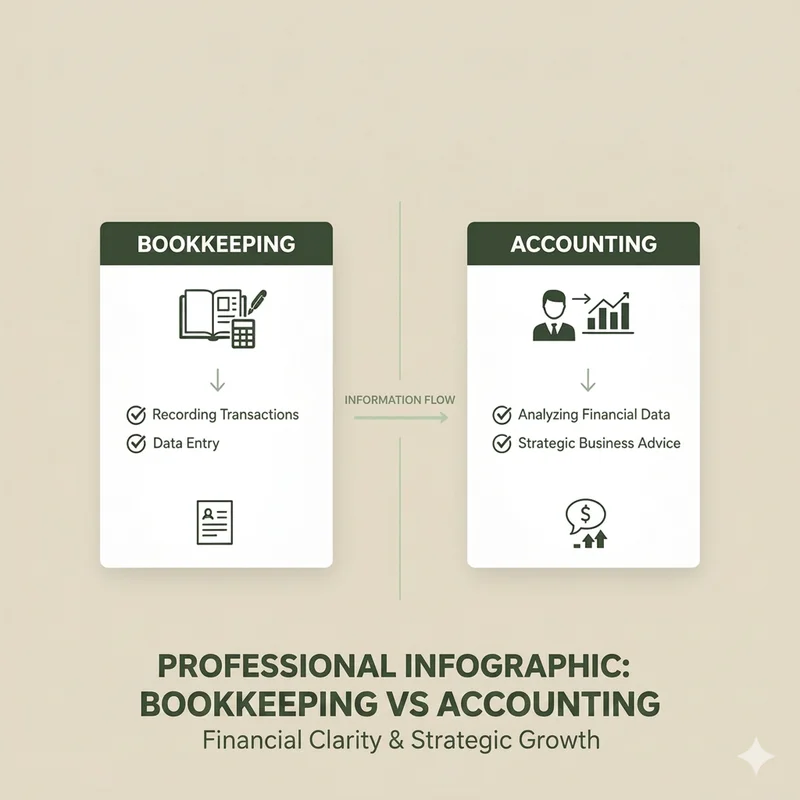
What Accounting Actually Is
Accounting is what you do with the data after it is recorded.
An accountant takes the organized financial data from bookkeeping and turns it into decisions. They interpret the numbers, identify patterns, flag risks, and advise on strategy.
An accountant handles:
- Preparing financial statements for investors, banks, or government filings
- Tax planning and compliance strategy (not just filing, but minimizing liability)
- Financial forecasting and budgeting for the next quarter or year
- Analyzing profitability by product, customer, or region
- Advising on business decisions: Should you expand? Raise prices? Cut costs?
If you are new to these concepts, our guide for non-accountants breaks down the basics of financial statements and reporting.
This requires deeper expertise. In most markets, accountants hold professional certifications like CPA, CA, or SOCPA credentials. They understand tax law, financial regulations, and how to structure a business for financial health.
Where bookkeeping is about "what happened," accounting is about "what it means and what to do next."
The Five Key Differences
The cost difference reflects the depth of expertise. A bookkeeper keeps the machine running. An accountant tells you if the machine is profitable and how to make it better.
What Your Business Needs (and When)
The right setup depends on your revenue stage and complexity.
Stage 1: Early startup (under 500K AED/SAR annual revenue)
You probably do not need a full-time accountant yet. You do need accurate bookkeeping.
Start with:
- DIY bookkeeping using accounting software, or hire a part-time bookkeeper
- Annual accountant for tax filing and compliance
At this stage, your goal is survival and validation. Keep your books clean so you can see cash flow clearly. Bring in an accountant once a year to file taxes and catch structural issues before they become expensive.
Stage 2: Growing revenue (500K-2M AED/SAR)
Now you need consistent, professional bookkeeping. Your transaction volume is too high for DIY, and mistakes cost more.
Hire:
- A full-time or outsourced bookkeeper to manage daily transactions
- A quarterly accountant check-in to review financials, plan for tax, and advise on margins
At this stage, you are scaling. You need reliable reporting to know if growth is profitable or just busy. An accountant should review your books quarterly to catch problems early.
Stage 3: Scaling (2M+ revenue)
You need both in-house and strategic expertise.
Build:
- An in-house bookkeeper (or accounting software with automation) to handle volume
- A controller or senior accountant to manage reporting, compliance, and month-end close
- A strategic accountant or fractional CFO for planning, forecasting, and investor relations
At this scale, your finance function is a team. Bookkeeping is the engine. Accounting is the navigation system. Both are critical, and neither can replace the other.
Common Mistakes GCC Businesses Make
Hiring an accountant to do bookkeeping work
This is expensive and wasteful. An accountant billing 400 AED/hour should not be entering receipts. You are paying expert-level rates for clerical work.
Expecting a bookkeeper to do tax strategy
This is risky. A bookkeeper can organize your transactions for a tax filing. They should not be advising on deductions, entity structure, or compliance strategy. That requires accounting expertise and can expose you to penalties if done wrong.
Waiting until tax deadline to involve an accountant
By then, it is too late to plan. Good tax strategy happens throughout the year: timing expenses, structuring contracts, deciding on entity changes. If your accountant only shows up in March, you lose those opportunities.
Not having clean books when the accountant starts
An accountant cannot fix reporting built on bad data. If your bookkeeping is a mess, the accountant will spend billable hours cleaning it before they can analyze anything. You pay more, and you get less value.
The pattern is clear: bookkeeping is the foundation. Accounting is the strategy layer. You need the foundation first.
The Bottom Line
You need both bookkeeping and accounting. But not at the same time, not from the same person, and not with the same expectations.
Start with clean bookkeeping. As your business grows, layer in accounting expertise. Good bookkeeping makes accounting efficient. Bad bookkeeping makes accounting expensive.
If you are not sure where you are, ask yourself:
- Do you know your profit margin by product or service? (That is accounting.)
- Can you reconcile your bank statements monthly? (That is bookkeeping.)
- Do you have a tax strategy, or just tax filing? (That is the difference.)
Most GCC SMEs can start with a bookkeeper and add accounting as they scale. The key is not doing both badly because you hired for the wrong role.
See how Bizrah automates bookkeeping and delivers accounting-ready reports — learn more