When to Hire an Accountant for Your Small Business
When to Hire an Accountant for Your Small Business
Most business owners wait until something breaks. That is expensive.
Most Business Owners Wait Too Long
You started your business to create, not to crunch numbers.
Yet, you convinced yourself that handling your own books was savvy. You saved money. You retained control. You believed hiring help was a luxury you could not afford.
That logic holds until it does not.
DIY accounting is not impossible. The real issue is that the hidden costs often outweigh the savings. You miss deductions you are unaware of. You waste hours on tasks an accountant would breeze through. You miss deadlines, incur penalties, and those penalties could have paid for professional help several times over.
By the time most business owners hire an accountant, they are already in trouble. Fixing errors, catching up on filings, or dealing with compliance issues that could have been avoided.
That is the trap.
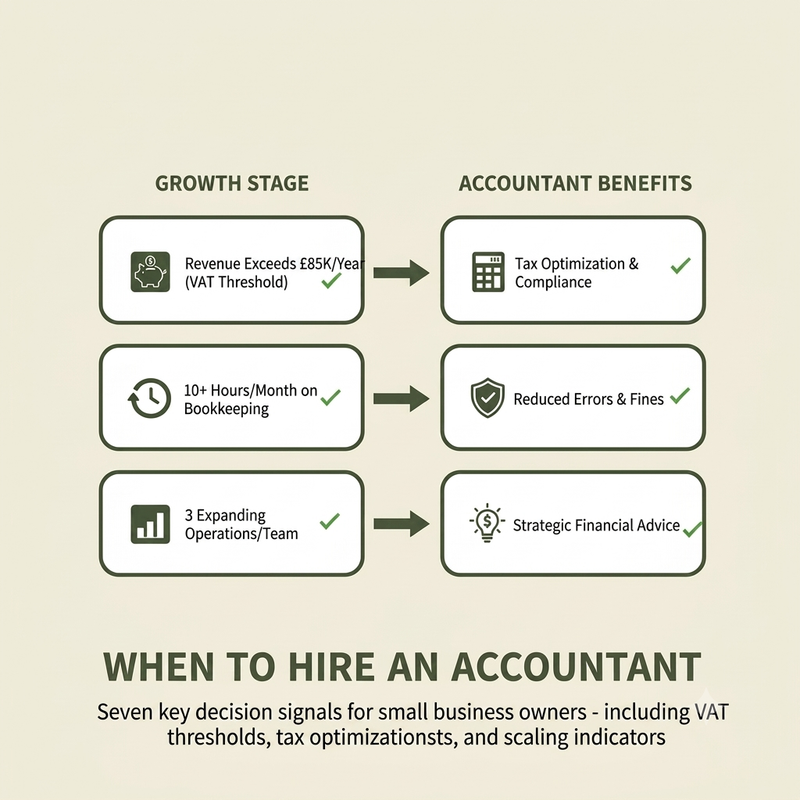
Seven Signs You Need an Accountant Now
Your Tax Situation Has Changed
Crossing the VAT registration threshold in the UAE or Saudi Arabia is a milestone. It also means quarterly VAT returns, e-invoicing compliance, and audit trails.
Or maybe your business structure changed. You incorporated, added a partner, or started selling internationally. Each change brings new tax obligations, and the margin for error is razor-thin.
In the UAE, corporate tax at 9% is now standard. In Saudi Arabia, Zakat and income tax depend on ownership structure. If you are unsure of your obligations, that is the sign you need help.
You Spend More Than 5 Hours a Week on Accounting
Time is money. Spending 5 hours a week on accounting adds up to 260 hours a year. For a business owner, that is 50,000 to 100,000 AED or SAR in opportunity cost.
What could you achieve with 260 extra hours?
Close more deals. Develop your product. Recruit better talent. Run your business instead of managing it.
If accounting consumes more time than revenue-generating activities, you are subsidizing inefficiency.
You Are Not Sure What Your Numbers Mean
You have a balance sheet and a P&L, but they are just numbers to you.
That is a problem.
Financial statements are not decorative. They reveal your business's health, cash flow, and necessary decisions. If you cannot interpret them, you are flying blind.
An accountant does more than file taxes. They explain your numbers, flag issues early, and guide decisions with data, not guesswork.
You Missed a Filing Deadline or Made an Error
In Saudi Arabia, ZATCA penalties for late compliance or VAT filing start at 5% to 25% of the tax due, escalating for repeat offenses.
In the UAE, late VAT filing incurs a 1,000 AED penalty for the first offense, 2,000 AED for the second, and it keeps climbing. Miss a corporate tax deadline, and penalties increase further.
One mistake can cost more than a year of professional accounting help.
If you have already erred or missed a deadline, that is not just a warning. That is the alarm.
You Are Scaling Fast
You hired employees, expanded markets, or opened a new location. Your revenue doubled in six months.
Scaling is thrilling. It also multiplies complexity.
Now you have payroll taxes, Wage Protection System (WPS) compliance, withholding tax, and employee benefits to manage. Your chart of accounts is chaotic. Your spreadsheets are failing. You spend more time fixing errors than analyzing performance.
Fast growth without proper accounting infrastructure leads to cash flow crises, even with rising revenue. You need systems that scale with you.
You Are Raising Capital or Seeking a Loan
Investors avoid businesses with messy books. Banks do not lend to those without clear financials.
If you are raising capital or applying for a loan, you need investor-ready financials. That means audited statements, clean records, and a coherent story. An accountant who knows what investors and lenders require can save you months of back-and-forth.
You Want to Optimize Tax and Deductions
Tax planning is not just timely filing. It involves strategic decisions: timing expenses, structuring entities, understanding deductions, and planning ahead.
Should you operate in a free zone or mainland? What deductions apply to your industry? How should you structure payments to minimize withholding tax? These are not questions for Google. They need expertise in GCC tax law and business strategy.
An accountant familiar with your industry can save you more in tax optimization than their fees.
What Does It Actually Cost?
Here is what professional accounting costs in the GCC:
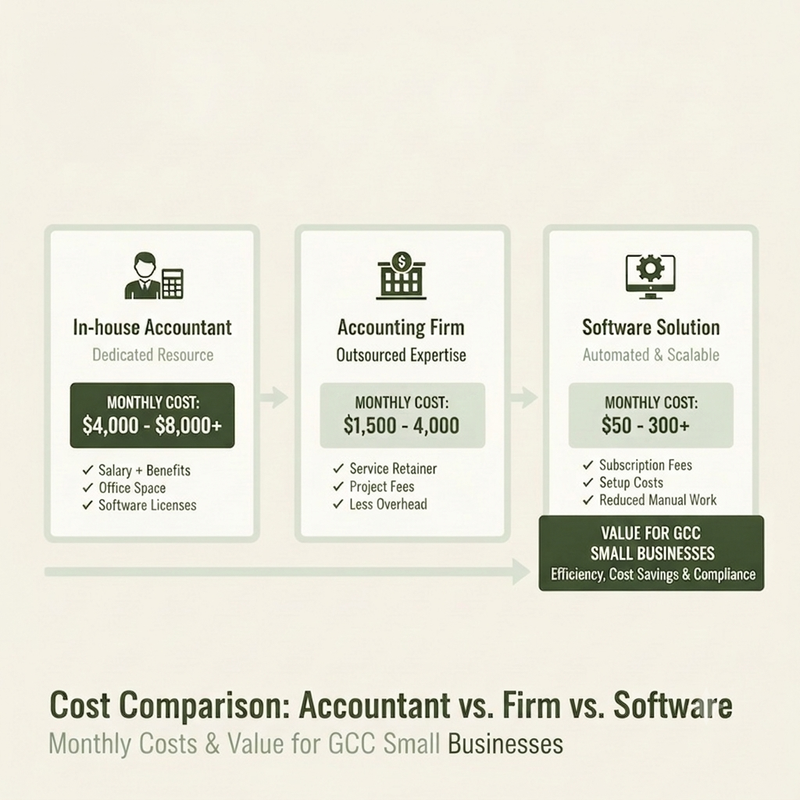
For most small businesses, the sweet spot is accounting software with on-demand advisory. Automation for routine tasks, expert help when needed, without full-time costs.
Accountant vs. Bookkeeper vs. CFO: What Do You Actually Need?
Not every business needs a CFO. Most do not even need a full-time accountant. Here is what each role does:
Bookkeeper: Manages transactions, reconciles accounts, handles payroll. The operational layer.
Accountant: Files taxes, ensures compliance, prepares statements, advises on structure and deductions. The strategic layer.
CFO: Builds models, manages fundraising, forecasts growth, advises on major decisions. The executive layer.
For most small businesses, a bookkeeper + accountant is sufficient. You can get both through a good firm or software platform, at a fraction of in-house costs.
What to Do Before You Hire
Do not hire an accountant and then dump a shoebox of receipts on their desk. Prepare first.
Organize your records: Bank statements, invoices, receipts, payroll records. Cleaner records mean faster help.
Identify your pain points: What are your struggles? What keeps you up at night? What questions do you have? This helps focus on what matters.
Understand your obligations: Know your VAT status, corporate tax requirements, and deadlines. An accountant can guide you, but you need the basics.
Set a realistic budget: Do not go cheap. The lowest-cost accountant often means you get what you pay for. Budget for quality help.
What Happens If You Never Hire One?
Some businesses never hire an accountant and do fine. They stay small, keep transactions simple, and use good software to automate compliance.
But most who try to remain DIY hit one of three problems:
Penalties and fines from missed deadlines or errors
Audit issues when tax authorities review their records
Missed opportunities from not optimizing their structure or deductions
The hybrid approach works best: software for routine tasks, expert help for complex issues. No full-time overhead, but you are not flying blind.
See how Bizrah combines automated accounting with on-demand expert help → Try free for 14 days