If your business operates in Egypt and you are still figuring out e-invoicing, you are already behind.
Why This Matters Now
Egypt does not negotiate on e-invoicing. Since January 1, 2023, every B2B transaction must be submitted electronically to the Egyptian Tax Authority (ETA) on the same day it is issued. No exceptions.
The e-receipt system for B2C is expanding fast too. Retailers and service providers are being pulled into the same digital net.
That is the part many businesses still underestimate. They assume compliance is something they will get to eventually. The ETA is not waiting for them to catch up.
If you operate in Egypt and your invoicing process still depends on manual work, disconnected systems, or software that handles VAT incorrectly, you do not have an e-invoicing problem later. You already have a systems problem now. The ETA mandate just makes it visible.
What Is the ETA Portal?
The ETA Portal is Egypt's centralized platform for submitting electronic tax documents in real time. It is the single gateway between your business and Egypt's tax system.
Two systems:
- E-Invoicing: All B2B transactions. Every registered taxpayer must comply.
- E-Receipt: All B2C transactions. Retailers and service providers must comply.
If you are familiar with how ZATCA handles e-invoicing in Saudi Arabia, the ETA follows a similar logic — but with its own technical requirements and enforcement timeline.
The ETA also provides a developer SDK and API portal with full documentation, Postman collections, code samples, and testing tools. If your team is building or integrating, start there.
How E-Invoicing Works
The Submission Flow
Your system creates an invoice, digitally signs it using CADES-BES format via an ITIDA-approved certificate, and transmits the JSON document to the ETA via RESTful API. The ETA validates everything — structure, tax calculations, signature, item codes. The buyer receives it on their portal dashboard.
That entire process must happen the same day. No batch submissions. No catching up later.
The system uses three document types: invoices for standard B2B transactions, credit notes to reduce amounts on a previously issued invoice, and debit notes to increase amounts. Credit and debit notes must reference an existing invoice and cannot exceed its total.
Technical Requirements
- Format: JSON, schema version 1.0
- Signature: CADES-BES with SHA256/RSA
- Authentication: OAuth via "Login as Taxpayer System" endpoint
- Item Codes: GS1 or EGS coding standard
- Tax Codes: 20 types (T1-T20) with subtypes
- Precision: 5 decimal places for unit prices
Getting the tax codes wrong is the single most common reason invoices get rejected. That is not an exaggeration. It is the number one support issue businesses report after going live.
Common Rejection Reasons
The ETA validates every submission in real time. Wrong tax calculations, invalid digital signatures, missing mandatory fields, duplicate submissions, future-dated timestamps, and unregistered item codes are what trip businesses up most often. If any check fails, the invoice is rejected instantly. You fix it and resubmit.
E-Receipt — What is Different
Same principles, different context. E-receipts target consumer transactions and must be transmitted in real time from your POS system — not same-day, but as they happen.
Your POS must connect to the ETA API, generate a UUID and QR code per receipt, and handle offline scenarios. The QR code allows consumers to verify the receipt directly on the ETA portal. If you have not been notified yet, do not assume you are exempt. The ETA is rolling out e-receipts in phases, starting with large retailers and expanding to smaller businesses.
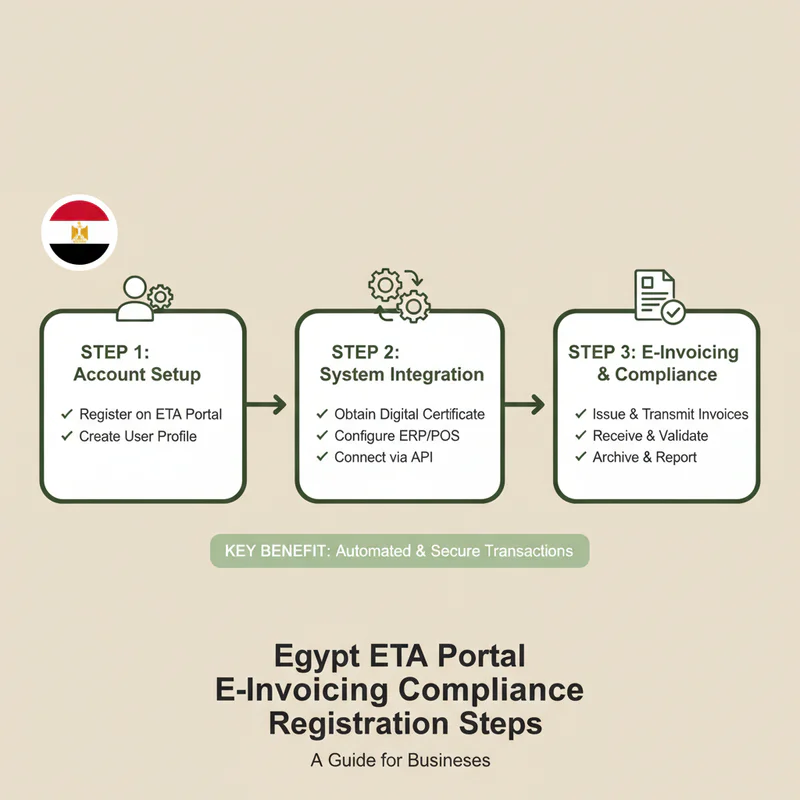
Registration — The Steps
- Register on the ETA Portal
- Submit documents — tax certificate, commercial register, signatory details
- Get your digital certificate — ITIDA-approved, either HSM or USB token
- Configure API credentials — register your system as a "taxpayer system"
- Map item codes to GS1 or EGS standards
- Test in sandbox — do not skip this
An expired certificate means you cannot submit invoices. That is not a minor inconvenience. That is a full operational block. The certificate must be renewed before expiry, and your team needs to monitor this proactively.
Before submitting real invoices, use the ETA sandbox environment. Test standard invoices, credit notes, API failures, and error handling. The businesses that test only the happy path are usually the ones that fail in production.
What Happens If You Do Not Comply
- Fines: EGP 20,000 to EGP 100,000 for failure to issue e-invoices
- Late submission: Penalties per transaction, escalating with repeats
- Incorrect data: Rejection plus potential audit trigger
- No certificate: Full operational block
- Blocked refunds: Non-compliant businesses may lose VAT refund access
The cost of non-compliance always exceeds the cost of getting compliant. Always.
If you are also dealing with UAE e-invoicing requirements, the pattern is clear. The entire region is moving toward mandatory digital invoicing. The businesses that prepare now across multiple markets will spend less time scrambling later.

Your Checklist This Week
- Verify your ETA registration — log in and confirm your account is active
- Check certificate expiry — renew if within 30 days
- Audit item codes — all products mapped to valid GS1 or EGS codes
- Test your API — run a submission in sandbox
- Review rejection log — fix any rejected invoices
- Train your team — same-day submission is non-negotiable
- Set up monitoring — alerts for failed submissions, not audit surprises
If your team is still checking invoice requirements manually, the problem is not just compliance. It is process design.
Get compliant without the complexity. Try Bizrah free — no credit card needed.