Corporate Tax in the UAE: What People Still Do Not Understand
More than two years after implementation, the confusion gap is wider than it should be.
The Misconception Gap is Real
Corporate tax in the UAE has been in effect since June 2023. That is long enough for the basics to settle in.
But here is what I keep seeing on the ground in Dubai: Many people still do not fully understand how corporate tax works. Not because the rules are hidden. The Federal Tax Authority publishes guidance. The information is out there.
The problem is clarity and action. Business owners hear fragments. They make assumptions. They wait until the deadline forces a decision. And when that decision comes, the gaps turn into compliance issues or messy fixes that could have been avoided.
Let me walk through the five misconceptions I encounter most often.
Misconception 1: "Corporate Tax is 9% on All Income"
This is the most common shortcut people take. They hear "9% corporate tax" and assume it applies to all profit. It does not.
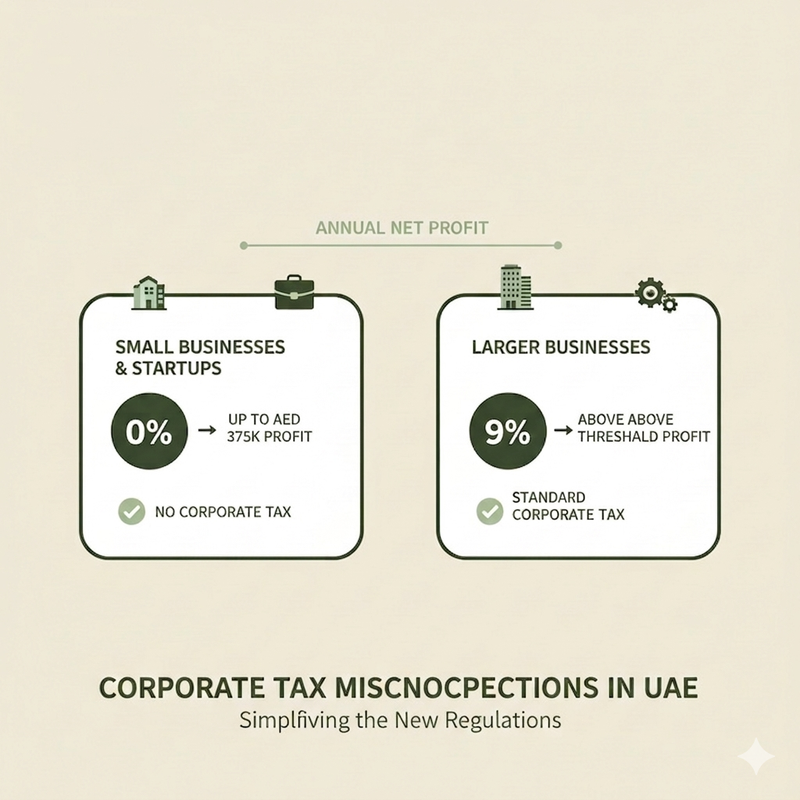
The actual structure: 0% tax on taxable income up to AED 375,000; 9% tax only on the amount above that.
If your business makes AED 400,000 in taxable profit, you pay 9% on AED 25,000 (the amount above the threshold). That is AED 2,250 in tax, not AED 36,000.
The first AED 375,000 is tax-free. Always.
But here is the part that trips people up: zero tax liability does not mean zero compliance. You still need to register. You still need to file a tax return. You still need proper books.
Misconception 2: "If My Company is Not Active, I Do Not Need to Register or File"
This one comes up constantly.
Business owners assume that if they did not conduct any business activity during the year, corporate tax does not apply to them. Wrong.
The FTA does not care if your company sat idle for 12 months. If your company is legally registered, you are required to register for corporate tax and file a return. Even dormant companies must file (usually a zero return).
Late registration triggers penalties. Late filing triggers penalties. The fact that you had no business activity is not a defense.
If your company exists, you register. If you are registered, you file. Every year.
Misconception 3: "Free Zone Companies Do Not Have to Worry About Corporate Tax"
This is the big one. And it is half-true, which makes it more dangerous.
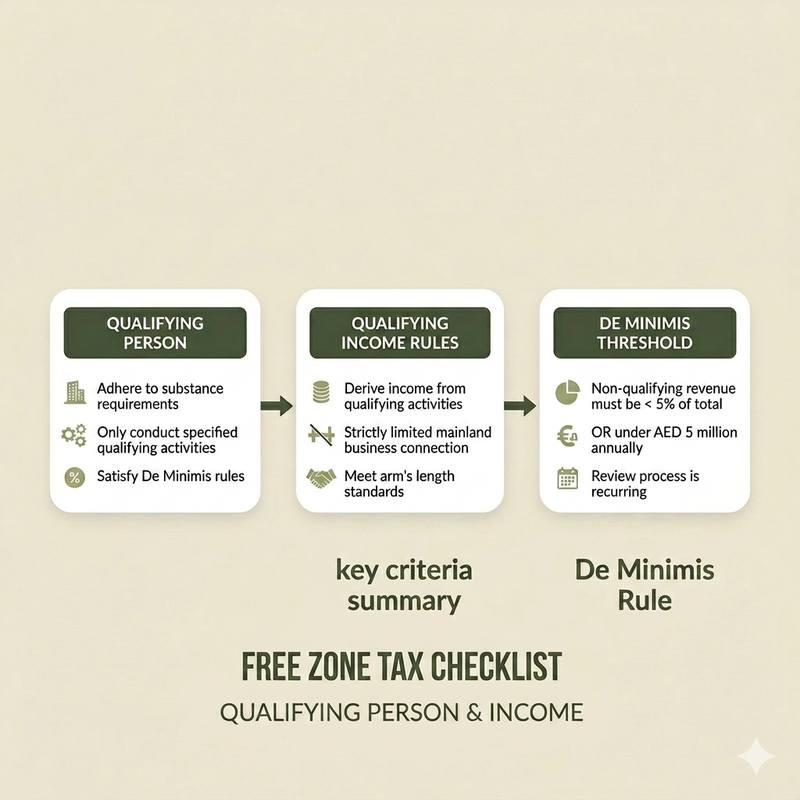
Free zone companies can qualify for 0% corporate tax. But only if they meet strict conditions:
1. Qualifying Free Zone Person status - not automatic
2. Qualifying income - no mainland transactions that break the ring-fence
3. Proper compliance and documentation - substance requirements, financial records, arm's length pricing
Many free zone companies assume the 0% rate is automatic. It is not.
If you do business with mainland customers, you may not meet the qualifying income test. If you do not maintain adequate substance in the free zone (office, employees, real operations), you may not qualify.
The mistake is treating "free zone" as a tax status. It is not. It is a possible tax status if you meet the conditions.
The 5% De Minimis Rule
The FTA allows a 5% de minimis threshold for non-qualifying income. A free zone company can earn up to 5% of its total revenue from non-qualifying sources and still maintain the 0% rate.
But if you cross that 5%, you lose the entire exemption. Your full taxable income becomes subject to 9% corporate tax.
Many free zone businesses do a bit of mainland business on the side, thinking it does not matter. It does. Track it.
Misconception 4: "Small Businesses Do Not Need to Care About This"
This assumption rests on the idea that corporate tax is a big-company problem. It is not.
Even if your taxable profit is well below the AED 375,000 threshold, you still need to understand when to register, what filing requirements apply, and how to track your taxable income with clean books.
The risk of ignoring this is not immediate. But when you cross the threshold (and you will, if your business grows), the clock starts ticking fast. If you are not already registered and your books are not clean, you will scramble.
Small businesses are not exempt from compliance. They are only exempt from paying tax if they stay below the threshold.
Misconception 5: "Accounting is Not Important Right Now"
This is the operational misconception that creates the most pain.
Many business owners treat accounting as something they will "sort out later." They track income in rough spreadsheets. They mix personal and business transactions. They assume that when it is time to file, they can just hand everything to an accountant and it will work out.
It will not.
Corporate tax filing requires proper books. Not estimates. Not rough numbers. Not a pile of receipts.
If your records are unclear, one of two things happens: You spend days reconstructing your financials, or you hire an accountant who charges you extra because cleaning up messy books is not cheap.
Proper bookkeeping is no longer a "nice to have" in the UAE. It is a compliance requirement.
What Actually Matters on the Ground
From what I see, most issues happen not because of the tax itself, but because of lack of clarity and late action.
The businesses that handle corporate tax well are not the ones with the most expensive accountants. They are the ones that registered early, kept clean books from the start, and took the time to understand which rules apply to them.
The businesses that struggle are the ones that waited. The ones that assumed "small business" meant "no compliance." The ones that treated accounting as a year-end scramble instead of a monthly habit.
Corporate tax is not the problem. Poor preparation is.
The solution is not complex:
1. Register on time - check your deadlines based on your license date
2. Keep clean books - monthly reconciliations, proper categorization, digital records
3. Understand your status - if you are in a free zone, confirm whether you meet the qualifying conditions
The rules are clear. The thresholds are generous. The registration process is straightforward. The only variable is whether you act early or wait until the deadline forces your hand.
See how Bizrah handles UAE corporate tax compliance for SMEs - clean books, automated reconciliation, and clear reporting built for GCC businesses. Learn more