The Modern Finance Glossary: 30 Terms Every Business Owner Must Know
The Modern Finance Glossary: 30 Terms Every Business Owner Must Know
You do not need an accounting degree to run your business. You do need to know what your accountant is talking about.
Most finance glossaries are written for accountants.
They alphabetize terms no business owner will ever use in a real conversation. They define "amortization" before they explain what cash flow means to someone deciding whether to pay suppliers this week or next.
That is backwards.
This glossary is organized by what you actually need to know — not by the alphabet. Terms are grouped by function: money movement, performance indicators, structural backbone, compliance requirements, and accounting methods. Skip to the section that matters right now. Bookmark the rest for later.
The Money Movement Terms
These are the terms that describe where your cash is, where it is going, and why timing matters more than totals.
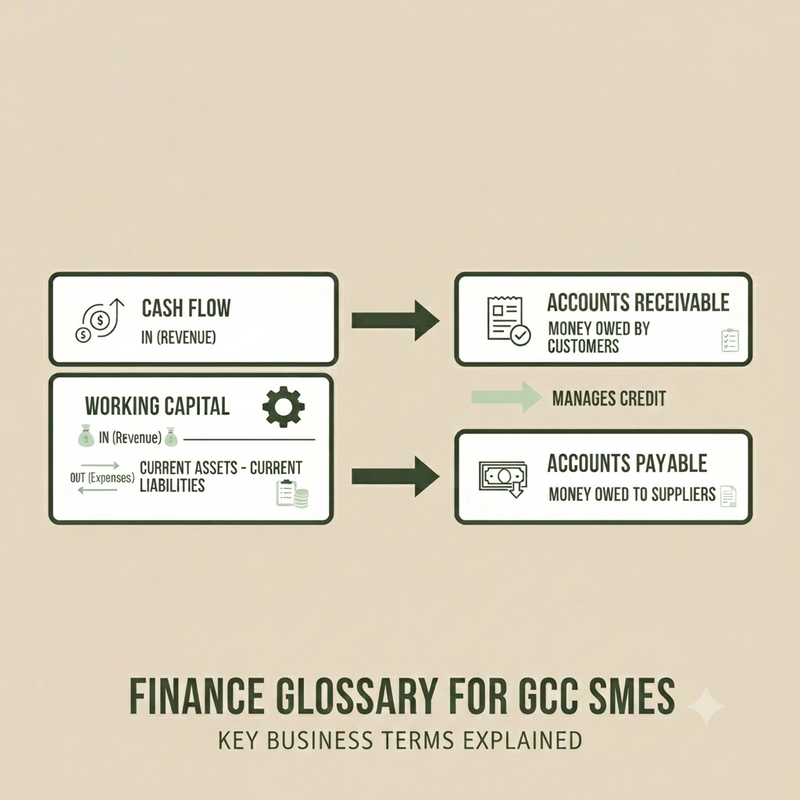
Cash Flow
Cash flow is the money moving in and out of your business in real time.
It is not profit. Profit is an accounting concept. Cash flow is survival.
You can show a profit on paper and still run out of money if customers pay late, suppliers demand upfront payments, or you carry too much inventory. Cash flow answers one question: can you make payroll this week? If the answer is no, the profit number does not help.
When it matters most: Monthly reconciliation, quarterly planning, and any time you are evaluating whether to take on new expenses before receivables clear.
Accounts Receivable (AR) & Accounts Payable (AP)
Accounts Receivable is money owed to you by customers who have not paid yet.
Accounts Payable is money you owe to suppliers and vendors.
The gap between these two numbers creates your cash flow problem or your cash flow cushion.
If AR is high and AP is due, you have a liquidity gap. You are owed money, but you cannot access it fast enough to cover what you owe. That is when businesses start chasing late payments or renegotiating supplier terms.
Why the timing matters more than the amount: A $50,000 AR balance is not useful if all of it is due in 90 days and your AP is due in 30.
Working Capital
Working capital is your operational buffer. It is current assets minus current liabilities.
In simpler terms: the money you have available to keep the business running day-to-day without external funding.
Low working capital means you are operating close to the edge. One late payment from a major client can force you to delay supplier payments, pause hiring, or miss payroll. High working capital gives you breathing room — you can absorb shocks without disrupting operations.
How to spot when you are running tight: If you are constantly checking bank balances before approving expenses, your working capital is too thin.
The Performance Indicators
These are the terms investors, lenders, and board members care about. They measure whether your business is healthy, growing, or burning cash faster than it should.
Gross Profit vs Net Profit
Gross profit is revenue minus the direct cost of delivering your product or service.
Net profit is what you keep after every expense — rent, salaries, marketing, taxes, interest, depreciation.
The gap between gross and net tells you whether your operational overhead is sustainable.
If gross profit is strong but net profit is weak, you are not pricing wrong. You are spending too much to run the business. That is an operations problem, not a sales problem.
EBITDA
EBITDA stands for Earnings Before Interest, Taxes, Depreciation, and Amortization.
It strips out financing costs, tax strategy, and accounting methods to show operational performance — what the business earns from its core activities before external factors distort the number.
When investors care about it: EBITDA is useful for comparing businesses with different capital structures or tax situations. A company with high debt will show lower net profit because of interest payments, but EBITDA reveals whether the underlying business is strong.
It is not a complete picture. EBITDA ignores capital expenses, debt obligations, and tax liabilities. Use it to compare operational efficiency, not to decide whether the business is actually profitable.
Burn Rate & Runway
Burn rate is how much cash you spend each month, net of revenue.
Runway is how many months you can operate before cash hits zero.
If you have $300,000 in the bank and you burn $50,000 per month, your runway is six months.
These terms matter most for early-stage businesses that have not reached profitability yet. Investors and founders track burn rate to decide when to raise the next funding round or when to cut costs.
What changes the calculation: Revenue growth. If you are adding $10,000 in monthly recurring revenue every month, your burn rate decreases over time. That extends your runway without raising more capital.
The Structure Terms
These terms describe how your financial data is organized. Get these wrong and nothing downstream works properly.
Chart of Accounts
The chart of accounts is the list of all categories used to record transactions.
Every business has one. It organizes income, expenses, assets, liabilities, and equity into standardized buckets so you can generate reports that make sense.
Think of it as the filing system for your finances. If you set it up poorly at the beginning, you will spend months fixing mis-categorized transactions later.
Why setup matters more than you think: GCC businesses need Arabic and English labels for compliance reporting. If your chart of accounts only supports one language, you are creating extra work every time you file VAT or prepare audited statements.
General Ledger
The general ledger is the master record of every transaction your business makes.
It pulls from your invoices, receipts, payroll, and bank statements and organizes them according to your chart of accounts.
When accountants say "close the books," they mean reconciling the general ledger so every transaction is accounted for and categorized correctly.
How it connects to everything else: The general ledger feeds into every financial report you generate — income statement, balance sheet, cash flow statement, VAT filings. If the ledger is wrong, everything downstream is wrong.
Trial Balance
The trial balance is a report that lists all accounts and their balances at a specific point in time.
It is the sanity check before closing your books. If debits equal credits, the trial balance balances. If they do not, something was recorded incorrectly.
Accountants use it to catch errors before generating final financial statements. It is not a financial statement itself — it is the step before you can trust your statements.
The Compliance & Tax Terms (GCC Context)
These terms describe regulatory requirements that GCC businesses face. Get these wrong and you face fines, rejected filings, or delayed payments from clients.
VAT (Value-Added Tax)
VAT is a consumption tax applied to most goods and services in the GCC.
In Saudi Arabia, the standard rate is 15 percent. In the UAE and Bahrain, it is 5 percent. In Oman, it is also 5 percent. Kuwait and Qatar have not implemented VAT yet.
Businesses registered for VAT collect it from customers, pay it to suppliers, and file returns showing the difference. You are not keeping the VAT you collect — you are holding it on behalf of the government.
When it matters: VAT registration thresholds vary by country. In Saudi Arabia, mandatory registration starts at SAR 375,000 in annual revenue. In the UAE, it is AED 375,000. If you cross the threshold and do not register, you are operating illegally.
ZATCA & ETA
ZATCA (Zakat, Tax and Customs Authority) is the regulatory body in Saudi Arabia that enforces e-invoicing, VAT, and corporate tax rules.
ETA (Egyptian Tax Authority) enforces Egypt's e-invoicing and e-receipt mandates.
These are not just tax collection agencies. They set technical standards for how invoices must be structured, transmitted, and stored. If your invoicing system does not comply with ZATCA Phase 2 requirements in Saudi Arabia or ETA's real-time submission rules in Egypt, your invoices are rejected at the system level.
Why their deadlines matter for your business: Non-compliance is not just a fine. It can block you from issuing valid invoices, which means you cannot get paid.
E-Invoicing (Fatoora)
E-invoicing is the digital invoicing mandate enforced across the GCC.
In Saudi Arabia, it is called Fatoora. It requires businesses to generate invoices in a structured XML format, include QR codes, and integrate with ZATCA-approved systems.
In the UAE, e-invoicing is coming in phases starting in 2026. Egypt already enforces real-time e-invoicing through the ETA portal.
What compliance actually requires: It is not enough to generate a PDF invoice and email it. E-invoicing mandates require structured data, cryptographic signing, and in some cases real-time transmission to government portals.
If your current invoicing process is manual or PDF-based, you are not compliant.
The Method Terms
These terms describe how accountants record and report financial activity. The method you choose changes what your financial statements look like.
Accrual vs Cash Accounting
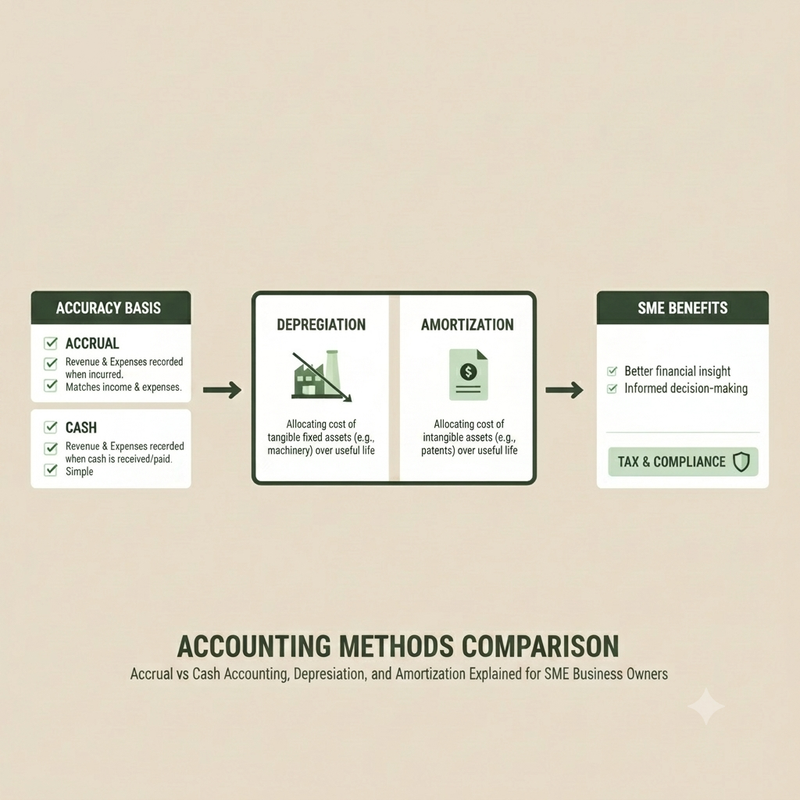
Cash accounting records revenue when you receive payment and expenses when you pay them.
Accrual accounting records revenue when you earn it and expenses when you incur them, regardless of when cash changes hands.
Most GCC SMEs use accrual accounting because VAT filings and audited financials require it.
Which method most GCC SMEs should use: Accrual. It matches revenue and expenses to the period they belong to, which gives a more accurate picture of profitability. Cash accounting is simpler, but it distorts performance when you have long payment cycles or seasonal revenue.
Depreciation
Depreciation is how you account for the declining value of physical assets over time.
When you buy a vehicle, equipment, or furniture, you do not expense the full cost immediately. You spread the cost over the asset's useful life.
That is depreciation. It shows up as an expense on your income statement even though no cash left your account.
Why it shows up on your statements: Depreciation reduces taxable income. It also ensures your balance sheet reflects the current value of your assets, not the purchase price from five years ago.
Amortization
Amortization is depreciation for intangible assets — software licenses, patents, trademarks, goodwill.
The concept is the same: you spread the cost over the asset's useful life instead of expensing it all at once.
Examples: A three-year software license is amortized over 36 months. Goodwill from acquiring another business is amortized based on accounting standards and local regulations.
What You Do Not Need to Memorize
Some terms only matter if you are raising venture capital, preparing for an acquisition, or working with auditors on complex compliance issues.
You do not need to know these unless your accountant brings them up:
Goodwill — the intangible value of a business beyond its physical assets (matters during acquisitions)
Impairment — when an asset's value drops below its book value (matters during audits)
Deferred revenue — payments received for services not yet delivered (matters for SaaS and subscription businesses)
Provision — an estimated expense for future liabilities (matters for large enterprises with complex accruals)
These terms exist. Your accountant will handle them. You do not need to memorize definitions that only apply in narrow scenarios.
See how Bizrah handles all of this in Arabic and English — no finance degree required. Try Bizrah free for 14 days.